Are Cooling Gel Pillows Safe? What Is Actually in the Gel
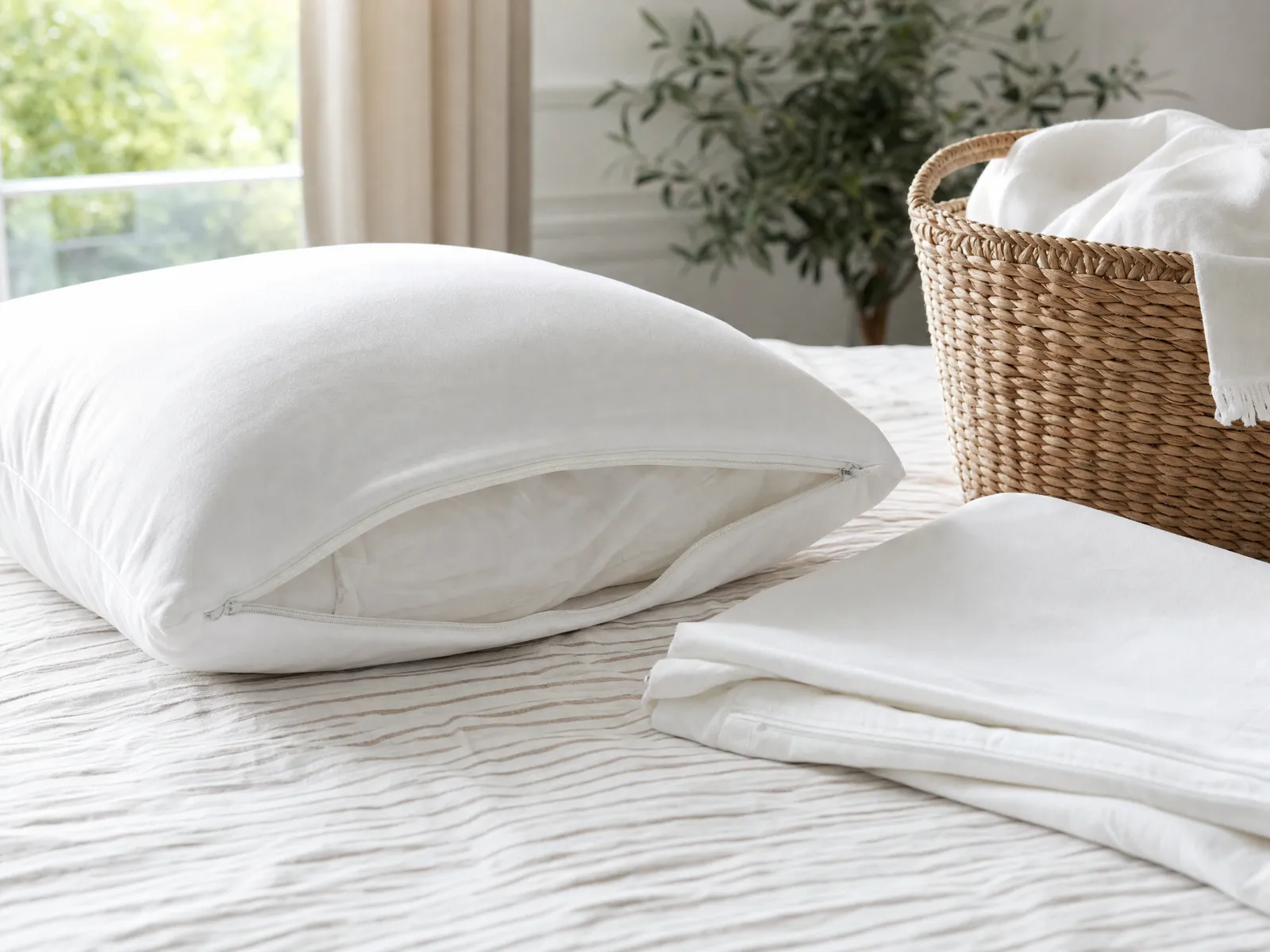
For a healthy adult this is a low-concern product, and the gel is the least interesting part of the answer. Are cooling gel pillows safe? In a consumer pillow the gel is not liquid in a bladder. It is a cross-linked solid, compounded into polyurethane foam or laminated to it. So this is a foam question. We earn a commission from links on this page, at no cost to you.
The useful version of the question is not what is in the gel but what the foam was made with and whether anyone measured what comes off it. That version has answers, because three certification schemes exist to produce them and they do not cover the same ground. If you are still choosing rather than checking, our best cooling pillow guide is the page to start on.
The Short Answer
- The gel is a solid, not a fluid. US patent 10113043 B2 defines a gel as "a soft elastomer solid" in particles "incorporated into polyether or polyester polyurethane foam while the foam is being produced".
- CertiPUR-US covers the foam and nothing else. Its own FAQ is blunt: "We do not certify furniture, product lines or companies. We only certify flexible polyurethane foam."
- GREENGUARD Gold is the emissions mark. UL Solutions states that Gold limits "emissions of more than 360 VOCs and total chemical emissions" and requires the California Department of Public Health method, "also known as California Section 01350".
- OEKO-TEX STANDARD 100 is about textiles. OEKO-TEX calls it "a label for textiles tested for harmful substances" - a reason to trust a cover against your face, and silent on the foam inside.
- For infants the answer is not a pillow at all. The American Academy of Pediatrics, writing on HealthyChildren.org, says "soft objects and loose bedding can increase your baby's risk of entrapment, suffocation or strangulation" and lists "pillows and pillow-like toys" first.
- We found no safety trial of a cooling gel pillow, on any brand, in any population. The certificates are the evidence that exists.
What the Gel in a Cooling Gel Pillow Physically Is
The mental image doing the damage is a water bed in miniature: a sac of coloured fluid behind a seam that might one day give way. Almost no cooling pillow on a shelf is built that way. There are three constructions in this category, and they are different objects.
- Gel compounded into the foam. US patent 10113043 B2, granted on 30 October 2018 and listing both Twin Brook Capital Partners LLC and L&P Property Management Co as current assignees on Google Patents, describes gel in "discrete visible particles between the range of about 0.01 to 12 millimeters in size", preferably "about 0.1 to about 2 millimeters", "incorporated into polyether or polyester polyurethane foam while the foam is being produced".
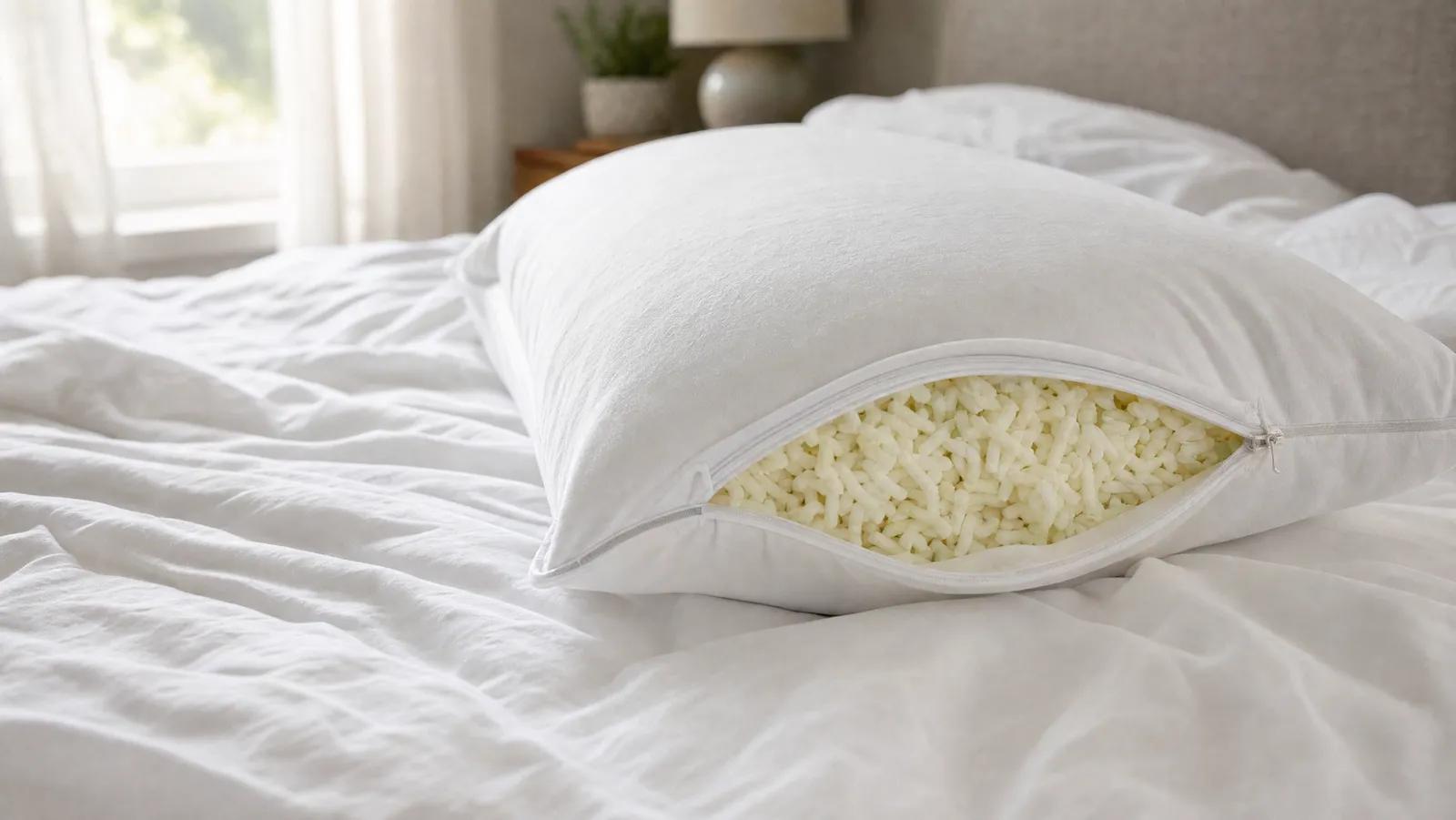
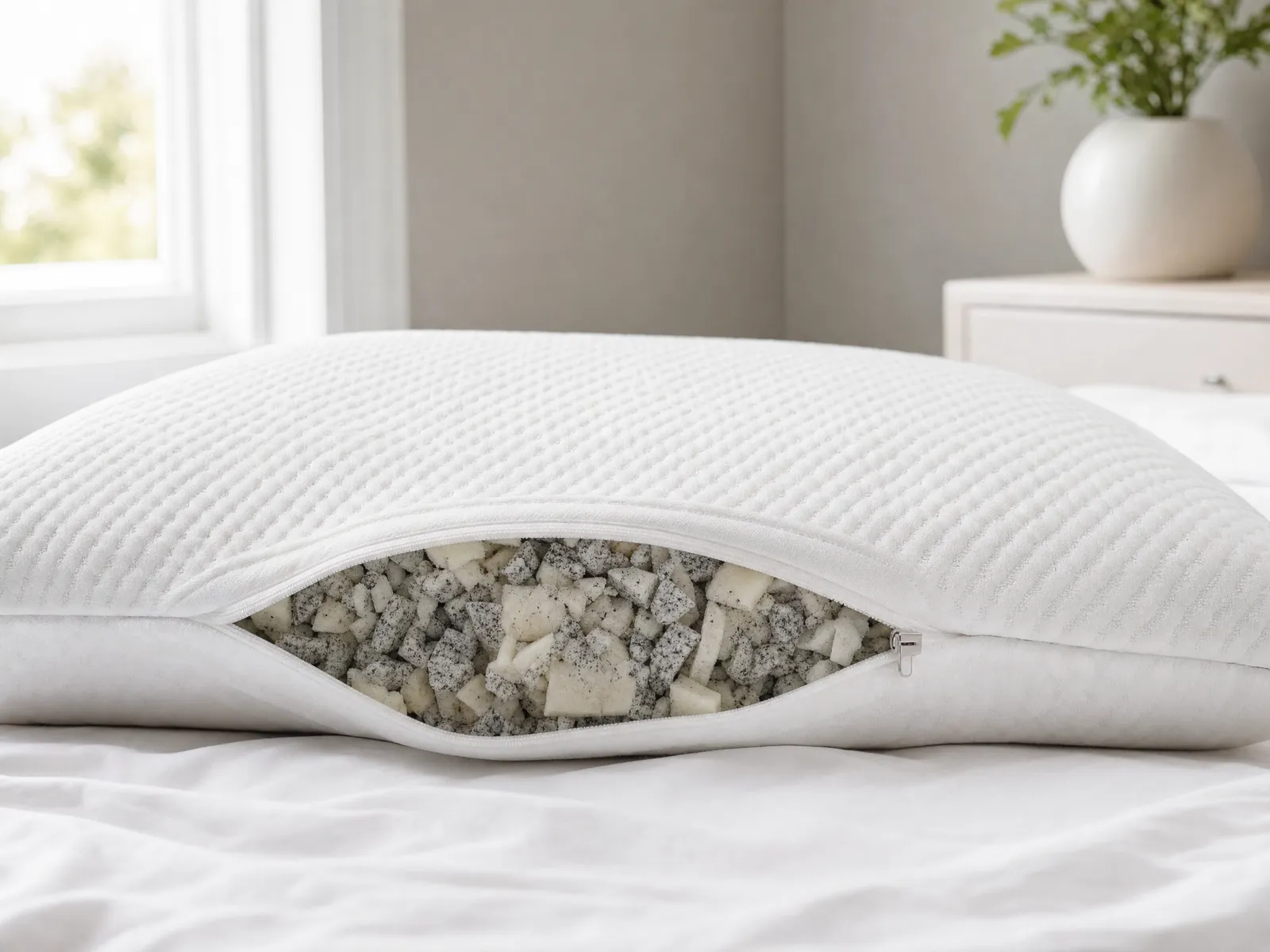
- Gel beads in a shredded fill. Take that same gel-infused foam and chop it up. You get a fill you can add to or remove, and far more surface area for air to move through.
- A gel layer laminated to one face. A sheet or moulded pad bonded to the top of a solid core. This is the construction behind most "cool to the touch" claims, because conduction happens at the surface.
The patent's definition is the part worth keeping. It calls a gel "a soft elastomer solid", and gives the classical definition as "a solid three-dimensional molecular network comprised of a substantially cross-linked system of elastomeric polymers". A cross-linked solid does not slosh and cannot leak, because nothing in it is fluid. On that definition there is no reservoir inside a gel-infused foam pillow to escape in the first place. For the heat-transfer side rather than the chemistry, how cooling pillows actually move heat sets out the mechanisms.
Which of Our Three Picks Is Which Construction
Naming the construction in front of you is the trick, so here is each pick.
The DORMANOVA shredded pillow is construction two. DORMANOVA describes a fill of "shredded gel memory foam and fiber blend" and says the shredded form lets "air move through the pillow instead of trapping heat like a solid foam block". Gel through the foam, foam then chopped: nothing fluid, nothing to puncture.
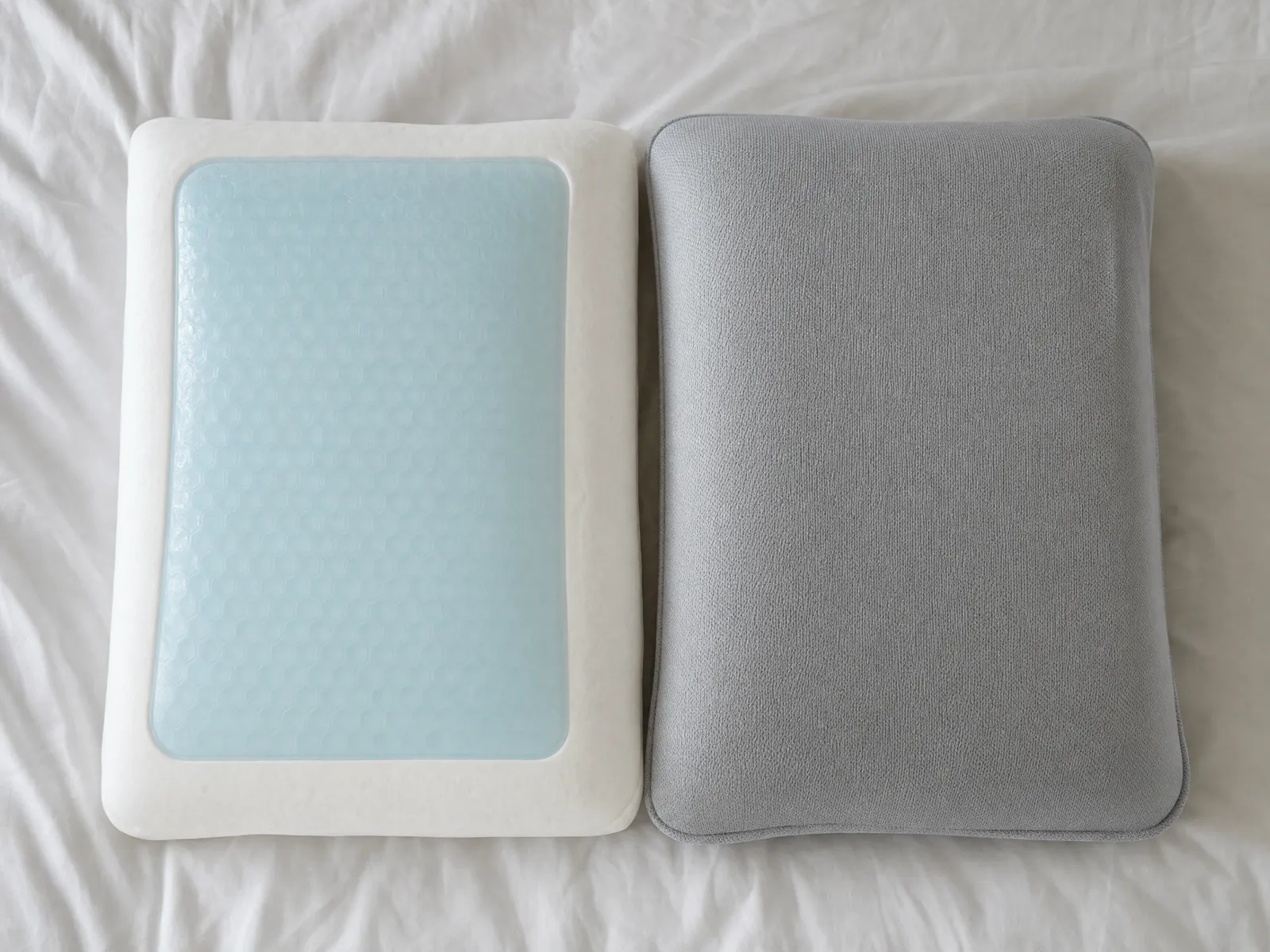
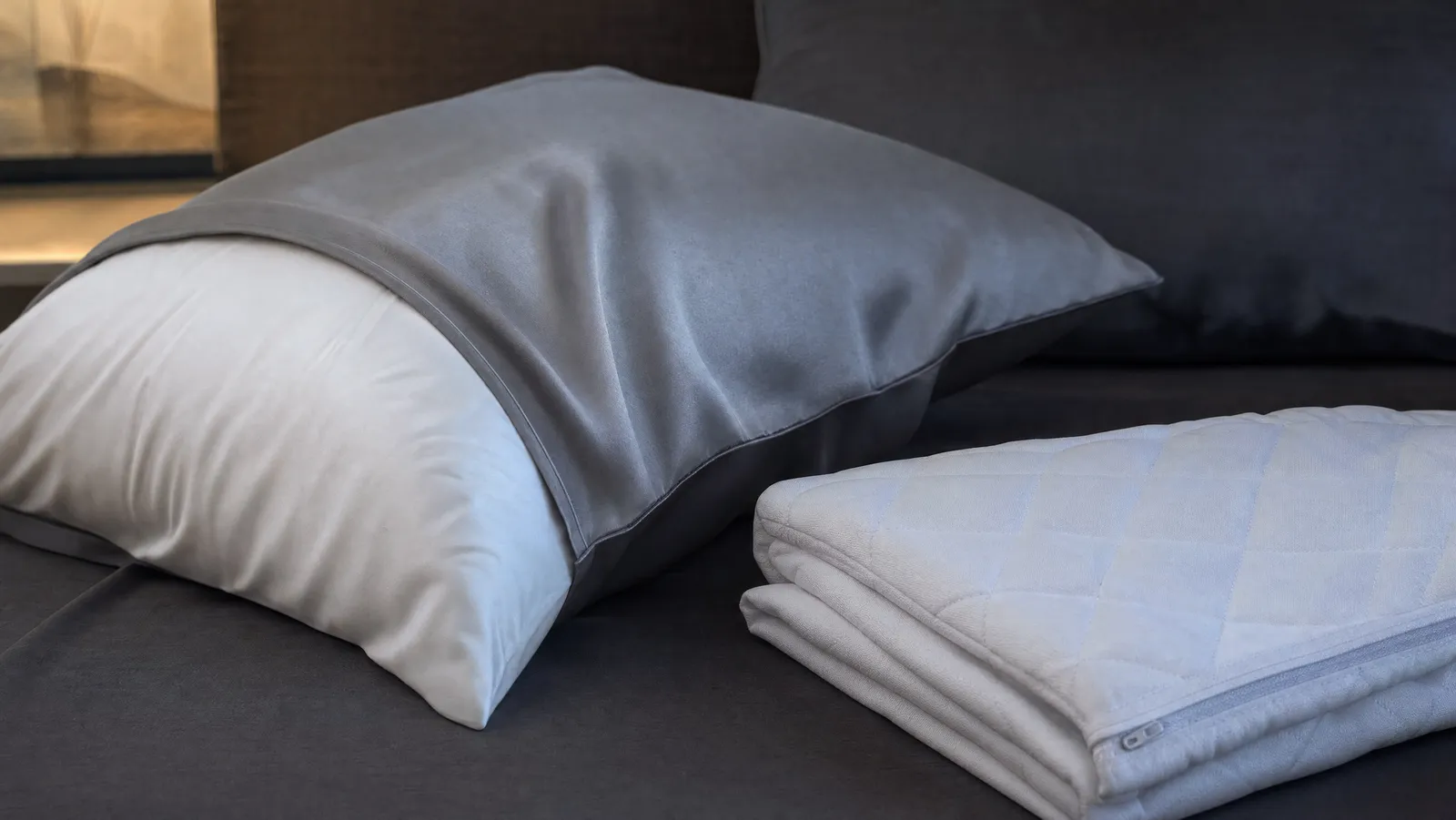
The fulocean gel pillow is construction three. fulocean states that "the gel layer delivers a refreshing, cool-to-touch feel upon contact", and that you can "pair the gel surface with the blue cover for a stronger cooling effect, or flip to the memory foam side with the white cover". A surface laminated to a core, and still not a bladder.
The Coop Home Goods pillow is none of them, because its listing does not claim gel. It is a cross-cut memory foam and microfiber fill, and it is here because it carries the strongest certification claims while making no gel claim at all.
One footnote on how thoroughly gel has taken over the category. On 4 November 2026 we searched Amazon's catalogue through its Creators API for "phase change material cooling pillow". It reported 126 matches, and every one of the top ten results described gel-infused or shredded memory foam. Not one declared a phase-change material. That is a picture of what the search term returns, not a claim about the whole market, and we take the two technologies apart in gel against phase change material.
Why This Collapses Into a Polyurethane Foam Question
Here is the reframe this article exists to make. The gel in that patent is polyurethane as well: such gels, it says, "are formed by reacting an isocyanate comprising of at least 2 isocyanate groups with isocyanate-reactive materials". Asking whether the gel is safe is asking about a minority component made of roughly the same stuff as the majority one.
What is left is the question you would ask of any foam pillow: what went into it, and has anyone measured what comes out of it. Content and emissions are not the same test, and the schemes below answer different halves. So the honest comparison is not gel against no gel but certified foam against uncertified foam, the ground our longer piece on whether memory foam pillows are toxic covers.
What CertiPUR-US Actually Certifies
CertiPUR-US is the mark you will see most, and it is narrower than shoppers assume. Its FAQ states it plainly: "We do not certify furniture, product lines or companies. We only certify flexible polyurethane foam." Its pillow guidance says the same, telling you to be sure "the foam in your pillow is CertiPUR-US certified".
On content, the program states that certified foams are made without formaldehyde, without ozone depleters, without "phthalates regulated by the U.S. Consumer Product Safety Commission" and without "mercury, lead and other heavy metals", and are screened for flame retardants and for chemicals classified as carcinogens, mutagens or reproductive toxins. The flame-retardant screen is the most useful line in that list, for the reasons set out in flame retardants in pillows.
On emissions it publishes a single threshold: "Low VOC (volatile organic compound) emissions for indoor air quality (less than 0.5 parts per million)". It also states that foam producers "must go through the complete certification procedure every six months for the first year", with annual renewal after that.
What it does not cover is the part to hold on to. Not the cover fabric, not the zip, not the adhesives, not a laminated gel face, not the assembled pillow. A pillow whose foam is certified has a certified component, which beats nothing and is not a certified product.
What GREENGUARD Gold Adds, and What It Does Not
GREENGUARD Gold is the one mark on a pillow that points at a measurement rather than an ingredient list. UL Solutions states that Gold limits "emissions of more than 360 VOCs and total chemical emissions", sets "even lower VOC emission limits" than base GREENGUARD, and requires the California Department of Public Health standard method, "also known as California Section 01350". UL describes Gold as suited to products used in "nurseries, schools, healthcare facilities".
The Coop Home Goods pillow is the only pick here whose listing names both CertiPUR-US and GREENGUARD Gold, which is why it carries our certified-fill label despite being the dearest at $89 as of November 2026.
Two limits, so nobody over-reads the logo. It is a chemical-emissions certification rather than a verdict that a product is non-toxic, and UL's framing is about contributing to indoor air quality, not guaranteeing a health outcome. Its criteria and test scenarios also appear to vary by product type, judging by the certificates UL publishes, so a limit quoted on one product's certificate is not necessarily the limit applied to a pillow. We work through the full label set in pillow certifications explained.
What OEKO-TEX STANDARD 100 Is For
OEKO-TEX describes STANDARD 100 as "a label for textiles tested for harmful substances" and says "every thread, button and accessory have been tested against a list of over 1,000 harmful substances". It sorts products into four classes by skin contact, class 2 being "products with direct skin contact, such as bed linens", and says it reviews "our limit values for harmful substances at least once a year".
So it is the right certificate for the layer against your face and the wrong one to read as a foam-emissions claim. On a gel pillow it usually describes the cover.
The Smell When You Open the Bag
A new foam pillow often arrives with an odour, and the useful question is what that odour is evidence of.
It is evidence that volatile compounds are leaving the product. It is not, by itself, a hazard measurement, and the EPA's indoor air guidance is candid about why: "at present, not much is known about what health effects occur from the levels of organics usually found in homes". The same page notes that "concentrations of many VOCs are consistently higher indoors (up to ten times higher) than outdoors", lists eye, nose and throat irritation, headaches and nausea among possible effects, and advises that you "increase ventilation when using products that emit VOCs".
The nearest thing to a measurement in bedding comes from Boor and colleagues in Environmental Science and Technology in 2014, who ran small-chamber tests on twenty new and used crib mattresses. They reported that all of them emitted volatile organic compounds, that new mattresses emitted more than used ones, that polyurethane foam released a wider range of compounds than polyester foam, and that concentrations in an infant manikin's breathing zone exceeded those in the surrounding room air. It is a crib mattress study, not a pillow study, and the direction to take is modest: emissions fall with time and airing, and a certificate with a chamber behind it beats a sniff test.
No maker here publishes an odour-dissipation time. fulocean asks buyers to "allow 24-48 hours for full expansion", which is about loft, not smell. What we would do: unwrap it somewhere ventilated, leave it a day or two, and return it if the smell is still objectionable. More on the mechanism in pillow off-gassing.
Gel Pads and Gel Bladders Are a Different Product
Everything above concerns gel bound into or onto foam. The product people picture is the other one: a sealed pad or bladder of soft gel, laid on a pillow or sewn into its top panel.
That class earns its own paragraph because the risk is structural rather than chemical. In a gel-infused foam pillow containment is irrelevant, as nothing inside is loose. In a filled pad containment is the design, and a punctured or cut pad is loose fill in a bed. Treat it as a sealed unit: do not cut it open, do not wash it beyond its rating, and keep a damaged one away from small children and pets who chew.
We will not dress that up as a quantified hazard. We could not find published injury data, a recall, or emissions testing specific to cooling gel pillow pads, and we will not invent a figure. The narrower thing we can say is more useful: none of our three picks is a gel pad.
Infants and Young Children: The Answer Is Not a Pillow
This is the one population where the advice genuinely tightens, and it does not tighten towards a safer pillow.
The American Academy of Pediatrics, writing for parents on HealthyChildren.org, says that "soft objects and loose bedding can increase your baby's risk of entrapment, suffocation or strangulation", and that this "includes pillows and pillow-like toys, quilts, comforters, mattress toppers, non-fitted sheets, blankets, toys, bumper pads or related products that attach to crib slats or sides". On the sleep surface it says "a firm surface means that it shouldn't indent when your baby is lying on it", and its guidance is footnoted as applying to "babies up to 1 year of age".
Read that against a cooling gel pillow and the conclusion has nothing to do with gel. An adjustable shredded-fill pillow is by design a soft indenting object full of loose material, the thing the guidance describes. For a toddler past the first year, ask your paediatrician rather than a bedding site.
When Overheating Is a Question for a Clinician First
Some night-time overheating is a bedding problem and some is not, and no product page can tell which.
MedlinePlus, the consumer health service of the US National Library of Medicine, advises contacting a provider if "you lose weight from sweating or often sweat during sleep", or if sweating comes with chest pain, fever, a "rapid, pounding heartbeat", shortness of breath or weight loss, noting that "these symptoms may indicate a problem, such as overactive thyroid or an infection". Its causes run from warm temperatures and exercise to menopause, infection, low blood sugar, several classes of medicine and cancer.
If that describes your nights, the clinician comes before the cart. A pillow may change how a bed feels; it treats no cause.
Our Picks for the Best Cooling Gel Pillow
All three prices are single units as of November 2026, so there is no per-pack arithmetic: $42.99 for the fulocean, $64.80 for the DORMANOVA, $89 for the Coop.
For the certificate, the Coop. It is the only pick whose listing names both CertiPUR-US and GREENGUARD Gold, the mark that implies a chamber emissions measurement. The irony is this article's point: it makes no gel claim at all.
For gel through the fill, the DORMANOVA is the clean example, with the caveat that its listing names no certification scheme we could check. That is a gap in published evidence rather than a finding of harm, and we would rather say which it is.
For a gel surface at the lowest price, the fulocean, noting that its "CertiPUR-US certified for quality, durability and safety" is a seller's phrasing of a foam-only mark, and the listing does not say whether the certificate reaches the gel face.
The Bottom Line
Are cooling gel pillows safe? For a healthy adult, a certified gel-infused foam pillow is a low-concern product, and the gel is the wrong part to worry about: here it is a cross-linked polyurethane solid dispersed through, or bonded to, a polyurethane foam. What survives is the ordinary foam question, and that one has published answers.
So check the certificate and read its scope. CertiPUR-US covers flexible polyurethane foam, not the finished pillow. GREENGUARD Gold is the emissions mark. STANDARD 100 is the textile mark. Ventilate a new pillow for a day or two, keep pillows out of an infant's sleep space entirely, and if you are sweating through the bedding most nights, ask a clinician before you ask a shop. To compare products, our guide to the best cooling pillows is the next page.
The shortlist
3 pillows compared — firmness, loft, and temperature side by side. The top pick is highlighted.
| Pillow | Firmness | Loft | Sleeps | Best for | Price |
|---|---|---|---|---|---|
Gel in Shredded FormDORMANOVA Adjustable Shredded Memory Foam Pillow | Medium | Adjustable | Neutral | Setting your own loft | $64.80 Check |
Best Certified FillCoop Home Goods Original Adjustable Pillow (Queen) | Medium Firm | Adjustable | Neutral | Certified foam with published emissions testing | $89 Check |
Most Gel-Forward Designfulocean Cooling Gel Memory Foam Pillow (Standard) | Medium Firm | Medium | Neutral | Switching between a gel side and a foam side | $42.99 Check |
DORMANOVA Adjustable Shredded Memory Foam Pillow

Taking a handful of fill out got me to a height no fixed pillow has ever managed, and the shredded fill does not hold heat the way the solid foam block it replaced did.
It is the second-dearest pillow here and the only one whose listing names no safety certification at all, so you are trusting the brand rather than a published criterion.
One pillow at $64.80 as of November 2026, and the clearest example here of the construction most shoppers are asking about. DORMANOVA describes a fill of "shredded gel memory foam and fiber blend" and says the shredded form lets "air move through the pillow instead of trapping heat like a solid foam block". The gel is not a layer and not a pouch: it is distributed through foam that has then been chopped up, so there is no fluid in the product to leak.
What we cannot do is point you at a test. The listing we read makes no CertiPUR-US, GREENGUARD or OEKO-TEX claim, which is not evidence of a problem but does mean there is nothing published to check. Buy it for the adjustability, which is documented: the cover unzips, a separate 200 g bag of matching fill comes in the box, and DORMANOVA states it measures 19.7 x 27.6 in.
Coop Home Goods Original Adjustable Pillow (Queen)

I wanted the certificates more than the loft and got both: I can add or take out fill until it sits right, and I know which schemes the foam has been through.
It is the dearest pick here, it makes no cooling-gel claim whatsoever, and Coop itself warns that "cooler environments may cause the foam to feel firmer".
At $89 as of November 2026 this is the dearest pillow on the page, and it is here for what its listing names rather than how it feels. Coop Home Goods states that the pillow is "CertiPUR-US and GREENGUARD Gold certified", says the foam is "freshly manufactured memory foam, never repurposed or recycled", and describes the fill as a "blend of cross-cut memory foam and microfiber". Of the marks a pillow can carry, GREENGUARD Gold is the one implying a chamber emissions measurement.
Now the honest part, which is this article's argument in one product. Coop's listing does not claim gel. The pick with the strongest published chemical credentials in front of us is not a gel pillow, which shows that the gel was never the variable that mattered. Note too that CertiPUR-US applies to the foam and not the finished pillow, so the Lulltra cover sits outside that mark.
fulocean Cooling Gel Memory Foam Pillow (Standard)

The gel face really is cold for the first minute, and being able to flip to the plain foam side in winter means I am not stuck with it in January.
The cool-to-touch effect is a surface effect that fades once the gel reaches your temperature, and it is unclear whether the CertiPUR-US mark extends past the foam core to the gel layer itself.
The cheapest pick here at $42.99 as of November 2026, and the only one built around a gel surface rather than gel mixed through the fill. fulocean states that "the gel layer delivers a refreshing, cool-to-touch feel upon contact and helps manage heat buildup", and that the pillow is reversible: "pair the gel surface with the blue cover for a stronger cooling effect, or flip to the memory foam side with the white cover". It lists dimensions of 24 in by 16 in by 5.5 in.
Two things to read carefully. fulocean says the core is "CertiPUR-US certified for quality, durability and safety", which is the maker's phrasing rather than the program's: CertiPUR-US certifies flexible polyurethane foam, so a laminated gel face and a removable cover are not obviously inside that scope. And fulocean asks buyers to "allow 24-48 hours for full expansion", which is a statement about loft, not odour.
How to Vet a Cooling Gel Pillow's Safety Claims in Five Minutes
Every listing in this category sells the same reassurance: the word gel, the word cooling, and a logo. Only one of those three can be checked, and it is the logo. These steps use nothing but what the seller publishes, and they take about five minutes.
Are Cooling Gel Pillows Safe? FAQ
Are cooling gel pillows safe? For a healthy adult, a gel-infused polyurethane foam pillow is a low-concern product, and the thing worth checking is the certificate rather than the gel. We found no controlled safety study of any cooling gel pillow, in any population. What exists instead is a set of published emissions criteria you can look up: CertiPUR-US states "Low VOC (volatile organic compound) emissions for indoor air quality (less than 0.5 parts per million)" for certified foam, and UL's GREENGUARD Gold limits "emissions of more than 360 VOCs and total chemical emissions".
Is the gel itself toxic? There is no single substance called "cooling gel", so the question cannot be answered in general. In the construction most consumer pillows use, the gel is a cross-linked solid rather than a fluid: US patent 10113043 B2 defines a gel as "a soft elastomer solid" and describes "discrete visible particles between the range of about 0.01 to 12 millimeters in size". In that patent the gel particles are polyurethane too, "formed by reacting an isocyanate comprising of at least 2 isocyanate groups with isocyanate-reactive materials". Chemically, the gel is a relative of the foam holding it.
Can the gel leak out? Not out of gel-infused foam, because on the patent's definition there is nothing fluid in it to leak. A sealed gel pad is the product people are picturing when they ask, and there the containment is the seam. None of our three picks is a gel pad.
What does the smell when I unbox it mean? It means something volatile is leaving the product, which is why ventilation is the standard advice, and it is not by itself a measurement of hazard. The EPA notes that "at present, not much is known about what health effects occur from the levels of organics usually found in homes" — a sentence that argues for a published emissions certificate rather than for a nose test.
Is CertiPUR-US enough on its own? It is the floor, not the ceiling, and it is narrower than most shoppers assume. It covers flexible polyurethane foam, and the program states that certified foams are made without formaldehyde, without ozone depleters, without phthalates regulated by the U.S. Consumer Product Safety Commission, and without "mercury, lead and other heavy metals". It does not certify the cover, the fill blend around the foam, or the finished pillow.
Can a baby or toddler use a cooling gel pillow? The guidance is not a different pillow, it is no pillow. The American Academy of Pediatrics, writing on HealthyChildren.org, says "soft objects and loose bedding can increase your baby's risk of entrapment, suffocation or strangulation", lists "pillows and pillow-like toys" among them, and notes that "unless mentioned otherwise, all these recommendations are for babies up to 1 year of age". Ask your paediatrician about older children rather than a bedding page.
I overheat badly every night. Is a cooling pillow the fix? Possibly in part, and heavy sweating in sleep is also a recognised reason to talk to a clinician. MedlinePlus, the National Library of Medicine's consumer health service, advises contacting a provider if "you lose weight from sweating or often sweat during sleep", and if sweating comes with chest pain, fever, a "rapid, pounding heartbeat", shortness of breath or weight loss. Bedding is the second conversation, not the first.
Why you can trust us

Aimee Cannon
Sleep & bedding writer
Aimee Cannon is a sleep and bedding writer who has spent years testing pillows of every kind — memory foam, down, wool, bamboo, buckwheat, and specialty support pillows. She focuses on matching the right pillow to each sleeping position and need, and reports what actually holds up after months of nightly use. When she is not testing pillows, Aimee is usually with her husband and her dog.