Gel vs Phase Change Cooling Pillow: Which Actually Stays Cool?
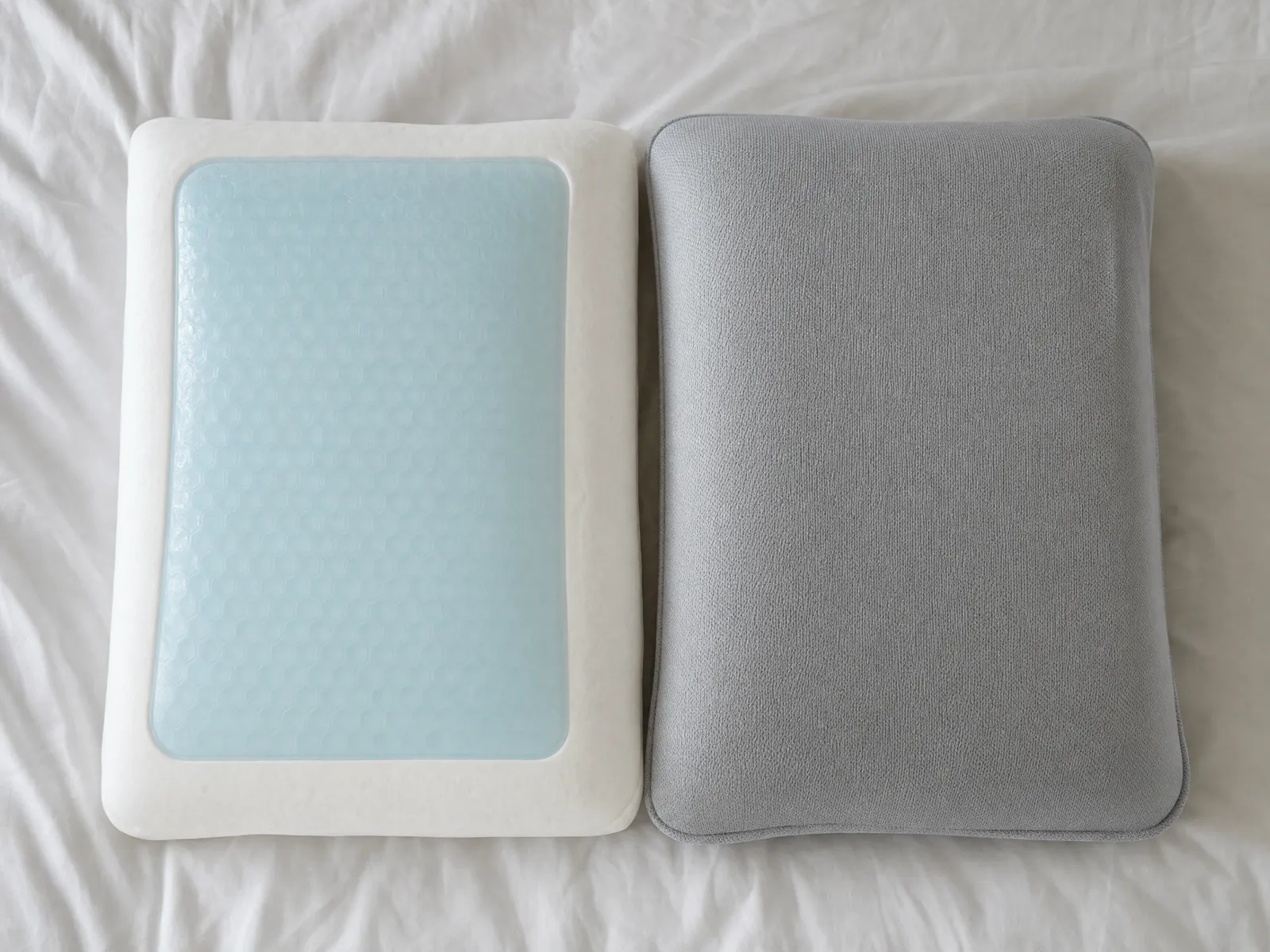
Phase change is the better mechanism, and the gel pillow is the one you can actually buy. Anyone weighing a gel vs phase change cooling pillow is comparing a crowded shelf with a nearly empty one: gel moves heat by conduction and stops when the surface warms to your skin, while a phase-change material holds near its melting point for longer. We earn a commission from links on this page, at no cost to you.
So the useful question is not the one in the search box. On 4 November 2026 we searched Amazon's catalogue through its Creators API for "phase change material cooling pillow", and in the top ten results not one product declared a phase-change material. The real decision in front of a hot sleeper is gel-infused fill versus a conductive or phase-change-treated layer over an ordinary breathable pillow, which is the framing we use throughout our best cooling pillow guide.
The Short Answer
- Gel cools by sensible heat. Heat flows from your skin into a cooler material, and the flow stops when the two temperatures meet. The feeling is sharp and short.
- A phase-change material cools by latent heat. The US Department of Energy describes a PCM simply as "a high latent heat material" used to "store thermal energy and regulate local temperatures", absorbing heat by melting and releasing it on solidifying.
- That should mean a flatter, longer hold, because a 2012 review in the Journal of Textile and Apparel, Technology and Management states that "during the melting/crystalline process, the temperature of PCM as well as its surrounding area remains nearly constant".
- The advantage lasts only while there is capacity left. Latent heat is a finite quantity. Once the capsules have melted, a PCM layer is just another fabric until it refreezes.
- The comparison is largely theoretical at pillow prices. Our catalogue search above found gel everywhere and no declared PCM pillow in the top results.
- Q-max is a peak, not a duration. It is the measure sellers quote, and it describes the first moment of contact only.
- Arc-Chill is evidenced as a cool-touch fabric, not a PCM. Avolare quotes a q-max figure for it, which is a conductivity claim.
- Nobody has published the trial. We could not find a controlled comparison of a gel pillow against a phase-change pillow for any sleep outcome.
Two Mechanisms: Sensible Heat and Latent Heat
Gel is the simple one. Put something cooler and more conductive against warm skin and heat moves into it. The rate depends on the temperature gap and on how readily the material carries heat away, and because the gap closes as the material warms, the effect has a built-in end. That is sensible heat: energy that changes a temperature.
A phase-change material works on a different line of the energy budget. The 2012 review Microencapsulation of PCMs in Textiles describes PCMs as materials "used to storage and release latent heat during their phase transition at a defined temperature range", and explains that latent heat storage is attractive "due to its ability to produce a high storage density at nearly isothermal conditions". In plain terms, melting swallows a lot of energy without the temperature climbing much.
In a textile, the wax is sealed into microcapsules and bonded in, because the raw material is a liquid above its melting point. The same review notes that microencapsulation "is an obvious choice but it adds weight", which is plausibly one reason the technology took hold in flat bedding and outerwear rather than in loose pillow fill. If you want the mechanism-by-mechanism version of this, we laid out all five routes in our explainer on how a cooling pillow moves heat.
What Each Mechanism Predicts You Will Feel
Here is where the two diverge in a way you could notice with no instruments at all.
Gel predicts a sharp first touch that fades. The cool is strongest in the first seconds, when the temperature difference is largest, and it decays as the surface equilibrates. Flipping the pillow restores it, briefly, for free. That minutes-long decay is the shortest of three separate clocks that end the cooling.
A PCM predicts a duller start and a flatter middle. Latent heat buys you a plateau rather than a spike, and there is a physical reason it cannot also win the first touch. A 2019 review in Molecules by Yang and colleagues reports that "paraffin has a low thermal conductivity, that is, with an average of 0.2 W/mK", and that this "can considerably reduce the energy charge and discharge rates". A material that takes heat in slowly does not feel icy when you first lie on it.
The honest limit on the PCM side is capacity. The plateau lasts until the capsules have finished melting, after which the layer behaves like whatever it is made of, and it recharges only when you roll off and let it refreeze. Any listing that implies an indefinite effect is describing marketing rather than thermodynamics.
Q-Max Measures the First Second, Not the Night
Every cool-touch claim in this category traces back to one number, and almost every listing misreads it.
Q-max is a peak heat flux recorded at the instant of contact. Japan's standard for it is JIS L 1927, which AFNOR's catalogue lists under the title "Textiles - Measurement method of cool touch feeling property" with a publication date of February 2020. Intertek, describing the equivalent instant-cooling test it runs to Chinese and Taiwanese standards, explains that the specimen sits on a cool plate at ambient temperature, a hot plate "similar to the body skin temperature" is lowered onto it, and the result reported is "the maximum heat flow in W/cm2", with the test determining instant cooling "by measuring the maximum heat loss in a short period of time".
North Carolina State University's Textile Protection and Comfort Center, which runs the test commercially, puts the interpretation plainly: the qmax value "indicates the instantaneous thermal feeling sensed when there is initial contact of the material with the skin surface", the test is "[s]imulating initial touch when shopping or when donning the fabric in wear", and "a higher value of qmax denotes that there is more rapid movement of heat from the body to the fabric surface". TPACC also warns that "the qmax value largely depends on the contact area between skin and fabric surface", which is an argument for judging the layer that touches you rather than the fill underneath.
Nothing in that measurement contains a duration. A q-max figure is a conduction claim about the first moment, which makes it the wrong instrument entirely for deciding whether a surface holds up at 3am.
We Searched for a Phase Change Pillow and Did Not Find One
This is our own observation, dated, and we would rather report it narrowly than dress it up.
On 4 November 2026 we queried Amazon's catalogue through its Creators API for "phase change material cooling pillow". The API reported 126 matches on that call, and 123 on a re-run the same day, so treat the count as approximate. Every one of the top ten results described gel-infused or shredded memory foam, and not one of them declared a phase-change material. That is a snapshot of one retailer's ranked results on one day, not a census of the market, and we are not claiming PCM pillows do not exist.
They do exist, in fact, away from the mass-market listings. NASA's own Spinoff account of the Outlast material, which began with Johnson Space Center work on temperature control and a prototype "for spacesuit gloves" that "was never incorporated into anything NASA launched into space", describes a direct-to-consumer bedding brand selling "several pieces of bedding that use the phase-change technology, from pillows and bedsheets to entire mattress pads".
So the shape of the market is the finding. Gel is what the volume retailers rank; phase change is a specialist purchase, and mostly a flat one.
Where Phase Change Material Bedding Actually Is Sold
Follow the technology and it leads to covers, not fill. The 2012 textile review lists textile-PCM applications as "also found in bedding materials such as mattress covers, sheers and blankets", alongside clothing, medical textiles and space suits. Its own table of PCM textile applications runs through casual clothing, professional clothing, medical uses, shoe linings, building materials and life style apparel. Pillow fill is not on it.
That makes engineering sense. A microencapsulated coating wants a thin, flat, stable substrate with good contact against skin, which is a sheet or a pad. Burying capsules inside a thick foam core puts them behind an insulator, where the low conductivity that Molecules flags for paraffin becomes a much worse problem.
It also makes commercial sense, which is the part that affects your wallet. A treated cover is cheap to manufacture, launderable, and replaceable without replacing the pillow. The same logic is why we concluded that a thin conductive case beats a cooling pillow as a first purchase when we worked through whether cooling pillowcases earn their price.
What Arc-Chill Is, and What It Is Not
Be careful here, because this is the name most often mistaken for a phase-change material.
Avolare states that its Arc-Chill cooling pillowcases use "Arc-Chill 3.0 Cooling Technology with Q-Max>0.5", and that the fabric "rapidly absorbs heat, lowering surface temperature by over 5°F upon contact". Read what that claim is pinned to. Q-max is a cool-touch conductivity measurement, so Avolare is making a conduction claim, and a first-contact one at that. We found no source describing Arc-Chill as a phase-change material, and we are not going to call it one.
The second half of the claim is the softer half. "Over 5°F" has no published method behind it the way q-max does, which is why sellers quoting the same fabric quote temperature drops that disagree with each other: across Arc-Chill-marketed listings we have seen "over 5°F", "over 5°C" and a 2-5°C range. The OEKO-TEX STANDARD 100 certification Avolare also lists is a harmful-substances scheme and says nothing about temperature.
None of which makes it a bad product. It makes it a conductive fabric sold honestly enough to name a standardised metric, which puts it ahead of most of the category.
Cooling Gel vs Phase Change in the Products You Can Actually Buy
Since the PCM pillow is not on the shelf, the real comparison is between two gel architectures and one cover. The arithmetic, all as of November 2026, is stark.
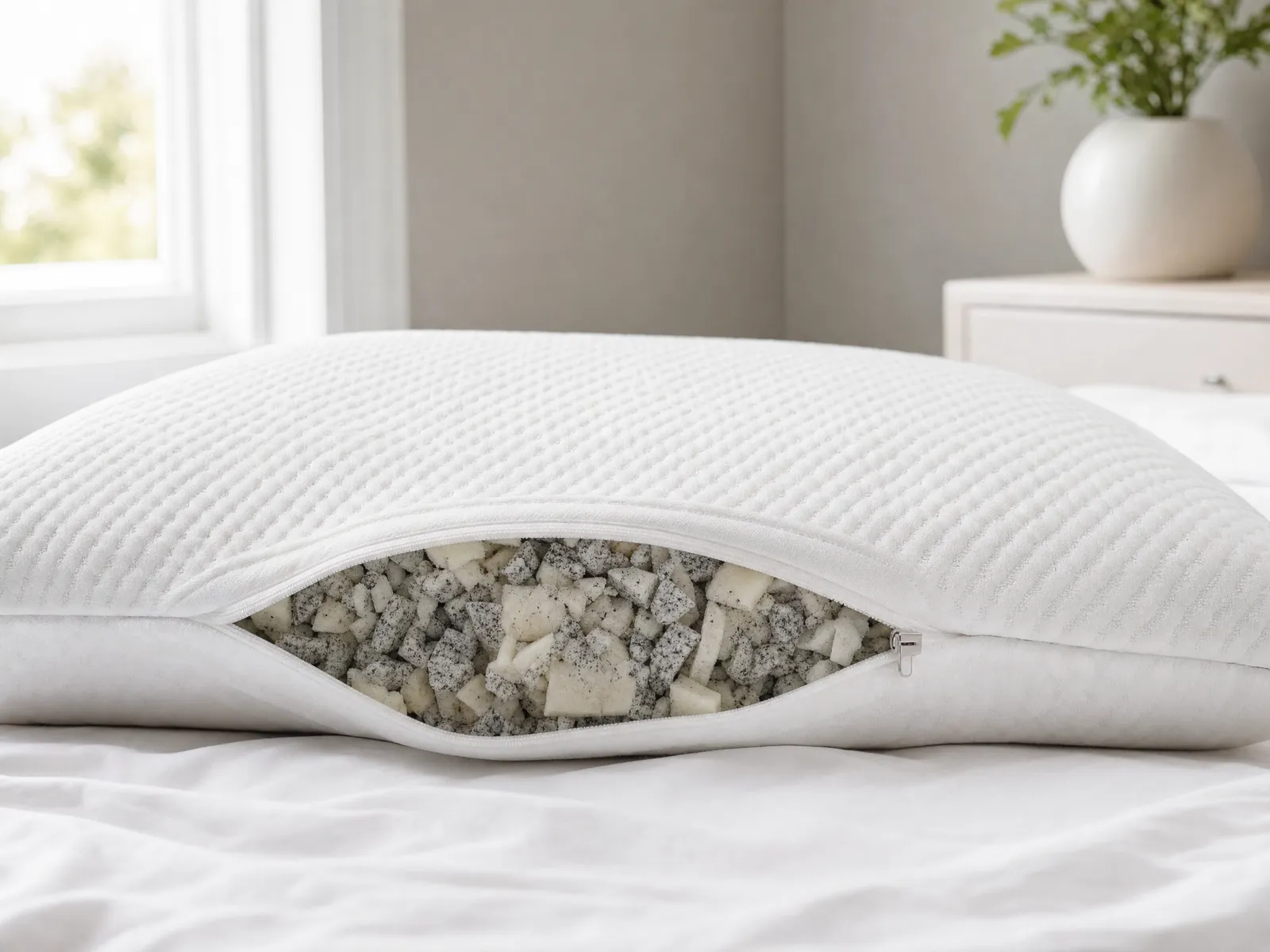
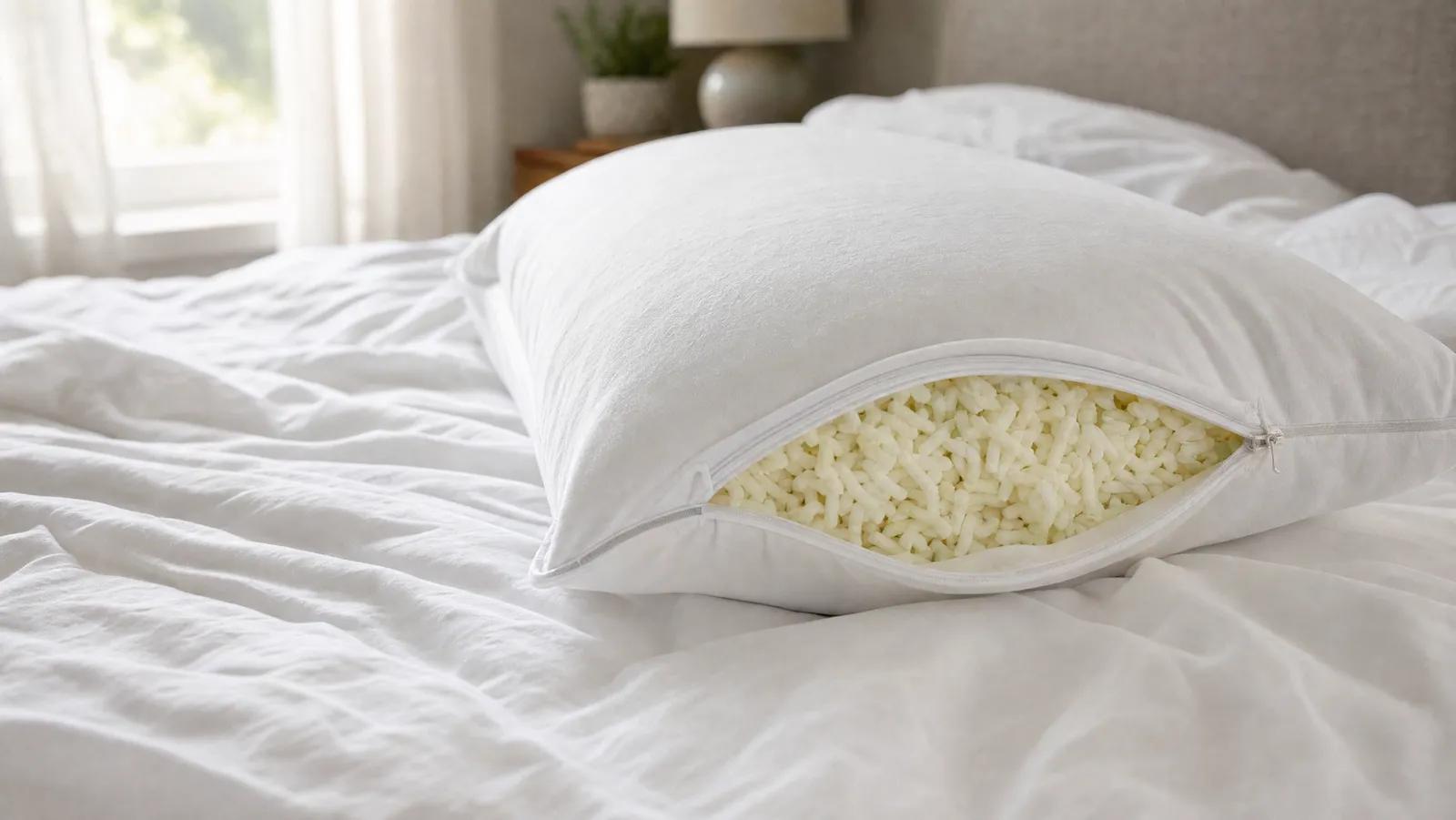
The DORMANOVA adjustable pillow is $64.80 for one pillow. DORMANOVA states a shredded gel memory foam and fibre blend, and frames the cooling comparatively: the construction "let[s] air move through the pillow instead of trapping heat like a solid foam block". We read the shredding, not the gel, as the part that keeps working, because airflow does not equilibrate the way conduction does.
The Vaverto firm pillow is $35.99 for one standard pillow, and Vaverto states that its "cooling gel infusion absorbs and disperses body heat" in a solid contoured core with an "open-cell structure". One solid slab of viscoelastic foam is the hardest case for a cooling claim, which is the subject of its own page on why memory foam pillows sleep hot. It also states CertiPUR-US certified foam, a programme CertiPUR-US says covers foam content, emissions and durability rather than anything thermal; what is in a cooling gel and whether it matters is the question we took up in what is actually in the gel.
The Avolare cases are $15.99 for two queen cases, which is $8.00 each. That number moved: the same pack was $14.39, or $7.20 a case, in October 2026, so the per-case price rose 80 cents, about 11 per cent, in a month. Even after the rise, one case costs an eighth of the DORMANOVA pillow and under a quarter of the Vaverto.
The Honest Gap: Nobody Has Run the Comparison
The sentence this article exists to be able to write: we looked for a controlled trial comparing a gel pillow with a phase-change pillow for sleep outcomes, and we could not find one.
What exists is thermal and material science on mattresses, pads and apparel, plus the standardised cool-touch measurement described above, which is a property of a fabric and not an outcome in a sleeper. We are not going to launder a mattress-pad result into a pillow claim, and we have not tested any of these products in a laboratory ourselves. We reached the same conclusion from the other direction when we audited what the evidence on cooling pillows supports.
So the comparison on this page is a mechanism comparison with a price tag attached. That is less than the marketing implies and more than nothing, and saying which is which is the whole job.
Our Verdict: Buy the Layer, Not the Mechanism
For a hot sleeper, the cover route is the better buy, and the argument does not depend on either cooling claim being true.
Three reasons, in order of how much weight we put on them. It is the layer in contact with your skin, which is where TPACC says contact coolness is decided. It costs a fraction of a pillow, so the experiment is cheap and reversible. And it goes in the wash weekly, which means it keeps moving moisture away from your skin long after any conduction or latent-heat effect has equilibrated.
Spend in this order: the room first, then airflow, then the surface touching you, then the pillow itself, and only if the problem outlasts the first hour. A complaint that starts at minute one is a surface problem. A complaint that arrives at hour three is a core problem, and no fabric fixes a core.
If you want the phase-change mechanism specifically, buy it where it is actually sold, as a treated pad, cover or sheet, and ask the seller for a melting temperature before you pay.
When Heat at Night Is Not a Bedding Problem
Some overheating is a bedding problem and some of it is not, and a product page cannot tell you which.
MedlinePlus, from the US National Library of Medicine, lists fever, infection, menopause, low blood sugar, anxiety, alcohol, caffeine and medicines including thyroid hormone among the causes of sweating, and advises contacting your provider if "you sweat a lot or sweating lasts for a long time or cannot be explained", or if "you lose weight from sweating or often sweat during sleep". It also flags chest pain, fever, a rapid pounding heartbeat, shortness of breath and weight loss as symptoms that warrant a call.
If that describes your nights, the next step is a clinician rather than a cart. Neither mechanism on this page treats a cause, and buying a pillow can be a way of postponing the question.
The Bottom Line
Gel vs phase change cooling pillow has a clean answer on paper and an awkward one in the shops. Latent heat should hold a surface temperature longer than conduction can, because melting absorbs energy at a near-constant temperature; conduction stops the moment the surface matches your skin. On that basis phase change wins.
Then you go shopping and find that in the top results of our 4 November 2026 catalogue search, no pillow declared a phase-change material, while gel was in almost everything. The buyable version of this choice is a gel-infused pillow against a conductive or PCM-treated layer over a breathable one, and at $8.00 a case as of November 2026 the layer is cheaper and it is the part you relaunder. If you want the full stack of picks and the reasoning behind them, our cooling pillow buying guide is the next page.
The shortlist
3 pillows compared — firmness, loft, and temperature side by side. The top pick is highlighted.
| Pillow | Firmness | Loft | Sleeps | Best for | Price |
|---|---|---|---|---|---|
Gel in Shredded FoamDORMANOVA Adjustable Shredded Memory Foam Pillow | Medium | Adjustable | Neutral | Setting your own loft | $64.80 Check |
Gel in Solid FoamVaverto Firm Gel-Infused Memory Foam Pillow (Standard) | Firm | Medium | Neutral | Showing what gel infusion does and does not fix | $35.99 Check |
Our Pick: The Cover RouteAvolare Arc-Chill Cooling Pillowcases (Queen, 2 Pack) | — | — | Cooling | Lowest price per case here | $15.99 Check |
DORMANOVA Adjustable Shredded Memory Foam Pillow

Being able to pull out fill until the height was right fixed the neck ache I had with every one-size pillow, and the shredded fill does not go swampy the way my old solid foam block did.
It is not cold to the touch in any obvious way, and at sixty-five dollars it costs more than eight of the cooling cases on this page.
At $64.80 as of November 2026 this is the most expensive thing on the page, and it is here as the best-built version of the gel argument rather than as a phase-change alternative. DORMANOVA states a shredded "gel memory foam and fiber blend" that you unzip and adjust, a separate 200 g bag of matching fill in the box, and a 19.7 x 27.6 in pillow that fits standard and queen cases. On cooling, the maker's own framing is comparative rather than absolute: shredded gel-infused foam and an airy fibre blend "let air move through the pillow instead of trapping heat like a solid foam block".
We think the honest reading of that sentence is that the shredding is doing most of the work. Air moving through gaps keeps working while the room is cooler than the pillow, whereas conduction into gel stops the moment the surface reaches your temperature. That is why we have rated it temp: neutral rather than cooling, and why the adjustable loft and the two-sided removable cover are the features we would actually buy it for. Nothing in DORMANOVA's listing claims a phase-change material, and we would not expect it to.
Vaverto Firm Gel-Infused Memory Foam Pillow (Standard)
The firmness is the real selling point and it has not flattened, and the bamboo cover comes off and washes without arguing.
The cool feeling is gone within a few minutes of lying down, which is what solid foam does regardless of what is mixed into it.
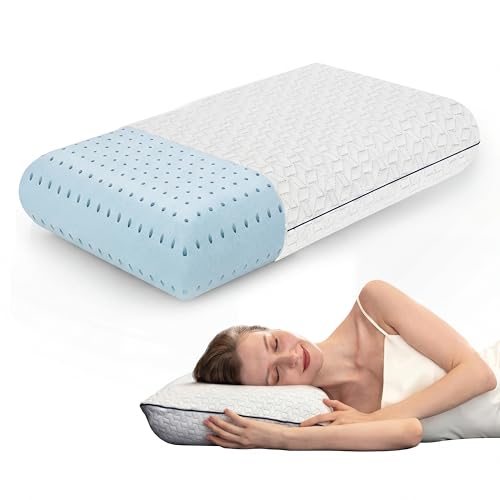
A single standard pillow at $35.99 as of November 2026, and the clearest example on this page of what a gel infusion can and cannot do. Vaverto states gel-infused memory foam in a contoured shape, and that the "cooling gel infusion absorbs and disperses body heat" while an "open-cell structure enhances airflow". It also states CertiPUR-US certified foam and a washable viscose-from-bamboo cover the maker describes as "naturally hypoallergenic". Treat the first claim as a mechanism and the second as a certification covering foam content, emissions and durability, not temperature.
The reason it earns a place is the geometry. This is one solid piece of viscoelastic foam, which is a dense structure with little room for air to move, so the gel is carrying the entire cooling argument on its own. That is conduction, and conduction has a finish line: it stops when the surface reaches your skin temperature. Buy it for the firm contoured support, which is what the listing is mostly about, and treat the cooling as a first-contact effect rather than an overnight one.
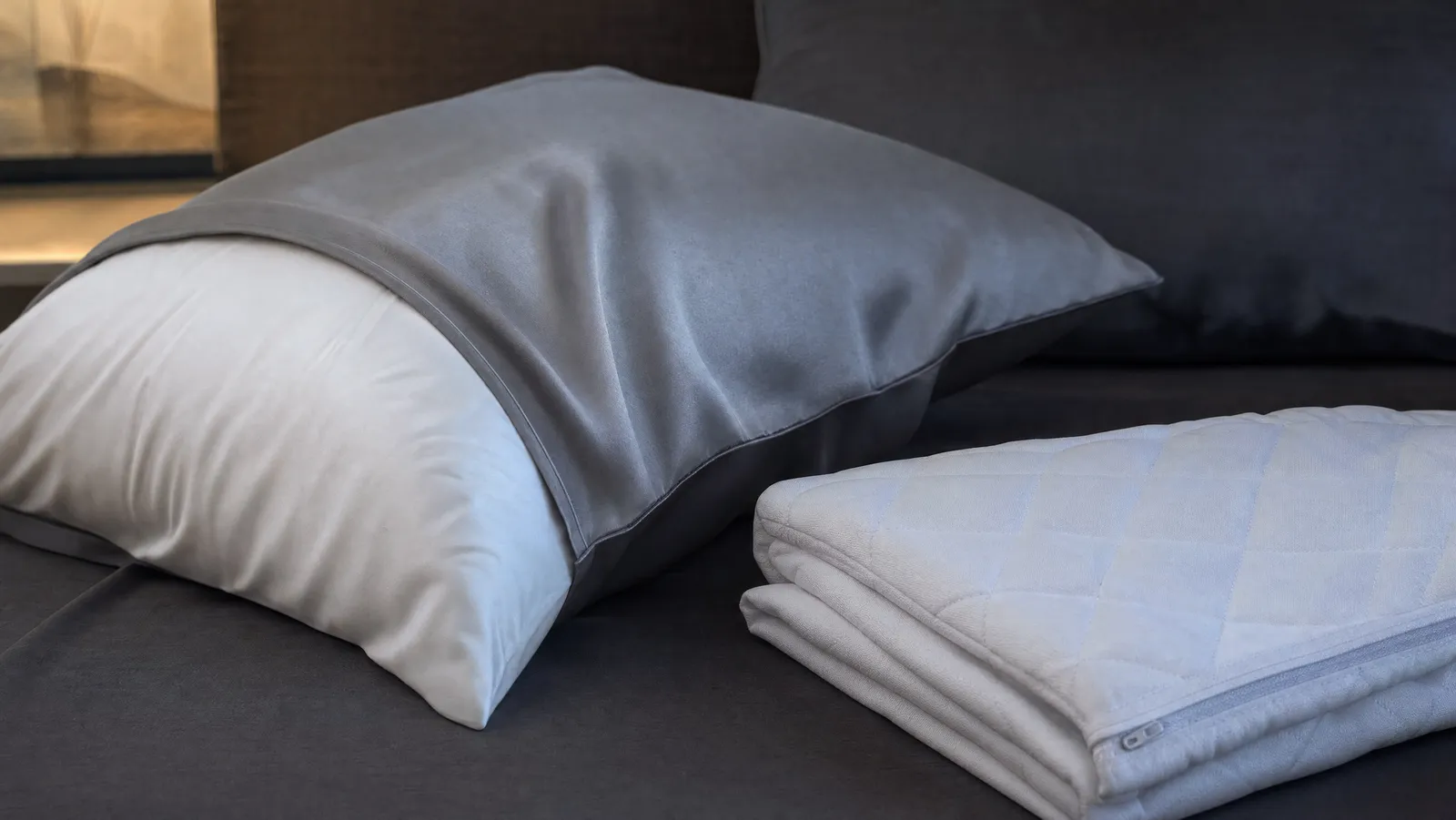
Avolare Arc-Chill Cooling Pillowcases (Queen, 2 Pack)

Eight dollars a case for something that feels genuinely cold for the first minute every time I flip it, and it washes with the sheets, which no pillow of mine ever has.
The cold is a first-contact thing that has gone before I am asleep, and the pack price went up between my first order and my second.
Two queen cases for $15.99 as of November 2026 works out at $8.00 a case, the cheapest layer on this page by a wide margin. Note the move: it was $14.39, or $7.20 a case, when we checked in October 2026, so the per-case price is up 80 cents, about 11 per cent, in a month. Avolare states Arc-Chill 3.0 Cooling Technology with a fabric that is "Q-Max>0.5", claims it "rapidly absorbs heat, lowering surface temperature by over 5°F upon contact", and states OEKO-TEX STANDARD 100 certification, which is a harmful-substances scheme rather than a thermal one.
This is our pick, and the reason is structural rather than thermal. It is the layer in contact with your skin, it costs an eighth of the DORMANOVA pillow, and it goes through the wash with the sheets, which is the one benefit in this category that does not fade. Be precise about what it is: a q-max claim is a conduction claim about first contact, and we found no source describing Arc-Chill as a phase-change material, so do not buy it expecting latent heat. Avolare's own cautions are worth reading too, that "the pillow core's thickness may affect the pillowcase's fit", and that it should be machine washed and will "air dry in about an hour".
How to Tell a Latent-Heat Claim From a Cool-Touch Claim in Two Minutes
Every listing in this category sells a sensation. Only some of them name a mechanism, and only one of the numbers on the packet is tied to a published test method. These eight checks sort the physics from the adjective using nothing but what the seller already publishes.
Gel vs Phase Change Cooling Pillow FAQ
Is a phase change pillow better than a gel pillow? On mechanism, latent heat should hold a surface temperature longer than conduction does, because, as the 2012 Journal of Textile and Apparel, Technology and Management review puts it, "during the melting/crystalline process, the temperature of PCM as well as its surrounding area remains nearly constant". The problem is availability. On 4 November 2026 we searched Amazon's catalogue through its Creators API for "phase change material cooling pillow". It reported a little over 120 matches (126 on one call, 123 on a re-run the same day), and every one of the top ten results described gel-infused or shredded memory foam. Not one declared a phase-change material.
Is Arc-Chill a phase-change material? We found no source saying so. What Avolare states for its Arc-Chill 3.0 cases is a q-max figure, "Q-Max>0.5", which is a cool-touch conductivity measure rather than a latent-heat one, plus a claim that the fabric "rapidly absorbs heat, lowering surface temperature by over 5°F upon contact". Read it as a conduction claim, because that is what the evidence supports.
What temperature does a phase-change material melt at? It depends entirely which one. The same 2012 review reports that organic and inorganic PCMs together cover melting temperatures "between 8.1°C and 130°C", and that for inorganic salt hydrates the useful heat absorbing and releasing interval "is usually between 20-40°C". Only a narrow band near skin temperature is any use in a bed, which is why the melting point is the number worth asking for.
Does gel in memory foam do anything? It raises how quickly heat leaves your skin at first contact, and then it equilibrates. Conduction needs a temperature difference, so once the pillow surface reaches your temperature the transfer stops whatever the material is. Whether the gel itself raises a safety question is a separate matter we went through in Are Cooling Gel Pillows Safe?
Can I get a phase-change surface without buying a new pillow? That is where the technology actually is. The 2012 review lists textile-PCM applications "also found in bedding materials such as mattress covers, sheers and blankets", and NASA's own Spinoff account of the Outlast material describes a direct-to-consumer brand selling "several pieces of bedding that use the phase-change technology, from pillows and bedsheets to entire mattress pads". Covers and pads, not mass-market pillow fill.
How long does either one stay cool? Nobody publishes a measured duration for a pillow. Q-max contains no duration at all, and no PCM bedding listing we have seen publishes its latent capacity. Expect the first minutes from a conductive surface, and treat any "all night" phrasing as copy rather than data.
Is there a trial comparing them? We looked for a controlled trial comparing a gel pillow against a phase-change pillow for any sleep outcome and could not find one. The published thermal work we could reach is on mattresses, pads and apparel.
I wake up drenched most nights. Is this a pillow problem? That is a question for a clinician before it is a shopping question. MedlinePlus, from the US National Library of Medicine, advises contacting your provider if "you sweat a lot or sweating lasts for a long time or cannot be explained", or if "you lose weight from sweating or often sweat during sleep", and lists fever, infection, medicines, menopause and low blood sugar among the causes of sweating. No pillow addresses any of that.
Why you can trust us

Aimee Cannon
Sleep & bedding writer
Aimee Cannon is a sleep and bedding writer who has spent years testing pillows of every kind — memory foam, down, wool, bamboo, buckwheat, and specialty support pillows. She focuses on matching the right pillow to each sleeping position and need, and reports what actually holds up after months of nightly use. When she is not testing pillows, Aimee is usually with her husband and her dog.