The Best Cooling Pillows for Side Sleepers

Buy for loft first, then for airflow. The best cooling pillow for side sleepers is a high-lofted pillow you can make lower, because the thickness your shoulder demands is the same thickness that insulates your head. Our pick is the HOMBYS 7-inch dual-layer at $79.99 as of October 2026, for the loft rather than the cooling fabric. We earn a commission from links on this page, at no cost to you.
That is a trade-off rather than a solution. Anyone selling a side sleeper pillow that is also the coolest thing on the bed is selling two specifications that fight: more foam under your ear means more material between your head and the room, and a pillow that conforms around your cheek leaves less of your head exposed to air. For the category ranked on temperature rather than support, start at our guide to cooling pillows for hot sleepers.
The Short Answer
- Loft is the side sleeper's first problem, and it is a support problem. The Sleep Foundation's position is that "Spinal alignment is imperative for side sleepers" and that most side sleepers need a pillow "at least 4 inches thick", over 6 inches for broad shoulders. No cooling feature compensates for a neck bent sideways all night.
- The same thickness is the insulation. L&P Property Management's 2022 patent on conductive foam additives states that "High density polyurethane foams have a tendency to trap heat and slowly diffuse heat through conduction and convection".
- Conforming makes it worse. North Carolina State University's Textile Protection and Comfort Center notes that the cool-touch figure quoted on these listings "largely depends on the contact area between skin and fabric surface", and a pillow that cradles your ear raises contact area.
- The resolution is construction, not marketing: adjustable fill you can take out, shredded or cross-cut cores rather than solid slabs, a cover you can launder weekly, and a cooler room. Nobody has measured any of it in a pillow, so we can tell you which mechanism you are buying, not how many degrees it is worth.
- Our pick: the HOMBYS 7-inch dual-layer, $79.99 as of October 2026. Cheapest: the QUTOOL shredded pair at $39.99 as of October 2026, which is $20.00 a pillow.
Why Side Sleepers Need Loft and Firm Support
On your back, your head sits almost on the mattress. On your side, your shoulder props your upper body up, so the gap between your ear and the mattress is about as wide as your shoulder is deep. A pillow fills that gap or your neck spends the night bent sideways.
The Sleep Foundation states the principle without hedging: "Spinal alignment is imperative for side sleepers", and "Neck pain can result from your neck and head being misaligned with your spine throughout the night." Its numbers: most side sleepers are comfortable on "high-loft pillows because added thickness ensures adequate head and neck support", which "usually means using a pillow that is at least 4 inches thick", and "If you have broad shoulders, you may need a pillow that is over 6 inches." On firmness it is more moderate than the marketing: "a medium to medium firm pillow is ideal."
The research is thinner than the shopping advice. In Ergonomic Consideration in Pillow Height Determinants and Evaluation, published in Healthcare in 2021, Lei and colleagues reviewed the pillow-height literature and concluded that "there remain no firm conclusions about the optimal pillow height for the supine and lateral positions", and that the suggested range for good cervical alignment, pressure distribution and low muscle activity "cannot yet be identified considering the lack of sufficient evidence". One concrete figure survives in that review, which cites Sacco and colleagues testing 5, 10 and 14 cm foam pillows and finding that "10 cm represents the best comfort for the lateral position". That is roughly 4 inches, from one study.
The useful conclusion is a method, not a number. Start higher than you think, come down until the neck is level with the spine, and accept that your shoulder breadth sets the answer rather than a product page. We walk the measurement through in pillow height for neck pain.
Why Loft and Cooling Pull Against Each Other
Thickness is insulation. A pillow is a layer of low-conductivity material between your head and the room, and a thicker layer resists heat flow more. The foam industry's own patent literature is candid about it. L&P Property Management's patent Increasing the heat flow of flexible cellular foam through the incorporation of highly thermally-conductive solids, granted in December 2022, puts uncompressed high-density flexible foam at "low thermal conductivities in the range of 0.02-0.04 W/(m-°K)" and says plainly that "high density memory foam has the tendency to 'sleep hotter' than traditional flexible foam" because of reduced open void space. Read it as a manufacturer-side document conceding the problem on the way to selling its fix.
Your weight makes it worse. The same patent records what happens when a head presses in: "As foam compression increases, convective heat transfer decreases and conductive heat transfer increases." A side sleeper loads a pillow harder than a back sleeper does, because more of the head's weight lands on a smaller patch, so the pillow firm enough to hold you up is the pillow being compressed hardest right where your cheek is.
Conforming cuts the exposed surface. The cool-touch number on these listings is a q-max figure, and North Carolina State University's Textile Protection and Comfort Center is explicit that "the qmax value largely depends on the contact area between skin and fabric surface". A closely conforming high-loft pillow raises contact area, which makes the first-contact figure look good and leaves less of your head exposed to air that could carry heat away.
So the pillow best suited to a side sleeper's neck is, by construction, the one most likely to sleep hot, which is why we keep a separate piece on why memory foam pillows sleep hot. For the mechanisms in order, and which survive to 4am, see how cooling pillows work.
How to Get Both: Adjustable Fill, Shredded Cores, Gussets
Four construction choices and one room change, ranked by how much each resolves the conflict rather than disguising it.
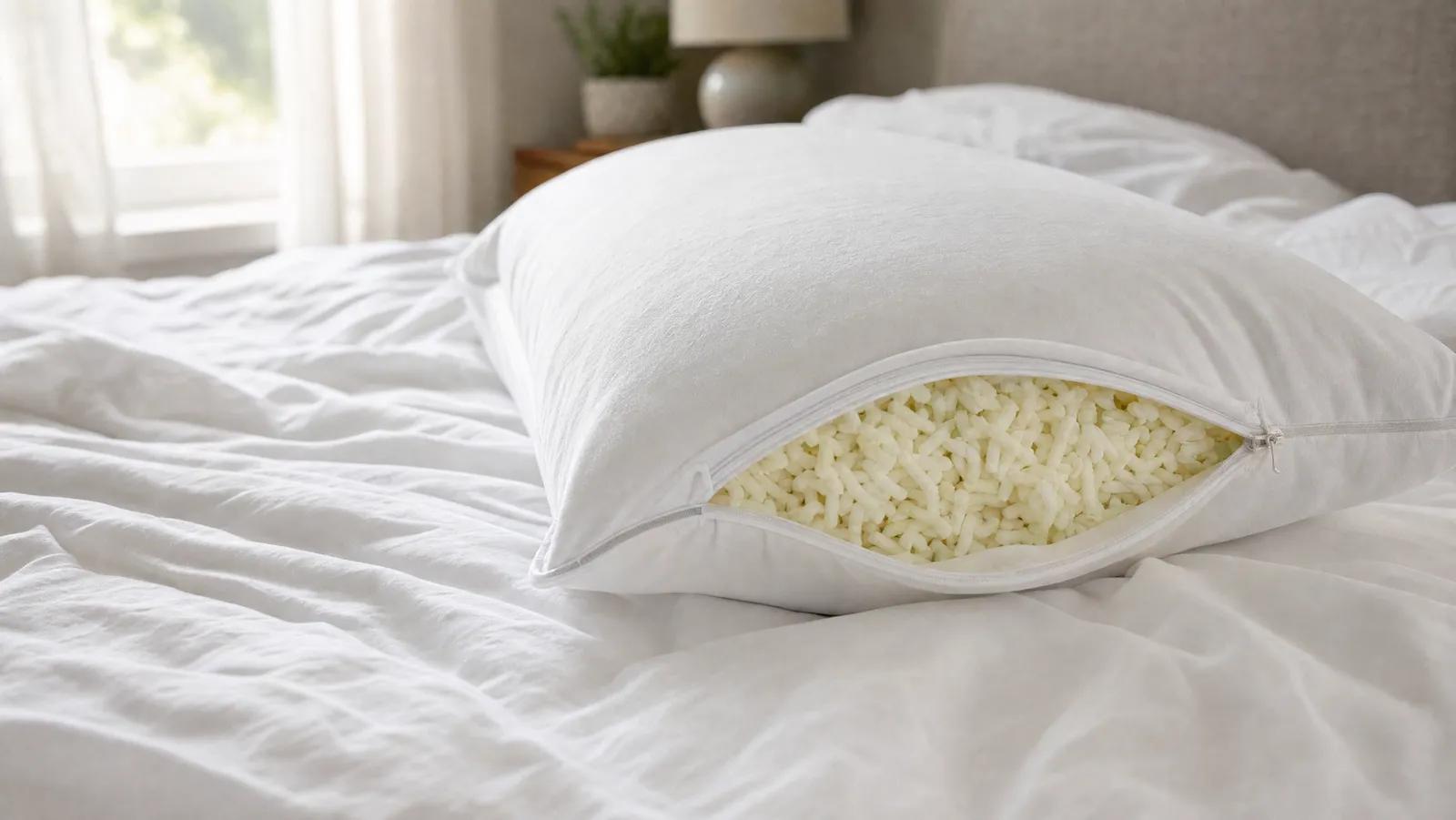
- Adjustable fill, used downwards. The only adjustment that improves alignment and heat together, because every handful you remove is both height and insulating mass gone. QUTOOL's phrasing for its own fill is the whole feature: you can "ADD or REMOVE foam filling to suit your size, shape or sleep position". Set it high enough for your shoulder and not a handful higher.
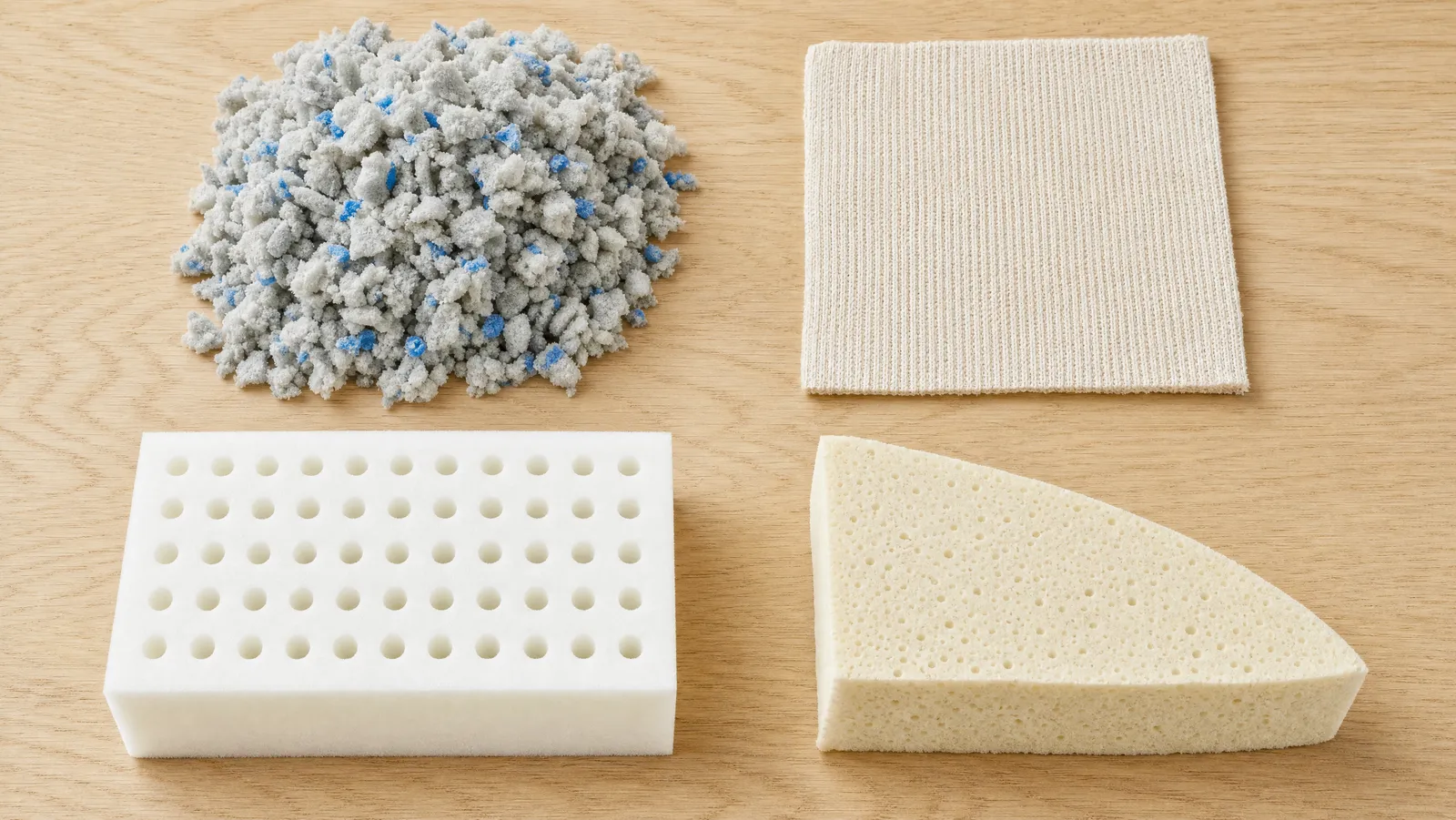
- Shredded or cross-cut cores rather than solid slabs. Gaps between pieces of foam are a pathway for air, and a pathway does not fill up the way a gel surface does. QUTOOL's claim for its own fill is the mechanism in one sentence: "Shredded memory foam allows air to circulate smoothly within the pillow." Nobody quantifies it, though: we have never seen a pillow listing publish an airflow figure, so you buy a visible structure rather than a measurement.
- A launderable wicking cover. Conduction stops once the surface reaches your temperature; evaporation keeps running while the room's air can still take the vapour, which makes the cover you strip and wash weekly worth more over a night than the gel is. A thin wicking case works on the same logic, and the fabrics are in our guide to the most luxurious pillow cases.
- Gussets, with a caveat. A gusseted pillow has a sewn side wall, so the fill is held in a box shape instead of spreading flat under load, which keeps loft without packing in more density. Sensible idea, no measurement: we found no published loft-retention test for gusseted pillows, and none of the picks here is gusseted.
- The room, which beats all four. The Sleep Foundation puts the best bedroom temperature at "approximately 65 degrees Fahrenheit (18.3 degrees Celsius)". QUTOOL recommends using its cooling pillow "along with a cooling blanket or a cooling comforter in an air-conditioned room", and fulocean's listing says its pillow "Pairs well with a fan or air conditioning". When two makers concede the environment does the work, believe them.
None of this makes the gel last longer. Gel versus phase-change cooling decides duration rather than depth, and it is a subject for its own page.
How We Picked
We do not run a sleep lab and will not pretend otherwise. What follows is how we read listings.
- Loft first. A pick has to state a height, be built for the shoulder-to-head gap, or let you set the height yourself. Anything sold only on temperature was out.
- Temp ratings follow construction, not the brand. Three picks are rated neutral. The Coop Original, because Coop claims no cooling for it at all, only a breathable cover. The Cool Gel contour pillow, despite its brand name, because its two thermal features, a gel-infused face and "open-cell memory foam construction" the maker says "allows air to circulate", both sit on a fixed solid core with no fill you can remove. And the fulocean, for the same reason: a gel face on a solid core, nothing removable.
- Certifications read as chemistry, never as temperature. CertiPUR-US and GREENGUARD Gold cover materials and emissions, not heat, and we untangle which covers what in pillow certifications explained.
- No ratings, no review counts. We have no rating data for these listings, so there are no popularity numbers on this page.
Our Picks for Side Sleepers Who Sleep Hot
Five pillows, and the spread between them is the argument rather than a ranking of warmth.
The HOMBYS 7-inch dual-layer at $79.99 as of October 2026 is our pick because it treats loft as the product rather than as a specification. HOMBYS states 26.8 x 16.9 x 7 inches and two separable layers, with the option to "remove one layer", so it is the only pick here with a stated height above the Sleep Foundation's 6-inch mark that can still come down. It is not the cheapest, at four times the per-pillow price of our cheapest pick, and its core is two solid slabs rather than shredded fill, so the mesh face and the layer you leave out do more thermal work than the cooling fabric does.
The QUTOOL shredded pair at $39.99 as of October 2026 is $20.00 a pillow, the cheapest per-pillow figure here, and the construction we would choose on heat alone: CertiPUR-US shredded foam you can add to or take out of, with air gaps between the pieces. If your shoulders are not broad, it is the better buy of the two.
The rest, all prices as of October 2026, mark out the trade-off. The Coop Original at $89.00 is the most expensive single pillow and the best certified, with cross-cut fill and no cooling claim at all. The fulocean at $42.99 is the cheapest single pillow and the mid-height option at a stated 5.5 inches. The Cool Gel contour at $62.50 has the best shape and the least escape: a moulded slab with nothing you can remove.
What the "Cooling Value" Numbers Mean
One of our picks publishes a number, which is rare enough to unpack. HOMBYS describes one face of the 7-inch dual-layer pillow as "premium Cooling Fabric with a 0.42 cooling value for a cool-to-touch feel". Note the grammar before the physics: HOMBYS states a 0.42 cooling value, and names no test method, no laboratory and no units, so that is a manufacturer's figure rather than a measured fact.
What it almost certainly describes is q-max, the textile industry's cool-touch metric, measured by pressing a warmed plate onto the fabric and recording the peak heat flow at the instant of contact. The standard behind it, Japan's JIS L 1927, published in February 2020, is titled "Textiles - Measurement method of cool touch feeling property". Higher is cooler-feeling: North Carolina State University's Textile Protection and Comfort Center explains that "A higher value of qmax denotes that there is more rapid movement of heat from the body to the fabric surface resulting in a cooler feeling fabric", and describes the test as "Simulating initial touch when shopping". Two things follow from that, and both are inconvenient for the listing.
It is a peak, not a duration. Roger Barker, who directs that centre, has put it about as plainly as a textile scientist can: of q-max, "It is best to see it not as an index of steady-state thermal insulation of fabrics." A figure measured in the first second tells you how the pillow feels when your cheek lands, and nothing about hour three.
It depends on contact area, which side sleepers have more of. The same centre notes that "the qmax value largely depends on the contact area between skin and fabric surface". Press your cheek into a high-loft conforming pillow and you increase contact area, which is why the sensation registers strongly at first and why less of your head is left exposed afterwards.
QUTOOL's number deserves the same treatment. Its listing says "the cooling ice-silky side helps lower surface temperature by about 4-9°F", with no test method and no indication of how long the figure holds. We quote it as the maker's claim because that is all it is.
If You Wake With Neck or Shoulder Pain
Clinician first, and we mean that as the lead rather than the small print.
Mayo Clinic lists "Sleeping in awkward positions or with too many or too few pillows" among the causes of neck pain, so pillow height is a reasonable thing to look at. It also notes that "Neck pain caused by muscle tension or strain often goes away on its own within a few days".
Where it stops being a bedding question, Mayo Clinic is specific. It advises calling a health care professional about neck pain that "Worsens in spite of self-care", "Persists after several weeks of self-care", "Radiates down your arms or legs", or "Is accompanied by headache, weakness, numbness or tingling", and emergency care for severe neck pain alongside a traumatic injury such as a car collision or a fall, "Weakness in an arm or leg or trouble walking", or a fever, which it notes may indicate an infection of the membrane covering the spinal cord and brain.
None of those is a pillow problem, and buying a pillow can be a way of not asking the question. If the pain is already there, the position-specific version of this conversation is in pillow for neck pain, side sleeper. One more unglamorous possibility is a collapsed pillow, less supportive and less airy at once, and how often to replace your pillow sets out the intervals.
Frequently Asked Questions
What is the best firm cooling pillow for side sleepers? Firm enough to hold its height all night, which is not the same as hard. The Sleep Foundation's view is that "a medium to medium firm pillow is ideal" for side sleeping, and all five picks here are medium-firm.
Can a cooling pillow for side sleepers be high loft and genuinely cool? It can be high loft and have a cooling mechanism, which is a different promise. The mechanisms that survive a whole night are airflow and evaporation, so a tall shredded pillow with a launderable wicking cover is the closest the category gets. Reaching that height with shredded fill does mean packing more foam in, so there is no setting where support and heat are both optimal.
What about night sweats specifically? A clinician's question before it is a bedding question, and we treat it that way in cooling pillows for night sweats.
The Bottom Line
The best cooling pillow for side sleepers is the one that gets your neck level with your spine and then lets you take material back out. Loft is the specification you cannot compromise on and also the one that makes a pillow warm, so buy the height you need and spend the rest on the parts that help heat without costing support: shredded rather than solid fill, a cover you can wash weekly, and 65 degrees in the room.
Our pick is the HOMBYS 7-inch dual-layer at $79.99 as of October 2026, for the loft and the layer you can lift out rather than the 0.42 figure on its cover. The QUTOOL pair, at $20.00 a pillow as of October 2026, is the cheaper answer and, on construction alone, the cooler-sleeping one for anyone who does not need 7 inches.
Treat every quoted cooling number as a first-contact measurement until a maker names its test. For the whole category compared on temperature rather than support, our guide to the best cooling pillows is the next page.
The shortlist
5 pillows compared — firmness, loft, and temperature side by side. The top pick is highlighted.
| Pillow | Firmness | Loft | Sleeps | Best for | Price |
|---|---|---|---|---|---|
Medium Firm | High | Cooling | Broad shoulders needing 7 inches of loft | $79.99 Check | |
Best Certified FillCoop Home Goods Original Adjustable Pillow (Queen) | Medium Firm | Adjustable | Neutral | Dialling in loft with certified fill | $89 Check |
Medium Firm | Adjustable | Cooling | Two adjustable queen pillows | $39.99 Check | |
Reversible Coverfulocean Cooling Gel Memory Foam Pillow (Standard) | Medium Firm | Medium | Neutral | Switching between a gel side and a foam side | $42.99 Check |
Contoured Solid FoamCool Gel Contour Memory Foam Pillow (Standard) | Medium Firm | Medium | Neutral | Contoured support, with the solid-foam heat trade-off | $62.50 Check |
HOMBYS 7" High Loft Cooling Memory Foam Shoulder Pillow

Seven inches is the first pillow that actually filled the gap under my ear without stacking two, and pulling the firm layer out on hot nights lowered the height and the amount of foam around my face at the same time.
It is two solid slabs rather than shredded fill, so the only real heat escape is the mesh side and whichever layer you leave out, and at $79.99 as of October 2026 it is near the top of this page on price.
This is the only pick on the page that sells loft as its primary feature and still lets you take it away. HOMBYS states dimensions of 26.8 x 16.9 x 7 inches and a "Dual-Layer Design with soft Gel Memory Foam and firmer Supportive Memory Foam", with the option to "remove one layer to create your ideal Soft Pillow or Firm Pillow experience". For a broad-shouldered side sleeper that is the right order of operations: the Sleep Foundation's guidance is that side sleepers usually need a pillow "at least 4 inches thick" and that "If you have broad shoulders, you may need a pillow that is over 6 inches", and a 7-inch pillow with a layer you can lift out starts above that 6-inch mark and comes down from it, though HOMBYS states no height for the single-layer setting. The cooling is secondary and the maker's own: HOMBYS describes one face as "premium Cooling Fabric with a 0.42 cooling value" and the other as "Breathable Mesh Fabric to improve airflow", and names no test method for the figure.
It is not the cheapest here, and that is the honest part. At $79.99 as of October 2026 it costs four times the $20.00 a pillow of the QUTOOL pair, and it wins anyway because loft is the problem a side sleeper cannot solve with a cover. Two trade-offs to go in with your eyes open about. The core is two solid foam layers rather than shredded fill, which is the construction most likely to hold heat, so the mesh face and the layer you can lift out are doing more thermal work than the cooling fabric is. And the adjustment is two steps rather than a dial: you can run it at full height or at one layer, but you cannot tune it by the handful the way you can a shredded pillow.
Coop Home Goods Original Adjustable Pillow (Queen)

The extra fill bag meant I could load it up for my shoulder width instead of hoping an off-the-shelf loft happened to fit, and two certifications on the box is more than anything else I looked at could show.
Coop never claims this one cools, so if you came for a cooling pillow you are buying a breathable cover and nothing more, at the highest price on this page.
Read this card as the adjustable benchmark rather than the cooling one. Coop makes no cooling claim for this pillow anywhere in its feature copy: what it claims is a "Lulltra fabric cover" it calls breathable, a fill it describes as "our proprietary Oomph fill, a perfect blend of cross-cut memory foam and microfiber", an extra bag of that fill in the box, and two certifications, CertiPUR-US and GREENGUARD Gold. We have rated it temp: neutral for exactly that reason, and we are not going to market it as cooling on Coop's behalf. What it is good at is the thing a side sleeper needs most: cross-cut fill you can add to or remove from until the height matches your shoulder, with air gaps between the pieces rather than a sealed slab.
The certifications are worth knowing precisely. CertiPUR-US certifies the foam, stating that certified foams are "made without formaldehyde", "made without ozone depleters" and "made without mercury, lead and other heavy metals", and meet a low-VOC limit for indoor air quality. GREENGUARD Gold is a different thing again: UL Solutions, which runs it, says a certified product "has been tested and evaluated to meet stringent chemical emissions limits", with Gold products emitting "even lower levels" and in particular "a really low level of formaldehyde emissions". Neither is a temperature measurement. At $89.00 as of October 2026 this is the most expensive single pillow on the page, and one maker's note deserves repeating because it will confuse you in winter: "cooler environments may cause the foam to feel firmer, so adjust accordingly."
QUTOOL Shredded Memory Foam Cooling Pillows (Queen, Set of 2)

Twenty dollars a pillow for shredded foam I can add to or take out of, and having a second one to put under my top arm turned out to matter as much as the cooling side did.
The cooling face cannot go in a hot tumble dryer, which is a real nuisance on the one pillow you bought because you sweat, and the maker's own advice is to pair it with an air-conditioned room.
The arithmetic and the construction point the same way here. Two queen pillows at $39.99 as of October 2026, against a $49.99 list price, is $20.00 a pillow, which is the cheapest per-pillow figure on this page by a wide margin, and the fill is the kind our own mechanism piece rates highest for lasting all night: QUTOOL says "Shredded memory foam allows air to circulate smoothly within the pillow", the foam is CertiPUR-US certified, and you can "ADD or REMOVE foam filling to suit your size, shape or sleep position". For a side sleeper that combination, adjustable height plus gaps between the pieces, is the cleanest answer to the loft-against-cooling problem that $20.00 buys.
Two things to hold at arm's length. The cover claim is a maker's number with no test behind it: QUTOOL says "the cooling ice-silky side helps lower surface temperature by about 4-9℉", and names no method, while the other face is 60% polyester and 40% rayon from bamboo. And the same listing tells you where the cooling really comes from, recommending you use the pillow "along with a cooling blanket or a cooling comforter in an air-conditioned room". The care limit matters too, because the cooling face is the fragile part: machine wash cold, and "do not tumble dry with heat, bleach, iron, or dry clean the cover." Allow the stated 1 to 2 days of airing before you judge the smell.
fulocean Cooling Gel Memory Foam Pillow (Standard)

Five and a half inches was the height I actually needed, and being able to flip to the white cover in October instead of buying a second pillow is the part I did not expect to use.
It is still a solid block of high-density foam under a nice cover, so the cool-to-touch feel is a first-contact thing and the maker's own suggestion is to add a fan.
Seven inches is too much pillow for plenty of side sleepers, and this is the mid-height option: fulocean states 24 inches long by 16 wide by 5.5 high, which sits inside the Sleep Foundation's "at least 4 inches" floor without going over the 6-inch mark it reserves for broad shoulders. The foam is described as "high-density adaptive memory foam" holding a "medium-firm feel" and CertiPUR-US certified, and the cooling mechanism is a gel layer the maker says "delivers a refreshing, cool-to-touch feel upon contact".
The feature worth paying for is the cover, which is genuinely two covers: "Pair the gel surface with the blue cover for a stronger cooling effect, or flip to the memory foam side with the white cover for a milder, naturally cool feel", and it comes off for machine washing. That gives you a summer face and a winter face on one pillow, which is a more useful kind of switchable than most of this category offers. The trade-off is the one that runs through this whole page: underneath both covers is high-density foam that conforms around your ear, and the listing quietly agrees about where the heat goes, noting the pillow "Pairs well with a fan or air conditioning to improve airflow". We rate it temp: neutral for that reason, and on the same grounds as the Cool Gel contour: a gel face is a first-contact mechanism, and there is no fill here you can take out. At $42.99 as of October 2026 it is the cheapest single pillow here.
Cool Gel Contour Memory Foam Pillow (Standard)

The contour put my neck where it should be without me having to experiment with handfuls of filling, and the shape has not flattened out the way a shredded pillow does.
It is a solid moulded slab, so there is no fill to remove, no height adjustment and no airflow through the core, and it is the pick I notice getting warm.
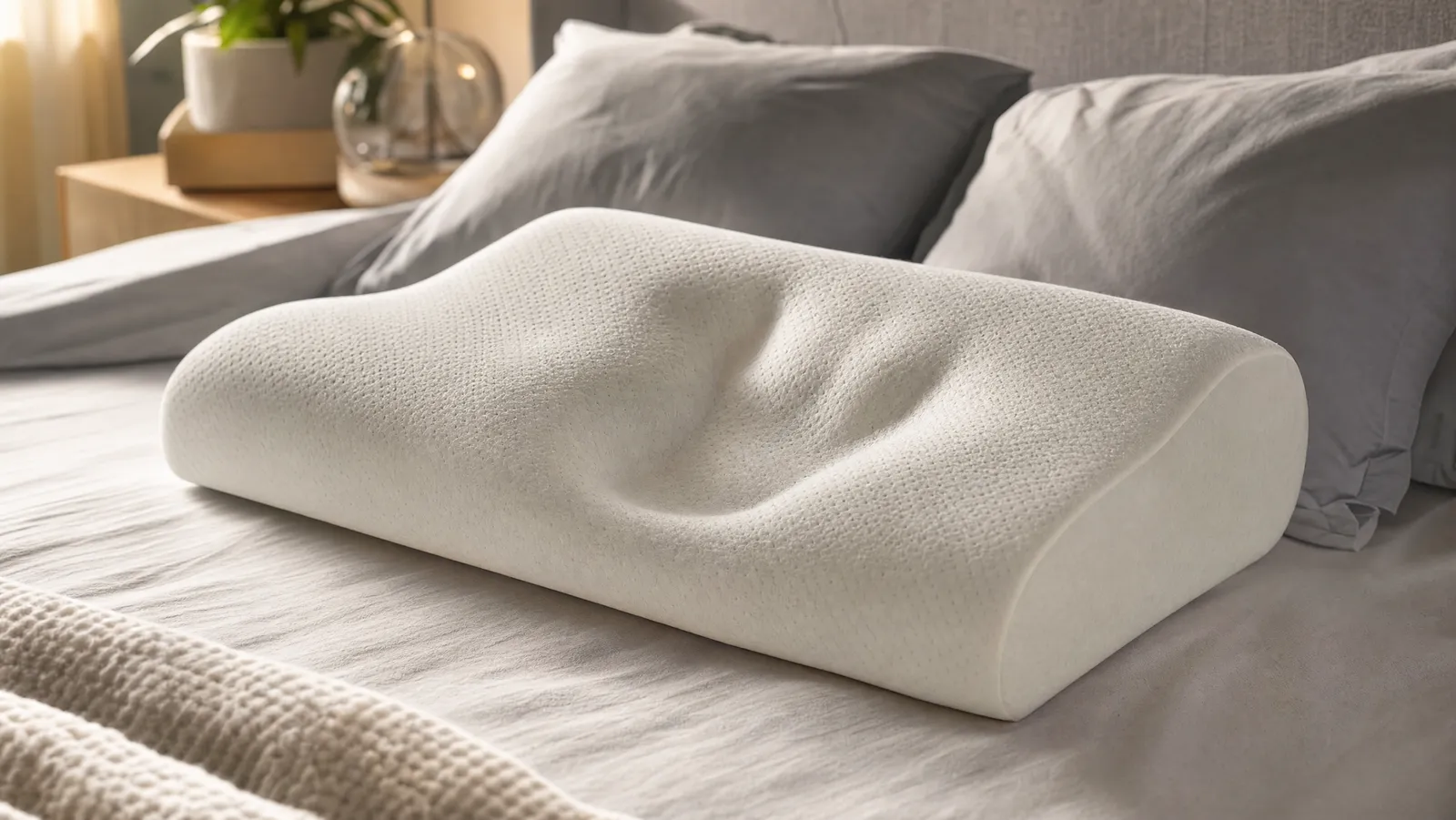
The ergonomics here are the best argument for a contoured pillow on the page, and the construction is the worst case for heat, which is why we have kept it and labelled it carefully. The maker describes "Supportive memory foam" that "helps fill the space between your head and mattress" in "an ergonomic shape ... designed to support a comfortable, naturally aligned sleeping position", with "MEDIUM-FIRM SUPPORT FOR SIDE & BACK SLEEPERS" and a removable washable knit cover. For a side sleeper who wants the shape decided for them rather than a bag of fill to tune, that is a reasonable thing to want.
We rate it temp: neutral despite the brand name, and the reasoning is the point of the card. Its two thermal features are a face you flip to for "a cooler-feeling sleep surface" and "open-cell memory foam construction" the maker says "allows air to circulate through the pillow". Both sit on a fixed solid core, and L&P Property Management's 2022 patent on conductive foam additives states that "As foam compression increases, convective heat transfer decreases and conductive heat transfer increases" and that dense memory foam tends to "sleep hotter" because of reduced open void space. A gel face mitigates that for the first minutes; it does not cancel it, and unlike every other pick here you cannot take any of the foam out. At $62.50 as of October 2026 it is the third most expensive pillow on this page.
Setting Up a High-Loft Pillow for Side Sleeping Without Cooking Your Head: What to Do, in Order
The order matters, because loft is a support decision and heat is a construction decision, and doing them in the wrong order means you end up changing the pillow twice.
Cooling Pillows for Side Sleepers FAQ
What is the best cooling pillow for side sleepers? One with enough loft for your shoulder that you can then make lower. Our pick is the HOMBYS 7-inch dual-layer pillow at $79.99 as of October 2026, because it is the only pick here that states a loft figure built for the shoulder-to-head gap and lets you lift out one of its two foam layers. If your shoulders are narrower, or the price is not on, the QUTOOL shredded pair at $39.99 as of October 2026, which is $20.00 a pillow, is the better construction for heat and the cheapest thing on this page.
How thick should a side sleeper's pillow be? Thicker than a back sleeper's, and beyond that nobody can tell you a number. The Sleep Foundation's practical floor is "at least 4 inches thick", over 6 inches for broad shoulders. The research is more cautious: in Lei and colleagues' 2021 review in Healthcare, "there remain no firm conclusions about the optimal pillow height for the supine and lateral positions", and the suggested range for alignment, pressure and muscle activity "cannot yet be identified considering the lack of sufficient evidence".
Do side sleepers need a firm pillow? Supportive rather than hard. The Sleep Foundation's view is that "a medium to medium firm pillow is ideal" for side sleeping. Firmness matters mostly because a soft high-lofted pillow collapses under the weight of your head by midnight and stops being high-lofted, which is a support problem rather than a temperature one.
Why does my side sleeper pillow get so hot? Because the construction that holds your head up is also an insulator, and your cheek is pressed into it. L&P Property Management's patent for conductive foam additives, granted in December 2022, states that "High density polyurethane foams have a tendency to trap heat and slowly diffuse heat through conduction and convection", and that "high density memory foam has the tendency to 'sleep hotter' than traditional flexible foam" because of reduced open void space.
Is a shredded pillow cooler than a solid one? It has the better mechanism, and nobody has published the size of the difference for pillows. Shredded or cross-cut fill leaves gaps that air can move through, and airflow does not run out the way a gel surface does. We have never seen a pillow listing publish an airflow figure, so you are buying a structure you can see rather than a measurement.
What does "0.42 cooling value" mean on a pillow listing? It is a q-max style figure: the peak heat flow at the instant your skin lands on the fabric. HOMBYS publishes it for its cooling face and names no test method, so read it as the maker's number. The test behind figures like it, Japan's JIS L 1927, is titled "Textiles — Measurement method of cool touch feeling property", and the director of North Carolina State University's Textile Protection and Comfort Center, Roger Barker, has said of q-max that "It is best to see it not as an index of steady-state thermal insulation of fabrics."
Will a cooling pillow fix waking up drenched? No, and that symptom deserves a different conversation. Recurrent night sweats have medical causes that bedding does not touch, which is why we treat them as a clinician's question first in our piece on cooling pillows for night sweats.
Does a cooling pillowcase do the same job for less? For the moisture half of the problem, often yes, because a thin wicking case can go through the wash weekly and a foam core cannot. For the support half it does nothing at all, and support is the side sleeper's first problem.
Why you can trust us

Aimee Cannon
Sleep & bedding writer
Aimee Cannon is a sleep and bedding writer who has spent years testing pillows of every kind — memory foam, down, wool, bamboo, buckwheat, and specialty support pillows. She focuses on matching the right pillow to each sleeping position and need, and reports what actually holds up after months of nightly use. When she is not testing pillows, Aimee is usually with her husband and her dog.