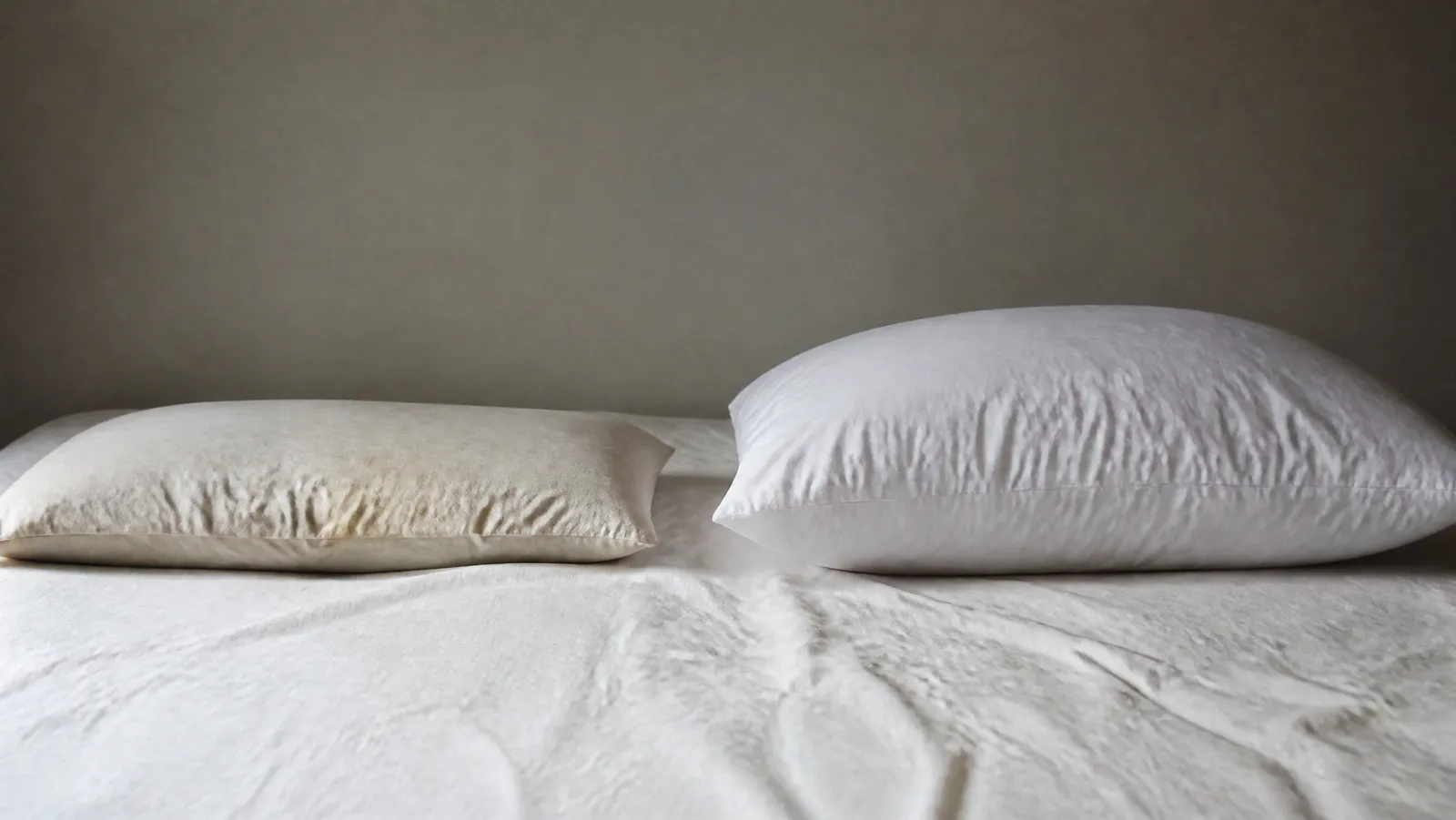
The Best Cooling Pillows for Hot Sleepers (2026 Review)
The best cooling pillow for hot sleepers is the one that pulls heat away from your head fastest and then stops pretending, which in practice means adjustable shredded fill, a breathable cover, and a bedroom in the mid-60s Fahrenheit. Our pick is the DORMANOVA Adjustable Cooling Memory Foam Pillow at $64.80 as of October 2026. We earn a commission from links on this page, at no cost to you.
Now the part the category does not advertise. The physics of sleeping cool is real, measured and genuinely important to falling asleep. The evidence that a pillow delivers it is one small randomised trial of a pillow topper in women on breast cancer treatment, plus a handful of head-cooling studies that used circulating water rather than foam. Hold both of those at once and the shopping gets much easier. Two of the five pillows below are rated neutral on temperature on purpose, and one of those two is sold under a listing title containing the word "Cooling".
What Makes a Pillow Actually Sleep Cool
Start with the body, because the mechanism is the opposite of what the marketing implies. According to Harding, Franks and Wisden's 2019 review "The Temperature Dependence of Sleep" in Frontiers in Neuroscience, "the extent of vasodilation, particularly in the hands and feet (distal-skin), is a good predictor of sleep initiation". You fall asleep by dumping heat from your extremities, which lets your core temperature fall. Your skin gets warmer; your middle gets cooler.
That matters because the same review states that "humans use bedding to form warm microclimates during sleep", and that at comfortable room temperatures "we attempt to establish skin microclimates between 31 and 35°C". It adds that "direct skin warming can shorten sleep-latency and promote NREM sleep", and that "small changes in skin temperature of only 0.4°C (in the 31 to 35 range) can shorten sleep latencies". The authors are blunt about the direction of causation too: body and brain cooling "per se has not been shown to initiate NREM but is instead a consequence of vasodilation".
So a pillow is not trying to refrigerate you. It is trying to avoid becoming the one place on your body that cannot shed heat at all.
How much does the core actually move overnight? Less than bedding copy suggests. The Sleep Foundation says the decline "starts about two hours before you go to sleep", that temperature "continues to fall, reaching a low point in the early morning", and that core temperature "fluctuates by about 2 degrees Fahrenheit" across the night, which is a little over 1°C. Harding and colleagues report a roughly 2°C swing in mice and much smaller brain-temperature steps, "about 0.2 to 0.4°C", at each transition into non-REM sleep. We found no single human measurement behind the confident "1 to 2°C drop" that cooling-bedding copy quotes, so treat that range as approximate.
The lever with the most leverage is the room. The Sleep Foundation reports that "most doctors recommend keeping the thermostat set between 65 to 68 degrees Fahrenheit". A pillow cannot win an argument with a warm bedroom, and if you want a cooler-sleeping material under your head to start with, resilient open-structured latex does better than any foam.
How Cooling Pillows Work
Understanding how cooling pillows work means separating four mechanisms that get sold as one.
- Conduction. A gel, graphite or copper additive moves heat out of the surface faster than plain foam does. This is the mechanism behind most "cooling gel" claims, and it is real but front-loaded: it works hardest while there is a temperature difference to exploit.
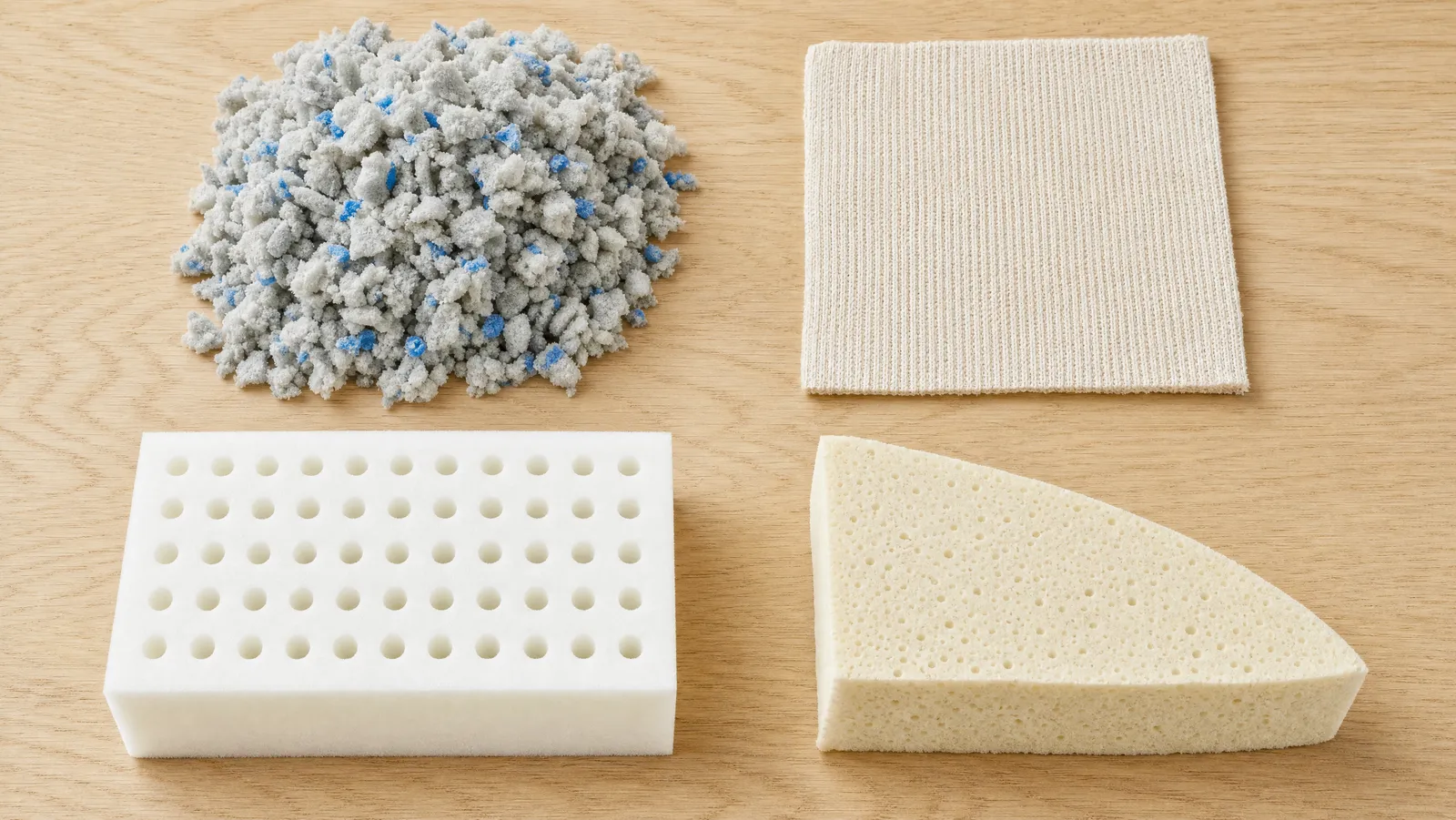
- Convection. Air moving through the pillow. Shredded fill, cross-cut foam, gusseted side walls and an open-weave cover all do this, and it is the only mechanism on the list that keeps working for as long as the pillow holds its structure.
- Evaporation. A cover that wicks moisture off your skin and spreads it so it can evaporate. Luxe Linen describes this accurately in its own copy: its cover "wicks moisture and enhances airflow" and keeps you fresh "without artificial chilling".
- Phase change. A material tuned to melt at around skin temperature, absorbing heat as latent heat while it does. This is the only mechanism that genuinely stores heat rather than passing it along, and it is also the one with a hard stop.
There is a fifth thing that is not a mechanism at all, and it is the one most shoppers actually buy: the cool-to-the-touch feeling of the cover. Textile labs measure it as Qmax. North Carolina State University's textile protection and comfort centre describes the test as indicating "the instantaneous thermal feeling sensed when there is initial contact of the material with the skin surface". Instantaneous is the operative word. It is a sensation at the moment of contact, not a temperature the pillow holds.
Do Cooling Pillows Actually Work?
Here is the whole evidence base, and it is short.
The question of whether cooling pillows actually work has, as far as we can find, exactly one randomised trial behind it, and that trial tested a topper rather than a pillow. Marshall-McKenna and colleagues published "A randomised trial of the cool pad pillow topper versus standard care for sleep disturbance and hot flushes in women on endocrine therapy for breast cancer" in Supportive Care in Cancer in 2016. It was a randomised phase II trial in 74 women, median age 49.5, 93.2% of them on tamoxifen. Sleep efficiency improved in both arms, with the improvement in the topper arm roughly double that in the control arm (p=0.024). Depression scores on the HADS fell further in the topper arm (p=0.036). The reduction in hot flushes was larger with the topper but did not reach conventional significance (p=0.09), and there were no significant differences in anxiety or in FACT-B quality-of-life scores. The authors concluded that the study "supports the use of the CPPT as an aid to reduce sleep disturbance and the frequency/severity of hot flushes".
That is a genuine randomised result and we will not undersell it. We will say what it is not: 74 women in one clinical population, using a pad laid over a pillow, with the hot-flush endpoint missing significance.
Next to it sit the head-cooling studies, which work but not with foam. Hamanishi and colleagues, in PLoS One in 2019, ran a randomised crossover pilot in 14 female university students using a temperature-controllable cooling sheet with circulating water, set to 25°C for cooling and 35°C for the control. They reported that "the proportion of arousal was lower with head cooling than with the control", with more stage 3 non-REM sleep and higher delta power, a tympanic temperature fall of about 0.2°C, and no effect on sleep efficiency. Their conclusion was that "head-cooling during sleep could improve sleep quality in young women during the luteal phase". Circulating water at a held temperature is a different object from a pillow.
And in the material literature, the measurements are about mattresses. In the closest laboratory comparison we found, reported by Priego Quesada and colleagues in Experimental Thermal and Fluid Science in 2017, twenty participants lay for twenty minutes each on a phase-change-material mattress and on a conventional one; the PCM mattress produced a smaller rise in back skin temperature, by 0.3 to 1.0°C (p=0.002), with no difference in reported thermal comfort or perception. A thermal-manikin study of phase-change viscose sleeping bags from the Hong Kong Polytechnic University reported that when ambient temperature shifted by about 10°C, the temperature inside the phase-change bag moved only 0.3 to 0.8°C.
Nobody, as far as we can tell, has run a controlled overnight trial of a retail cooling pillow with sleep outcomes. That is the honest state of play, and it is why this page weights adjustable loft, airflow and certification above temperature marketing.
Gel vs Phase-Change Materials
The practical difference in gel versus phase-change cooling is whether the material moves heat or stores it, and there is published measurement on both sides.
Gel moves it. The laboratory data filed with US patent 8,933,140, "Thermal storage gelatinous triblock copolymer elastomer particles in polyurethane flexible foams", granted to Peterson Chemical Technology in January 2015, tested foams under ASTM E1225 and reported 0.0226 Btu per hour-foot-°F for a non-gel sample against 0.0292 for a gel sample, or 0.0391 against 0.0505 W per metre-kelvin. The filing calls that "a 29.2% improvement in thermal conductivity". Read that sentence carefully, because it is routinely misread: higher conductivity means heat leaves faster, not that the pillow holds a lower temperature. Once your head and the foam have equalised, a better conductor has nothing left to do.
Phase change stores it, and the storage is finite. A Heriot-Watt University paper on thermo-regulating polypropylene fibre notes that most phase change materials used in textiles melt in the range of 28 to 32°C, which is why the effect is tuned to skin rather than to ice, and reported 9.2 J/g of latent heat in a monofilament carrying up to 12% microcapsules.
The sobering number is what survives the move from capsule to cloth. A Marmara University study on denim reported microcapsules storing 111 J/g at a peak temperature of 28.1°C, while the treated fabrics held only 0.7 to 0.8 J/g at peak temperatures of 25.2 to 25.5°C. The capsule is impressive. The fabric loading is where the effect collapses by two orders of magnitude. None of the five pillows below claims a phase-change material, and after reading those figures we are not treating that as a gap.
Why Memory Foam Sleeps Hot
There are three reasons why memory foam pillows sleep hot, and only one of them is about chemistry.
The first is contact area. Viscoelastic foam is sold on the fact that it conforms to your head, and a conforming surface is one that wraps a larger fraction of your skin with an insulator. The second is airflow: a solid foam block has no convection path through it at all. The third is conductivity, and here the patent numbers above are useful in reverse: a plain non-gel foam measured 0.0391 W per metre-kelvin, which is poor conduction by design, because the air trapped in the cells is what makes foam comfortable in the first place.
This is why the fill descriptions here matter more than the covers: shredded and cross-cut foams restore the convection path, solid blocks do not. Our memory foam pillow guide covers feel, support and durability, and Coop's own feature copy supplies the line that sums up foam and temperature: "cooler environments may cause the foam to feel firmer".
How We Picked
Five axes, in the order they changed our ranking.
- Adjustable loft. The single spec with the clearest effect on sleep. Four of the five picks let you add or remove fill.
- What the cover is made of, and what the maker claims for it. Breathable and wicking are claims we can accept at face value. Cooling is a claim we check against the maker's own feature copy, not the listing title.
- Whether there is any cooling mechanism at all. Gel, graphite, copper or phase change count as mechanisms. "Breathable microfiber" is a fabric, and we grade it as one.
- Certification. OEKO-TEX STANDARD 100, CertiPUR-US and GREENGUARD Gold tell you something real about materials, and nothing about temperature. Our guide to pillow certifications covers what each mark covers.
- Price per pillow. Set listings hide it. As of October 2026, the Utopia four-pack works out at $7.87 a pillow, the Luxe Linen pair at $35.00 each, the DORMANOVA at $64.80, the IWS king at $87.30 and the Coop queen at $89.
Two picks are here to keep the page honest rather than to win on temperature. The Coop Original is rated neutral because Coop does not market it as a cooling pillow and we are not going to do it for them. The Utopia four-pack is rated neutral because, although Amazon's listing title calls them "Cooling Pillows", the maker's own feature list claims a "soft and comfortable microfiber cover", "100% virgin polyester fiber" fill and a "breathable microfiber fabric". No gel, no phase change, no cooling-specific technology is described anywhere in it. The word is in the title, not in the product.
One thing we did not do: quote a star rating or a review count. We have no rating data for these listings, so there are no popularity numbers on this page at all.
Cooling Pillows for Side Sleepers
Side sleeping changes the priority order, and not in the direction the category wants.
Shopping for cooling pillows for side sleepers is really shopping for loft, because a side sleeper's head sits further from the mattress than a back sleeper's and an under-lofted pillow drops the neck into a sideways bend all night. That is a support problem, and no amount of surface cooling compensates for it. Get the height right first, then take whatever temperature benefit the fill gives you.
Adjustable fill is therefore worth more to a side sleeper than any cover. All four of the adjustable-fill picks here let you load the pillow up for a wider shoulder, and the gusseted side walls on the Luxe Linen pair are designed to hold that loft rather than let it spread flat. For the actual measurement, our guide to pillow height for neck pain walks through how to work out what you need, and if you are already waking up sore, start at our pillow for neck pain hub instead of here.
One secondary benefit: side sleeping buries less of your head than back sleeping does, leaving more surface exposed to the room. The pillow you can turn over easily is the one that feels coolest at 3am.
Cooling Pillows for Night Sweats and Hot Flashes
Clinician first, and we mean that as the lead rather than the disclaimer.
The National Institute on Aging, in guidance last reviewed in September 2021, states that "when they happen at night, hot flashes are called night sweats", and that "before considering medication, first try making changes to your lifestyle". Its specific advice for symptoms that cost you sleep is this: "If hot flashes keep you up at night, lower the temperature in your bedroom and try drinking small amounts of cold water before bed. Layer your bedding so it can be adjusted as needed and turn on a fan." It also advises avoiding alcohol, spicy foods and caffeine, and talking to a doctor about hormonal and non-hormonal treatment options.
Read that list again and notice what is absent. The NIA's first-line advice is the room, the bedding you can adjust, a fan and cold water. It does not mention a pillow.
So the honest framing for cooling pillows for night sweats is support, not treatment. The one randomised trial in this space, Marshall-McKenna and colleagues' cool pad pillow topper study above, found a sleep-efficiency improvement roughly double the control arm's, in women on endocrine therapy, with the hot-flush endpoint missing significance. If what you want is a surface that handles moisture rather than one that promises chilling, the Luxe Linen bamboo viscose pair at $69.99 as of October 2026 is the pick on this page, and we chose it partly because its own copy declines to overclaim: it keeps you fresh "without artificial chilling".
Night sweats also have causes that have nothing to do with menopause. The Sleep Foundation notes that "body temperature often rises in response to infections" and that "sweating at night is a side effect of many kinds of drugs", and its guidance is that "persistent, severe, or unexplained night sweats" should be evaluated by a doctor, "particularly when accompanied by symptoms like fever, weight loss". That is a reason to see a doctor, not a reason to buy bedding.
Are Cooling Gel Pillows Safe?
The useful version of this question is narrower than it sounds: the gels in these products are bound into or encapsulated within foam, so what you are really asking about is foam.
On that, there are published criteria. CertiPUR-US states that certified foams are "made without formaldehyde", "made without ozone depleters", "made without phthalates regulated by the U.S. Consumer Product Safety Commission" and "made without mercury, lead and other heavy metals", are "screened for relevant chemicals, including flame retardants", and meet a limit of "low VOC (volatile organic compound) emissions for indoor air quality", which the programme sets at under 0.5 parts per million. The OEKO-TEX STANDARD 100 FAQ describes that mark as an independent testing and certification system for textiles and accessory materials with limit values for harmful substances, which began with around a hundred regulated chemicals and now covers several hundred, and which raises its requirements the closer a material sits to the skin. Hohenstein, one of the OEKO-TEX member institutes, is explicit that "STANDARD 100 is not an eco/sustainability claim" and that "sustainability is verified through the OEKO-TEX MADE IN GREEN label" instead, which is a different mark from the one on these pillows.
What neither programme does is say anything whatsoever about temperature. There is no cooling certification. All three of the certified picks here, the IWS king, the Luxe Linen pair and the Coop Original, earn that credit on materials testing alone.
Two more honest notes. We found no safety testing specific to the cooling gels used in bedding foam, so the absence of harm is an absence of evidence rather than a clean bill of health, and the sensible read on whether cooling gel pillows are safe is that a certified foam is a better bet than an uncertified one. And new foam pillows smell. What that smell is, and how long it takes to go, is covered in our guide to pillow off-gassing; the longer version of the materials argument is in are memory foam pillows toxic, and if certification is your main filter, the non-toxic pillow hub is the better starting point than this page.
Cooling Pillowcases and Protectors
A pillowcase is the only part of this system your skin actually touches, which makes it the cheapest intervention available and the most over-claimed.
The question of whether cooling pillowcases work has a real answer and a real caveat. The real answer is that fabrics differ measurably in contact coolness, which labs quantify as Qmax. A Korean study of knitted fabrics ranked cotton highest for Qmax, ahead of acrylic and cotton blends, then cotton and polyester blends, with wool last, and found that Qmax rises as relative humidity rises. The caveat is harder on the marketing: a Textile Institute study on the objective measurement of the "cool feeling" in fabrics found that Qmax values "did not correlate well with subjective assessments when fabrics of different fibres were evaluated", tracking perceived coolness only within one fibre type. A Qmax number compared across materials is not a prediction of what you will feel.
Treat "bamboo" on a case as a question rather than an answer. The US Federal Trade Commission's Textile Rules require chemically processed bamboo pulp to be labelled rayon or viscose made from bamboo, and the agency has enforced that repeatedly: in April 2022 it sought civil penalties of $2.5 million from Kohl's and $3 million from Walmart over rayon products marketed as bamboo, after settlements totalling $1.3 million with Bed Bath and Beyond, Nordstrom, J.C. Penney and Backcountry.com in 2015. Luxe Linen's own cover description says "Rayon derived from Bamboo", which is the compliant wording. The IWS cover is described only as "Bamboo". Linen, cotton percale and wool all have real breathability stories of their own, and none of them needs a technology name.
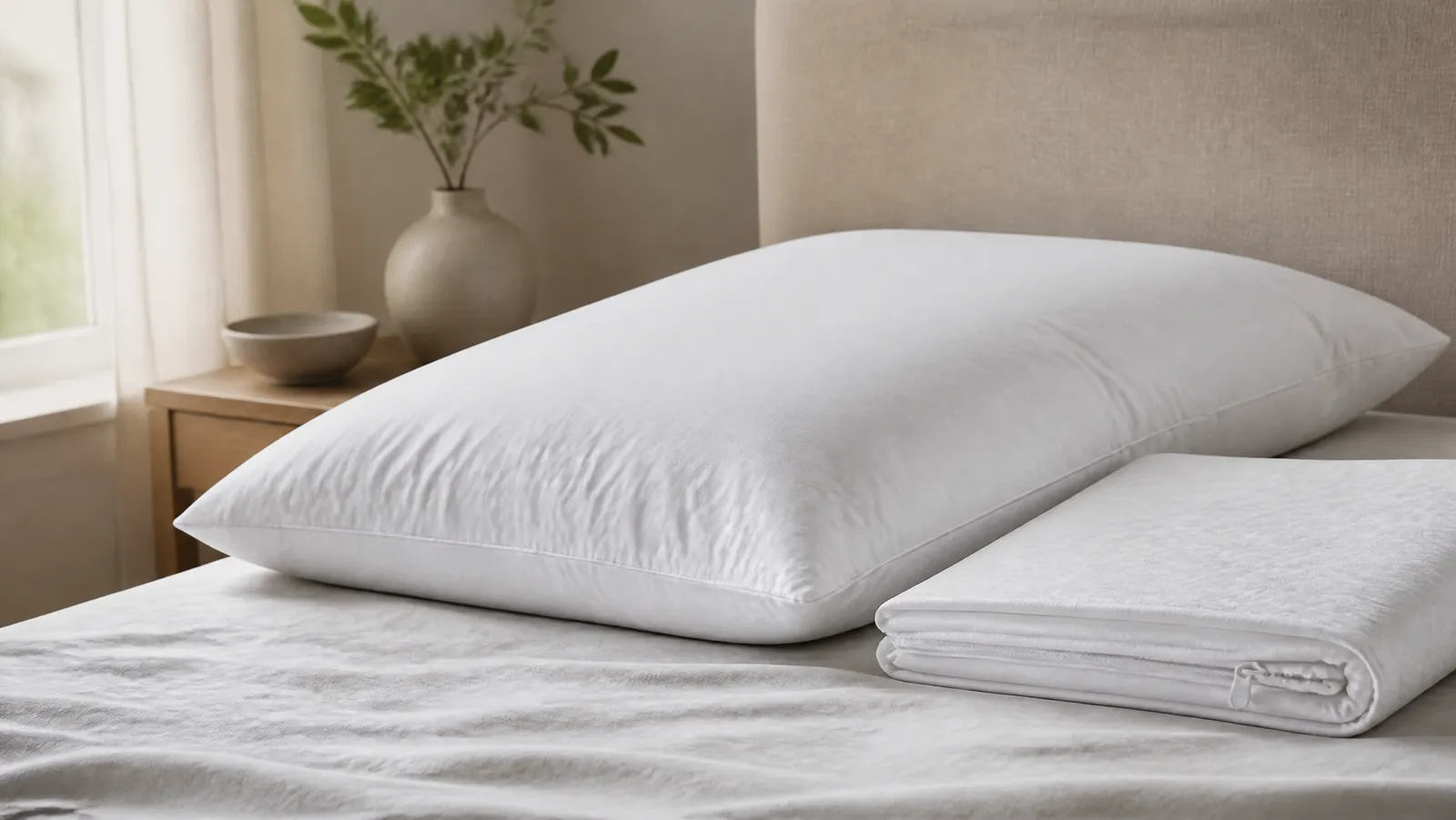
Protectors are a trade-off rather than an upgrade here. A zippered encasement adds a layer between you and the fill, which is exactly what you want for allergens and exactly what blunts the airflow you bought the shredded fill for. What to look for in the fabric is covered in our guide to dust mite pillow protectors, and the full bedroom plan is in the pillow for allergies hub.
Washing and Caring for a Cooling Pillow
The rule is simple: launder the cover, protect the fill.
- Solid foam does not go in the machine. The Sleep Foundation states that "solid memory foam pillows should not be machine washed, as this can cause the foam to crack or degrade", and that "these pillows can be spot cleaned as needed to remove stains or residue".
- Shredded fill is not the same as solid foam, but follow the label anyway. Every adjustable pick here is designed around a removable, washable cover for exactly this reason.
- Dry past the point it feels dry. The Sleep Foundation warns that when tumble drying pillows, "additional time may be needed to dry the interior fill, even if the cover feels dry". A damp core is the start of a different article entirely.
- Check the care line before you buy a set. The Utopia four-pack is spot clean or hand wash only and says not to bleach, which is a real limitation on a pillow you are buying four of.
- Air it rather than making the bed instantly. The cheapest maintenance step for washing a cooling pillow is leaving it uncovered for twenty minutes in the morning so overnight moisture can leave.
Two practical notes: vacuum-sealed pillows need their stated expansion time, 24 to 48 hours in Luxe Linen's case, before the loft is representative, and adding or removing fill is easier over a bedsheet than over a carpet.
Why the Cooling Effect Fades
Every mechanism in a cooling pillow is finite, and the honest answer to why cooling pillows stop working is that three different clocks run out at different speeds.
The contact sensation goes first, in seconds to minutes. Qmax, as North Carolina State's description makes clear, is the "instantaneous thermal feeling sensed when there is initial contact of the material with the skin surface". Conduction goes next, over tens of minutes, because a conductor can only move heat while there is a temperature gradient to move it along. Once your head and the foam have equalised, the 29.2% conductivity improvement measured in that ASTM E1225 test has no gradient left to exploit. Phase change goes last and hardest: once the material has fully melted, it stops absorbing until it has a chance to re-solidify, which is why the measured figures are in joules per gram rather than in degrees held.
Convection is the exception and that is the whole argument for shredded fill. Air keeps moving as long as the structure stays open, which also means the day the fill compacts is the day the cooling goes with it. Foam fatigue and loss of loft are the two failure modes worth watching, and our guide to how often to replace your pillow covers the timelines and the tests.
Meanwhile, the free fix remains the best one. Turning the pillow over hands you a fresh surface at the room's temperature, which is a bigger step change than anything a gel will give you at 3am.
What Actually Keeps You Cool at Night
To spend the next hundred dollars where it does the most work, spend it in this order.
- The thermostat. The Sleep Foundation's "65 to 68 degrees Fahrenheit" range is the most effective single number on this page.
- A fan. It is also the National Institute on Aging's advice for hot flashes that keep you awake, and it drives the convection that every breathable fabric depends on.
- Bedding you can shed. The NIA's wording is to "layer your bedding so it can be adjusted as needed", which beats any single all-season product.
- The sheet and the pillowcase, because they are the surfaces in contact with you.
- The pillow, chosen for loft first and airflow second.
Frequently Asked Questions
Is the best cooling pillow on the market a gel pillow or a bamboo one? Neither, reliably. Gel is a conduction claim and a rayon-from-bamboo cover is a wicking claim; both have measurement behind them, and both lose to the pillow that actually fits your neck.
What is the single best spec for a hot sleeper? Shredded or cross-cut fill with a removable cover. Convection is the one mechanism that works all night, and a washable cover is what keeps it working for years.
Does a top rated cooling pillow have to be expensive? No, but the cheap option is cheap for different reasons. The budget set here is $7.87 a pillow as of October 2026 and we rate it neutral; the premium picks buy adjustable loft and certification, not a lower temperature.
Is a cooling pillow safe for children? Treat certification as the floor, not the temperature claim. CertiPUR-US and OEKO-TEX STANDARD 100 both test for harmful substances, and OEKO-TEX raises its requirements the closer a material gets to skin. Loft and firmness are separate safety questions for a child, and they belong to a paediatrician rather than to us.
Do cooling pillows help with sleep apnoea? There is nothing in the evidence above about apnoea, and nothing on this page is a treatment for it. We found no evidence that cooling a pillow changes apnoea at all. Apnoea is diagnosed and treated clinically, and that is where this question belongs.
Why do two of your picks say neutral when the listings say cooling? Because the maker's own feature copy, not the listing title, is the document we grade. Coop never claims cooling and warns that cooler rooms make its foam feel firmer. Utopia's listing title says "Cooling Pillows" while its feature list claims only a breathable microfiber fabric. Labelling either of them as cooling would make the card contradict this page.
What is the best cooling bed pillow for a king-size bed? The IWS SnowTouch is the only king-width single pillow here, with adjustable cross-cut gel foam and an OEKO-TEX certified cover, at $87.30 as of October 2026 against a $103 list price. The Luxe Linen pair is king-size too.
Explore the full series
- Do Cooling Pillows Actually Work? What the Evidence Says — What the evidence does and does not show, and why the cool feeling fades.
- How Do Cooling Pillows Work? Gel, Phase Change, and Airflow Explained — Gel, phase change, airflow and cover fabrics, one mechanism at a time.
The shortlist
5 pillows compared — firmness, loft, and temperature side by side. The top pick is highlighted.
| Pillow | Firmness | Loft | Sleeps | Best for | Price |
|---|---|---|---|---|---|
Medium | Adjustable | Cooling | Adjustable loft & gel cooling | $64.80 Check | |
Best Breathable CoverIWS I WANNA SLEEP Premium SnowTouch Adjustable Pillow (King) | Medium Soft | Adjustable | Cooling | Adjustable loft with a breathable certified cover | $87.30 Check |
Best for Night SweatsLuxe Linen Bamboo Viscose Gusseted Pillows (King, Set of 2) | Medium Firm | Adjustable | Cooling | Moisture-wicking surface for sweaty sleepers | $69.99 Check |
Best CertifiedCoop Home Goods Original Adjustable Pillow (Queen) | Medium Firm | Adjustable | Neutral | Certified materials & full adjustability | $89 Check |
Best BudgetUtopia Bedding Bed Pillows (Queen, Set of 4) | Medium Soft | Medium | Neutral | Budget multipacks & guest beds | $31.49 Check |
DORMANOVA Adjustable Cooling Memory Foam Pillow

Pulling a couple of handfuls of fill out dropped the loft to where my shoulder stopped aching, and the shredded foam never gets the swampy warmth the solid foam block it replaced used to build up by 3am.
DORMANOVA names no certification and no test of any kind behind the cooling gel, so you are taking the temperature claim on the maker's word alone.
This is the pillow we would buy, and the reason is the fill rather than the word on the box. It is shredded gel-infused memory foam blended with fiber, with a 200g refill bag so you can set the loft yourself, and a removable washable cover, at $64.80 as of October 2026. DORMANOVA's own temperature claim is worth reading precisely: cooling gel particles that help "regulate temperature and reduce heat build-up during sleep". That is a conduction claim, not a refrigeration claim, and shredded fill earns most of it by letting air move through the pillow instead of trapping it.
It suits almost anyone, because the adjustability covers side, back and stomach sleeping and the loft is the variable that decides whether a pillow works at all. The trade-off is honesty about the gel: DORMANOVA names no certification, no phase-change material and no test behind the cooling claim, so the gel is a manufacturer claim and the airflow is the part you can feel.
IWS I WANNA SLEEP Premium SnowTouch Adjustable Pillow (King)

The fill is properly adjustable rather than token, the king size finally covers the width of the bed, and the cover does feel cool for the first minute or two every time I turn it over.
At $87.30 as of October 2026 it is the priciest king-size pillow here, and the cover is listed as "Bamboo" with no indication of whether the fibre is rayon made from bamboo.
A king-size adjustable pillow with cross-cut gel-infused foam that IWS calls TitanPro, a bamboo cover, and OEKO-TEX certification, at $87.30 as of October 2026 against a $103 list price. We renamed this slot from "best cooling cover" because the maker does not actually claim the cover cools: its own words are that the bamboo cover "promotes airflow around the pillow while providing a soft, comfortable sleeping surface". Breathable and certified is a real thing to buy. Cooling is a different claim, and IWS does not make it about the fabric.
Buy it if you want a genuinely king-width pillow, fill you can add and remove, and a cover that has been tested for harmful substances. Two trade-offs: it is the most expensive king-size pillow on this page, and the cover is described only as "Bamboo", without the "rayon made from bamboo" wording the US Federal Trade Commission's Textile Rules require for chemically processed bamboo pulp.
Luxe Linen Bamboo Viscose Gusseted Pillows (King, Set of 2)

Two king pillows at $35.00 each as of October 2026, and the bamboo-viscose face is noticeably drier by morning than the polyester cases it replaced.
It arrived vacuum-sealed and needed the full 24 to 48 hours to expand, and medium-firm is firmer out of the bag than the gusseted look suggests.
Two gusseted king pillows for $69.99 as of October 2026, which is $35.00 each, with adjustable shredded memory foam inside and a three-layer cover whose face is rayon derived from bamboo. Luxe Linen states OEKO-TEX STANDARD 100 and CertiPUR-US certification, and its feature copy is the most honest on this page: the cover "wicks moisture and enhances airflow", and keeps you fresh "without artificial chilling". That is the evaporative mechanism described accurately, and it is the one that keeps working all night rather than for the first few minutes.
It suits the sleeper whose complaint is damp rather than hot, which is a different problem with a different fix. One caution and one trade-off: if you wake soaked most nights, that is a conversation with a clinician before it is a bedding purchase, and a wicking cover does nothing at all without air moving around it. The pillows also arrive vacuum-sealed and need the stated 24 to 48 hours to expand before you can judge the loft.
Coop Home Goods Original Adjustable Pillow (Queen)

Adding and removing the extra Oomph fill got the height right inside a week, and the two certifications were the reason I stopped comparison shopping.
Coop never calls it a cooling pillow and its own copy warns the foam feels firmer in a cooler room, so do not buy this one to solve overheating.
This slot is here to keep the page honest. Coop does not market the Original as a cooling pillow, and we are not going to do it for them. Its Lulltra cover is described as having an "ultra-soft texture and breathable fabric", its fill is cross-cut memory foam blended with microfiber, and its own feature copy notes that "cooler environments may cause the foam to feel firmer", which is the opposite of a cooling promise. What it does have is CertiPUR-US and GREENGUARD Gold certification and a bag of extra fill, at $89 as of October 2026.
Buy it for materials you can check and a loft you can tune, which between them decide more about a night's sleep than surface temperature does. The trade-off is plain: it is the most expensive queen pillow here, cross-cut foam with microfiber will warm under your head like any foam, and no certification on earth certifies cooling. We rate it neutral on temperature and it still earns its place.
Utopia Bedding Bed Pillows (Queen, Set of 4)

At $7.87 a pillow as of October 2026 I put a fresh one in every bedroom and the guest room, which is the only reason anyone buys a four-pack.
They are spot clean or hand wash only rather than machine washable, and nothing in the maker's own description supports the word "cooling" in the listing title.
Four queen pillows for $31.49 as of October 2026 is $7.87 a pillow, and that arithmetic is the entire argument for buying them. The listing title calls them "Cooling Pillows". The maker's own feature copy claims a "soft and comfortable microfiber cover", a fill of "100% virgin polyester fiber", and a "breathable microfiber fabric" for year-round use. There is no gel, no phase-change material and no cooling-specific technology described anywhere in it. The word cooling here is a listing title, not a feature, so we rate it neutral on temperature and say so on the card.
What these are genuinely good for is volume: a guest room, a child's bed, or a stack you can replace without flinching. The trade-off is care, and it is a real one. Utopia's instruction is to spot clean or hand wash and not to bleach, so these are not machine washable, which rules them out for anyone who wants to launder the pillow rather than only its case.
Buying a Cooling Pillow Without Being Sold One
Work through these in order. The first three steps matter more to how warm you sleep than any fabric name on the label, and the last one is the step that stops you paying twice.
Cooling Pillow FAQ
Is there any trial behind cooling pillows? One, and it is not quite a pillow. Marshall-McKenna and colleagues ran a randomised phase II trial of a cool pad pillow topper against standard care in 74 women on endocrine therapy for breast cancer, published in Supportive Care in Cancer in 2016. Sleep efficiency improved in both arms, with roughly double the gain in the topper arm (p=0.024), and depression scores on the HADS fell further in the topper arm (p=0.036). The reduction in hot flushes was larger but did not reach conventional significance (p=0.09), and quality-of-life and anxiety scores did not differ.
Does gel actually do anything? It conducts. In the laboratory data filed with US patent 8,933,140, foams tested under ASTM E1225 measured 0.0391 W/(m·K) for a non-gel sample against 0.0505 W/(m·K) for a gel sample, which the filing describes as "a 29.2% improvement in thermal conductivity". Better conduction means heat leaves your head faster at first. It does not mean the pillow stays cold.
How cold is a phase-change material? Not cold. It is tuned to melt near skin temperature. A Heriot-Watt University paper on thermo-regulating polypropylene fibre notes that most phase change materials used in textiles melt in the range of 28 to 32 °C, and reported 9.2 J/g of latent heat for a monofilament carrying up to 12% microcapsules.
Will a cooling pillow stop my night sweats? Nothing on this page treats night sweats. The National Institute on Aging states that "when they happen at night, hot flashes are called night sweats", and its advice is to "lower the temperature in your bedroom", "layer your bedding so it can be adjusted as needed and turn on a fan". Frequent night sweats are worth raising with a doctor rather than solving by shopping.
Why does my cooling pillow feel warm by 2am? Because every mechanism in it is finite. Conduction stops helping once the pillow and your head reach the same temperature, a phase-change material stops absorbing once it has fully melted, and the cool-touch sensation of a cover is measured at the instant of contact. Turning the pillow over genuinely resets some of it.
Is a cooling pillowcase cheaper than a cooling pillow? Much, and it changes the one surface your skin touches. Just do not expect the Qmax number on the packet to predict the feeling: a Textile Institute study of the "cool feeling" in fabrics found that Qmax values "did not correlate well with subjective assessments when fabrics of different fibres were evaluated".
Does a latex or shredded pillow sleep cooler than solid memory foam? Generally yes, and the reason is airflow rather than material magic. Solid viscoelastic foam contours to your head, which maximises the contact area and minimises the air moving through it. Shredded fill and open latex structures leave channels for convection.
Why you can trust us

Aimee Cannon
Sleep & bedding writer
Aimee Cannon is a sleep and bedding writer who has spent years testing pillows of every kind — memory foam, down, wool, bamboo, buckwheat, and specialty support pillows. She focuses on matching the right pillow to each sleeping position and need, and reports what actually holds up after months of nightly use. When she is not testing pillows, Aimee is usually with her husband and her dog.