Non-Toxic Latex Pillows: What Natural Latex Actually Gets You
Non-toxic latex pillows get you three things you can actually verify: a fill made from one named material, a supply chain that can be certified organic back to the plantation, and a construction that does not depend on the stain- and water-repellent finishes testing keeps finding in bedding. What they do not get you is a guarantee — no certificate on the market issues one. We may earn a commission from links on this page, at no extra cost to you.
The word doing the work in this category is certified, and nearly every page that sells you a latex pillow blurs which part of the pillow got certified. That is the whole game. So we will start there, then the picks, then the two things readers actually search for: Talalay versus Dunlop, and whether latex foam is safe if you react to latex. If you want the wider category first, our guide to non-toxic pillows works through every fill in order.
GOLS vs GOTS: what a natural latex pillow label really certifies
This is the distinction that will save you the most money, and it takes one paragraph each.
GOTS, the Global Organic Textile Standard, certifies textiles. Its labelling rules state that products carrying the "Organic" label grade contain a minimum of 95% certified organic fibres, and certification runs the whole chain — spinning, weaving, dyeing, sewing. On a latex pillow, the textile is the cover. The latex core is not a fibre, and it is not what GOTS is assessing.
GOLS, the Global Organic Latex Standard, certifies the latex. Control Union, the certifier that developed the standard, describes it as addressing natural rubber latex and other agricultural ingredients from certified organic plantations under USDA NOP or EU organic rules, processed in GOLS-certified units, with permissible limits for harmful substances, emission test requirements, and stated polymer and filler percentages. The threshold reported for the standard is a minimum 95% certified organic natural rubber latex by weight of polymer content, a maximum 5% processing chemicals and fillers, and no synthetic or non-organic latex in the finished product.
Put those together and you get the single most useful sentence on this page: "GOTS certified organic cotton cover" is a claim about the fabric, and it tells you nothing about the thing your head rests on. Both marks are worth having. Only one of them is about the latex.
Two other marks turn up on the listings below, and they answer different questions again:
- OEKO-TEX STANDARD 100 is substance testing, not organic certification. OEKO-TEX says every thread, button and accessory is tested against a list of over 1,000 harmful substances. Its Product Class 1 covers "products for babies and children up to 3 years" and, in OEKO-TEX's own words, "has the strictest requirements and limit values". A Class 1 certificate on an adult pillow means it was held to the baby-goods tier.
- GREENGUARD Gold, from UL Solutions, is about emissions rather than content. UL says Gold-certified products limit emissions of more than 360 VOCs plus total chemical emissions and must also comply with the California Department of Public Health Standard Method. It certifies what a product releases into the air, not what it is made of.
None of these is a "non-toxic" certificate, because there is no such thing to be certified against. The Federal Trade Commission's Green Guides address the phrase at 16 CFR 260.10: an unqualified non-toxic claim likely conveys that a product is non-toxic for humans and for the environment alike, and marketers making it should hold competent and reliable scientific evidence for both. That is a rule about substantiating advertising, not a standard a pillow passes — which is why we use "non-toxic" as a category name here and not as a fact about any product. We work through the whole landscape in what pillow certifications actually mean.
"Latex" in the product name does not mean the fill is latex
A product name is marketing copy. The fill statement is where a listing says what is actually inside, and that is where the answer lives — usually as the maker's own disclosure, since US fibre-content labelling rules are written around fabrics rather than foam fills.
The clearest example in this roundup is Coop Home Goods' Adjustable Latex Pillow. Coop states that the fill is cross-cut Talalay latex blended with recycled PET poly fibre — 23 bottles' worth in the king, 18 in the queen — with a cover listed as 35% recycled PET poly fibre, a liner of 100% recycled polyester and a case in a cotton and poly-spandex blend.
None of it is concealed; Coop publishes it. But it sits below a product name most shoppers will read as the fibre content, and the two are not the same thing. This is not a gotcha — it is the reason to read past the name on every pillow you consider, including the ones with the nicest logos.
Coop earns one genuine credit here: GREENGUARD Gold is a real emissions certification with published criteria and a named test method.
How we chose the best non toxic latex pillows
We have not slept on these pillows and we have no lab results for them. What we can do is read listings carefully and sort every claim into three buckets: what a named third party has certified, what the maker says about its own product, and what is neither.
So we will not describe any pillow here as non-toxic, safe or PFAS-free. What is true and checkable is narrower and more useful — what each one is made of, who certified what, and what that certificate leaves out. All five were in stock and priced as listed as of September 2026.
Our picks, and what each is actually certified for
Full details render on each card at the end of this page. The short version:
- The Turmerry Green Natural Bed Pillow, $89.00 as of September 2026, is our pick because the certification is on the core. Turmerry says it is crafted with at least 95% organic certified GOLS latex, under a cover the maker lists as GOTS certified organic cotton. That is both halves, in the right order.
- The Sleep On Latex shredded natural latex pillow, $49.00 as of September 2026, is the cheapest way in and the only all-latex pick whose loft you can lower. Its mark is OEKO-TEX Standard 100 Class 1 rather than GOLS — testing, not organic origin.
- The ORGANIC TEXTILES 100% Talalay pillow, $115.95 as of September 2026, is the solid Talalay core. Here the certification runs the other way: GOTS on the cotton cover, with the maker describing the latex as pure and sustainably harvested rather than GOLS certified.
- The ORGANIC TEXTILES Organic Latex Contour Pillow, also $115.95 as of September 2026, is the cervical shape, and the maker lists GOLS on the core and GOTS on the cover.
- The Coop Home Goods Adjustable Latex Pillow, $159.00 as of September 2026, is the cautionary pick described above — a Talalay-and-polyester blend, GREENGUARD Gold certified.
Talalay vs Dunlop latex pillow: what actually differs
They are not two materials. They are two ways of turning the same liquid — natural rubber latex — into foam, and the difference is in the moulding.
Dunlop is the original process, developed in 1929. Liquid latex is whipped into a froth, poured into a mould in a single step, and baked. Because it goes in all at once, sediment settles slightly during the bake, which leaves a Dunlop slab marginally denser at the bottom than the top. The result is heavier, firmer and more grounded.
Talalay, developed by the Talalay brothers in the late 1940s, adds two steps. Published descriptions of the process say the frothed latex only partly fills the mould, which is then sealed and put under vacuum so the foam expands to fill it; the mould is then flash-frozen to about −20°F (−28°C) to lock that bubble structure in place, before carbon dioxide is passed through to trigger gelling and the mould is heated to roughly 230°F (115°C) to vulcanise. Typical moulding cycles run about an hour.
What that buys is uniformity. Without a settling gradient, the cell structure is more consistent top to bottom, which is why at a comparable firmness rating Talalay reads as lighter and bouncier and Dunlop as denser and more solid. It also costs more to make, which is why it costs more to buy.
For a pillow, the practical difference is feel and price, not safety. Both processes start from the same natural rubber latex; neither is a substance-testing or organic claim, and neither tells you anything about certification. If you want a springier, airier feel and the budget is there, Talalay. If you want firm support for less money, Dunlop. Anyone selling you one as the "clean" option and the other as the compromised one is selling you a manufacturing preference as a health claim.
Is latex foam safe? The natural rubber latex allergy question
This is the one genuine safety caveat in a category otherwise sold on safety, and it deserves to be stated plainly rather than buried or dramatised.
Natural rubber latex allergy is a real, well-documented allergy — a reaction to proteins in natural rubber latex, not to rubber as an abstraction. It is also uncommon: the Cleveland Clinic states that fewer than 1 in 100 people are allergic to latex, and lists the higher-risk groups as people with occupational latex exposure such as healthcare and dental workers, people who have had frequent surgical procedures, and people with certain food allergies.
The classic exposure route is dipped products. Mayo Clinic says the most common cause of latex allergy involves touching latex-containing products including gloves, condoms and balloons — all made by dipping — and the literature on latex allergy describes skin contact in the presence of moisture as the usual route for extractable latex proteins from those products. Powdered gloves added an inhalation route on top of that, because latex proteins adsorbed onto the cornstarch powder can become airborne. The US Food and Drug Administration banned powdered surgeon's gloves and powdered patient examination gloves in a final rule effective 18 January 2017, citing sensitisation to natural rubber latex allergens among the risks.
Foam is a different product with a different history, but the evidence is not zero. The most directly relevant study we found is Chardin and colleagues in the International Archives of Allergy and Immunology in 1999, which analysed five latex foam mattresses. No protein or allergen could be extracted from synthetic foam. Variable quantities could be extracted from the mattresses containing natural latex, the allergen patterns were qualitatively similar across them, and the allergen Hev b 1 was identified. The authors concluded that because the natural rubber of the mattresses contains latex allergens, those allergens are a potential source of sensitisation and could constitute a risk, at least to allergic individuals.
Read the method as carefully as the conclusion. The mattresses were converted to powder and the proteins extracted with water or urea, which is not what happens when a covered pillow is under a head. That study establishes that allergens are present in finished natural latex foam. It does not measure the dose a sleeper receives, and we have not found a study that does — not for mattresses and not for pillows.
So the honest position is narrow. If you have a diagnosed natural rubber latex allergy, talk to your clinician before buying a latex pillow; that is a conversation with someone who knows your history, not a decision to make from a product page. Nobody should self-diagnose a latex allergy from a listing either. And if you develop hives, itching, a runny nose, watery eyes or wheezing that you associate with new bedding — symptoms Mayo Clinic lists among those of latex allergy, and also of a dozen other things — stop using it and see a clinician.
Latex smell is a different question from foam off-gassing
New latex has a faint rubbery smell of its own — Turmerry, for one, describes its pillow as odorless.
What we will not do is fold that into the memory foam off-gassing conversation, because the chemistry is different and so is the evidence base. We have not found published emissions measurements for latex pillows specifically, so we are not going to give you a number of days. If it is polyurethane foam you are worried about, we covered what the measurements actually show in how long pillow off-gassing lasts. One thing worth noting: GOLS includes emission test requirements, which is one more thing a certified core carries that an uncertified one does not.
Loft, shape and why a solid core cannot be adjusted
This is the most practical fork in the category, and it has nothing to do with certification.
A solid moulded core — the Talalay pillow and the contour here — arrives at one height and stays there. You cannot remove fill or fluff it flatter. That is the same property that makes it hold its loft for years, so it is a feature and a limitation at once. Order the loft carefully.
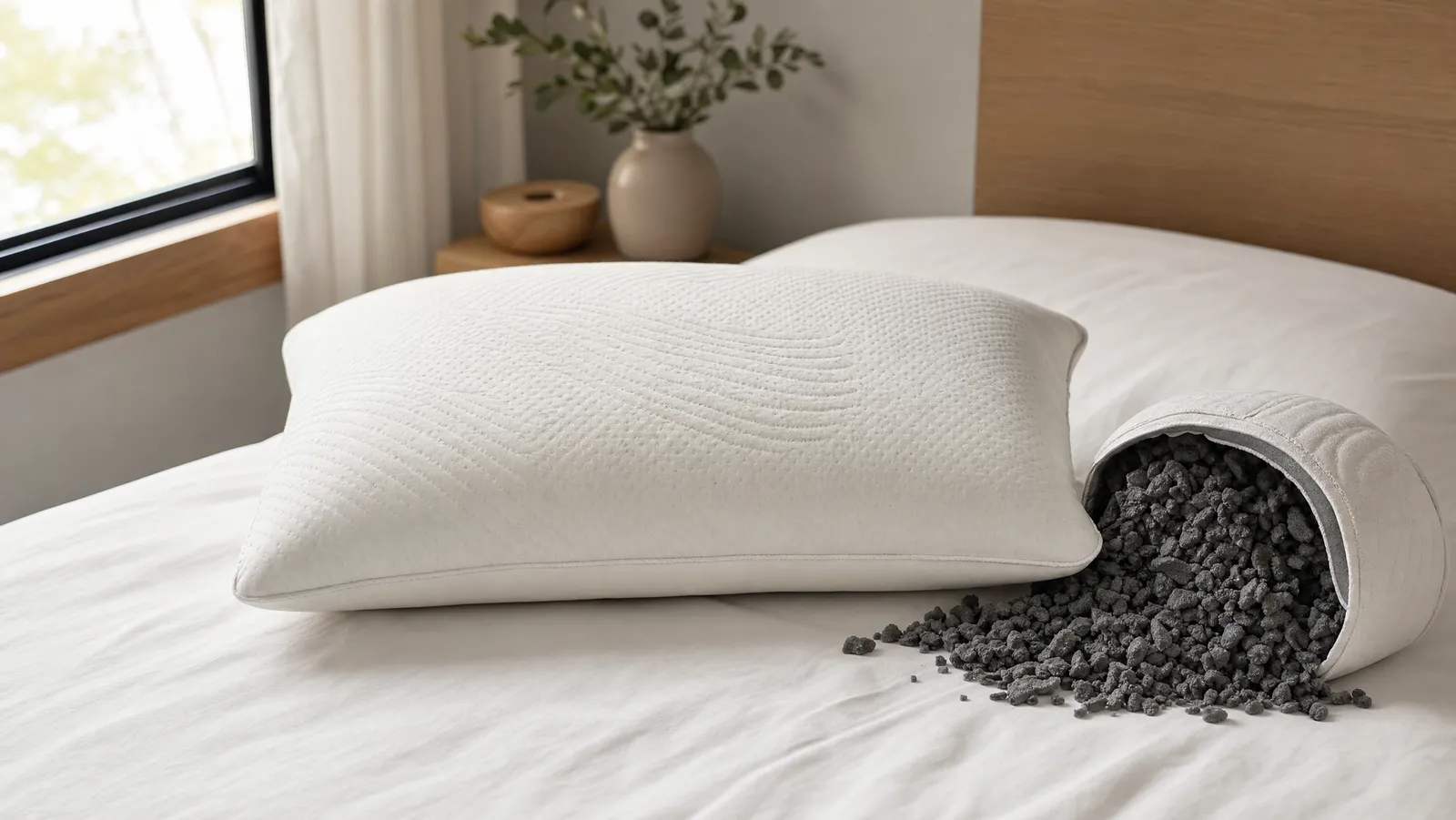
Shredded fill — the Sleep On Latex pillow — is the opposite trade. Open the cover, take out a handful, sleep on it, repeat until it is right. The cost is that shredded latex packs down and needs periodic fluffing, where a moulded core does not. Coop's blended pillow makes the same trade and goes one better by shipping a spare bag of fill so you can add as well as subtract.
Loft is also the specification most likely to decide whether a pillow works for you at all, and it depends on your sleeping position more than your preference: broad-shouldered side sleepers generally need the most height, and tend to do worst with a pillow that is too low. We go through that in detail in our guide to non-toxic pillows for side sleepers.
Weight, washing and how long a latex pillow lasts
Three things nobody mentions until the pillow arrives.
It is heavy. A moulded latex core is dense, and it is markedly heavier than a fibre pillow of the same dimensions. That is not a defect — it is the same density that makes it hold its shape — but it does change how the pillow behaves: it does not travel well and it does not get thrown about.
The core never goes in a machine. ORGANIC TEXTILES states this outright for its Talalay pillow, and it is the general rule for moulded latex. The cover does all the cleaning work, which is why a removable, machine-washable cover is worth more here than on any other kind of pillow. Sleep On Latex, Coop and the ORGANIC TEXTILES Talalay pillow all state theirs is machine washable; the Turmerry and contour listings do not say either way, so check first.
It lasts, which is the honest reason it costs what it does. The Sleep Foundation suggests replacing a latex pillow every 2 to 4 years, against 2 to 3 years for memory foam, 1 to 3 years for down and 6 months to 2 years for polyester, with a general recommendation of every 1 to 2 years for pillows overall. On that arithmetic, the Turmerry and a succession of cheap polyester pillows are closer on cost per year than the sticker prices suggest — though a cotton or kapok pillow is cheaper up front either way, and we compare that route in the best organic cotton pillows.
Who should buy which
- If you want the certification on the latex, not just the cotton: the Turmerry, at $89.00 as of September 2026. GOLS on the core, GOTS on the cover.
- If you are trying latex for the first time, or you are not sure about loft: the Sleep On Latex shredded pillow, $49.00 as of September 2026. Half the price, and the only all-latex pick you can make lower.
- If you want the springier Talalay feel and a pillow that keeps its shape: the ORGANIC TEXTILES Talalay pillow — accepting that GOTS here covers the cover.
- If you sleep better with cervical shaping: the ORGANIC TEXTILES contour, GOLS on the core, with a shape that is either exactly right for you or exactly wrong.
- If adjustability and GREENGUARD Gold matter more than a pure fill: the Coop, as long as you have read the fill statement and are content with a latex-and-polyester blend.
The bottom line
Natural latex gets you a fill you can name, a process you can look up, and — if you buy the right listing — a certificate that covers the core rather than the cotton. That is a genuinely short materials list, and it is the reason this fill keeps coming out well in our non-toxic coverage.
It does not get you a guarantee, and it comes with one real caveat that most pages in this category skip: natural rubber latex allergy is uncommon but documented, and it is a question for a clinician rather than a checkout page. Everything else here is a preference. Talalay or Dunlop is feel and budget. Moulded or shredded is whether you want to adjust the loft. Certified or uncertified is how much of the claim you want a third party standing behind.
If you are working through the wider category rather than latex specifically, start with Home Pillow Review's non-toxic pillow guide and come back here when you have narrowed it to a fill. And if you are shopping this way because you feel unwell and suspect your bedroom, please take that to a clinician first. Some people simply prefer a bedroom made of materials they can name, and that is a perfectly reasonable thing to want on its own.
The shortlist
5 pillows compared — firmness, loft, and temperature side by side. The top pick is highlighted.
| Pillow | Firmness | Loft | Sleeps | Best for | Price |
|---|---|---|---|---|---|
Medium | High | Cooling | A GOLS-certified organic latex core, not just an organic cover | $89 Check | |
Medium Soft | Adjustable | Cooling | Natural latex on a budget with adjustable loft | $49 Check | |
Medium | Medium | Cooling | A solid Talalay core with a GOTS organic cover | $115.95 Check | |
Soft | High | Cooling | Cervical contour shaping in certified organic latex | $115.95 Check | |
Read the LabelCoop Home Goods Adjustable Latex Pillow (King) | Medium Firm | Adjustable | Cooling | Adjustability and GREENGUARD Gold, if a latex blend is acceptable | $159 Check |
Turmerry Green Natural Bed Pillow, GOLS Certified Organic Latex (Standard, High Loft, Medium)
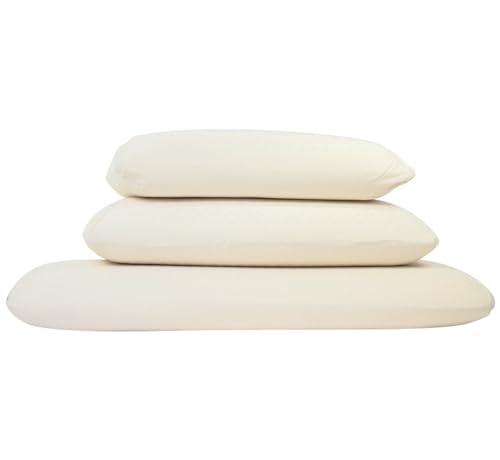
Dense and springy rather than squashy, it has held the same loft since the day it arrived, and there was nothing to air out — no smell at all out of the box.
It is firmer and considerably heavier than the fibre pillow it replaced, and the standard 15 x 22 is noticeably smaller than my queen pillowcases.
This is the only pick here whose certification sits on the part of the pillow you actually sleep on. Turmerry says the core is crafted with at least 95% organic certified GOLS latex — GOLS being the standard written for latex itself rather than for fabric — and separately lists the zippered cover as GOTS certified organic cotton. Most listings in this category give you the second claim and let you assume the first.
The maker also describes the pillow as odorless, free of synthetic fillers and OEKO-TEX certified, and the construction as zoned: a softer centre with firmer edges. The standard size is 15 x 22 inches, with the High Loft measuring 5 inches (12.7 cm) and the Mid Loft 4.25 inches (10.7 cm). At $89.00 as of September 2026 it sits in the middle of this group on price and at the top of it on what has been certified.
Sleep On Latex Natural Latex Shredded Foam Pillow (Standard)

Half the price of the moulded latex pillows I looked at, and I could pull fill out by the handful until the height was exactly right.
Shredded latex packs down more than a solid core does, so it wants a shake and a fluff every week or so to stay where you set it.
The cheapest route into natural latex here, and the most forgiving one. The fill is shredded rather than moulded, which means loft is something you set rather than something you accept: open the cover, take out a handful, sleep on it, repeat. Sleep On Latex says the foam is Fair Trade natural latex from Sri Lanka under a machine washable organic cotton cover.
The certification here is OEKO-TEX Standard 100 Class 1 rather than GOLS, which is a different kind of claim — tested substance limits, not organic origin. It is worth knowing that Class 1 is OEKO-TEX's strictest tier, the one written for products for babies and children up to three years old. At $49.00 as of September 2026 this is roughly half the price of the moulded picks.
ORGANIC TEXTILES 100% Talalay Latex Bed Pillow with GOTS Certified Organic Cotton Cover (Queen, Medium)

Years on it is the same shape it came in, and the ventilation holes are not just marketing — it never gets that warm patch under my ear.
A solid core is take it or leave it on height, and the core itself cannot go anywhere near a washing machine, so the cover does all the work.
Talalay is the more involved of the two latex processes — a vacuum and a flash-freeze step added to the older Dunlop method — and it produces a lighter, more uniformly celled and more expensive foam. ORGANIC TEXTILES says this queen-size pillow is made from pure, sustainably harvested Talalay latex with a pin-hole ventilated core for airflow and shape retention, under a removable GOTS certified organic cotton cover.
Note which way round the certification runs: GOTS covers the cotton, and the maker's language for the latex is "pure, sustainably harvested" rather than GOLS certified. Two practical points. The cover is machine washable and ORGANIC TEXTILES states plainly that the latex core must not be. And a solid moulded core cannot be made lower — the loft you order is the loft you keep. It is hand-finished in Orange County, California, and costs $115.95 as of September 2026.
ORGANIC TEXTILES Organic Latex GOLS Certified Contour Bed Pillow (High-Loft, Soft)

It gives the neck the same ridge a memory foam contour does, without the slow sink and without the first-week smell.
A contour shape is prescriptive by design — if you move around a lot at night you spend part of it hunting for the groove again.
The option for readers who want cervical shaping without going to memory foam. ORGANIC TEXTILES lists the core as GOLS certified organic, sustainably harvested latex and the cover as GOTS certified organic cotton — so both halves of the pillow carry a mark, which is less common than the marketing in this category suggests. The maker also says the core is ventilated with pin holes for airflow.
It is a high-loft, soft-feel pillow that the maker positions for side and back sleepers. Buy it knowing that the shape is the product: a contour profile decides where your neck goes, which is the whole point for some people and the whole problem for others. $115.95 as of September 2026, the same price as the flat Talalay pillow above.
Coop Home Goods Adjustable Latex Pillow (King)
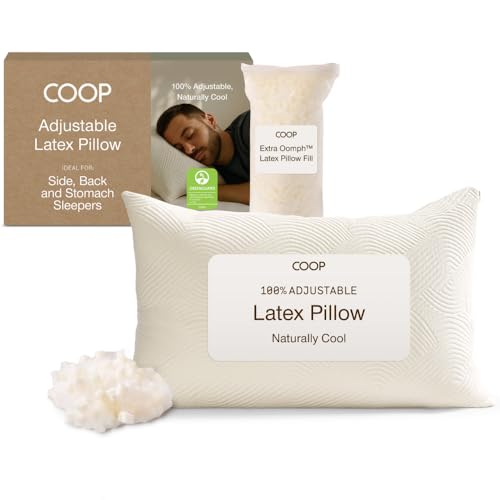
Genuinely adjustable: the spare bag of fill let me dial the height in over about a week, and it runs cooler than the memory foam pillow it replaced.
The name says latex and the fill is latex mixed with recycled polyester, and it costs more than the pillows here that are all latex.
We have included this one to make a point about product names. It is sold as the Adjustable Latex Pillow, and Coop states that the fill is cross-cut Talalay latex blended with recycled PET poly fibre — 23 bottles' worth in the king, 18 in the queen. Coop also lists the cover as 35% recycled PET poly fibre, the liner as 100% recycled polyester and the case as a cotton and poly-spandex blend. That is a latex blend, and none of it is hidden; you simply have to read past the name to find it.
Credit where it is due. Coop says the pillow is GREENGUARD Gold certified, which is a genuine emissions programme rather than a slogan, and it ships with an extra bag of fill so loft and firmness can be tuned. Case and liner are both zippered, the case is machine washable, and Coop describes it as more breathable than memory foam. At $159.00 as of September 2026 it is the most expensive pick here — and the one with the least latex in it.
How to Check What a Latex Pillow Listing Has Actually Certified
Every pillow in this category is sold on the same three or four logos. Five minutes of reading tells you which part of the pillow each logo is attached to — which is the only thing that matters.
Natural Latex Pillow FAQ
What is the difference between GOLS and GOTS? GOTS, the Global Organic Textile Standard, certifies textiles — on a pillow, that is almost always the cover. Its "Organic" label grade requires a minimum of 95% certified organic fibres. GOLS, the Global Organic Latex Standard, was developed by Control Union to cover natural rubber latex from certified organic plantations, and it is the one that applies to the core.
Is latex foam safe? For most people it is an ordinary bedding material, and natural rubber latex allergy is uncommon — the Cleveland Clinic puts it at fewer than 1 in 100 people. But it is a real allergy. If you have a diagnosed natural rubber latex allergy, ask your clinician before buying a latex pillow rather than deciding from a product page.
Talalay or Dunlop for a pillow? They are two manufacturing processes for the same material, not two materials. Talalay adds a vacuum and a flash-freeze step and produces a lighter, more uniformly celled and more expensive foam; Dunlop is the older, simpler, denser process. For a pillow the practical difference is feel and price.
Does a latex pillow smell? Natural latex has a faint rubbery smell of its own, which is a different question from the VOC off-gassing of polyurethane foam. We have not found published emissions measurements for latex pillows specifically, so we will not put a number of days on it.
Can you wash a latex pillow? The cover, yes, if the maker says so. The core, no — ORGANIC TEXTILES states plainly that the latex core must not be machine washed, and that is the general rule for moulded latex.
How long does a latex pillow last? The Sleep Foundation suggests replacing a latex pillow every 2 to 4 years, against a general recommendation of every 1 to 2 years for pillows overall and 6 months to 2 years for polyester. Durability is the honest reason latex costs what it does.
I think my bedding is causing a reaction. What should I do? Stop using it and see a clinician. Hives, itching, a runny nose, watery eyes and wheezing are among the symptoms Mayo Clinic lists for latex allergy, but they are also symptoms of many other things, and neither we nor a listing can examine you.
Why you can trust us

Aimee Cannon
Sleep & bedding writer
Aimee Cannon is a sleep and bedding writer who has spent years testing pillows of every kind — memory foam, down, wool, bamboo, buckwheat, and specialty support pillows. She focuses on matching the right pillow to each sleeping position and need, and reports what actually holds up after months of nightly use. When she is not testing pillows, Aimee is usually with her husband and her dog.