The Best Organic Cotton Pillows (2026 Review)
The best organic cotton pillow for most people is the LOFE Organic Pillow at $39.95 as of September 2026 — but read the fill statement before you buy anything in this category. "Organic cotton pillow" almost always describes the shell and the case, not the stuffing inside them. LOFE's stuffing is polyester pearl fibre, and LOFE says so on its own listing. We may earn a commission from links on this page, at no extra cost to you.
That is not a gotcha. It is the buying frame, and once you have it the category stops being confusing. A pillow is two materials with two separate stories: a shell that can be certified organic cotton, and a fill that might be polyester, kapok, or — rarely, expensively — more cotton. Almost every price difference on this page traces back to which of those three you are buying. If you arrived from the broader chemical-safety question rather than the fibre one, our guide to the best non toxic pillows works through materials and certifications in order.
What an organic cotton pillow actually is
Three constructions get sold under one phrase, and they are not close substitutes.
- Organic cotton shell, synthetic fill. The cheapest build, and in our reading the most common. The certified fibre is the part you can see and wash; the loft comes from polyester. Our top pick is this, openly.
- Organic cotton shell, plant fill. Usually kapok, sometimes wool or buckwheat. Two nameable materials, no synthetics doing the structural work, and — for most readers — the sensible place to land.
- Organic cotton shell, cotton fill. The literal reading of the phrase, and the rarest. Cotton makes a dense, low, firm pillow, and it costs the most per inch of pillow you get.
None of that makes the first build dishonest. A certified organic cotton case is a real thing to buy: it is the layer touching your face all night, it is the layer that gets washed, and it is the component a certificate most often covers. It just is not the same product as a pillow that is organic cotton all the way through, and the listings rarely draw the line for you.
The practical version: decide which of the three you want before you compare prices, because you cannot compare a $39.95 shell-only pillow against a $74.95 all-cotton one on any axis that means anything.
What GOTS certifies — and what it does not
GOTS, the Global Organic Textile Standard, is the mark you will see most often here, and its scope is narrower and more specific than the shorthand suggests.
What it covers, per GOTS itself: organic fibre content and processing. The "organic" label grade requires at least 95% certified organic fibres and the "made with organic materials" grade at least 70%. GOTS requires certification of all processing stages, from certified organic fibre processing through to the finished product, so spinning, weaving, dyeing and sewing all sit inside the audit rather than just the farm. Along the way it restricts chemical inputs to an approved list, mandates functional wastewater treatment for wet-processing units, and applies social criteria aligned with ILO conventions.
What it does not cover is just as important. GOTS is not a finished-product emissions test. It tells you how a fibre was grown and how the textile was processed. It does not tell you what comes off the pillow in your bedroom, and on a pillow it typically describes a textile — the cover, the case, the fabric a mill sold the brand — rather than the fill inside it.
That is why the second mark exists. OEKO-TEX STANDARD 100 tests a finished item, including every thread, button and accessory, against a list of more than 1,000 substances — and OEKO-TEX states that all types of textiles from yarns to finished products may carry the label, which means it says nothing at all about whether a fibre is organic. The two answer different questions and neither substitutes for the other. We take the whole landscape apart in our explainer on what pillow certifications actually mean.
One more point worth knowing, because it comes up in this tower constantly: GOTS does address fluorinated chemistry, but as an input rule. The change log for GOTS Version 7.0 lists all PFAS compounds among prohibited chemical inputs and sets residue limits of under 0.025 mg/kg for PFOS and PFAS C9–C14. That is a restriction on what a mill may use, not a certificate that a specific finished pillow has been tested and found free of anything. We would not describe any product on this page as PFAS-free, and neither would the standards bodies — our piece on whether pillows contain PFAS explains why the finish matters more than the fibre.
How we picked the best organic cotton pillows
We ranked on things a buyer can verify from a listing, because that is what is actually available to us.
- A legible fill statement. Every pick names what is inside it. Where the product name oversells the fill — and our top pick's does — we say so in the first line rather than the fine print.
- Certification with a stated scope. Two picks name GOTS and one names OEKO-TEX Standard 100, all on the maker's say-so. Two — both kapok pillows — name no third-party certification at all, and we flag both.
- Size stated plainly. Per the Sleep Foundation a US standard pillow is 20 x 26 inches and a queen is 20 x 30. Our top pick is a standard, the ORGANIC TEXTILES pick is travel size, and only the Bean Products pillow is a queen.
- Live pricing. Prices were pulled from the Amazon Creators API on 4 September 2026 and are stated "as of September 2026."
Two things we cannot give you. No star ratings or review counts — the Creators API does not return them, so nothing here is ranked by crowd sentiment. And we have not physically tested these pillows. We recommend on materials, stated specifications and third-party certifications, and we attribute every maker claim to the maker.
Our pick: LOFE Organic Pillow
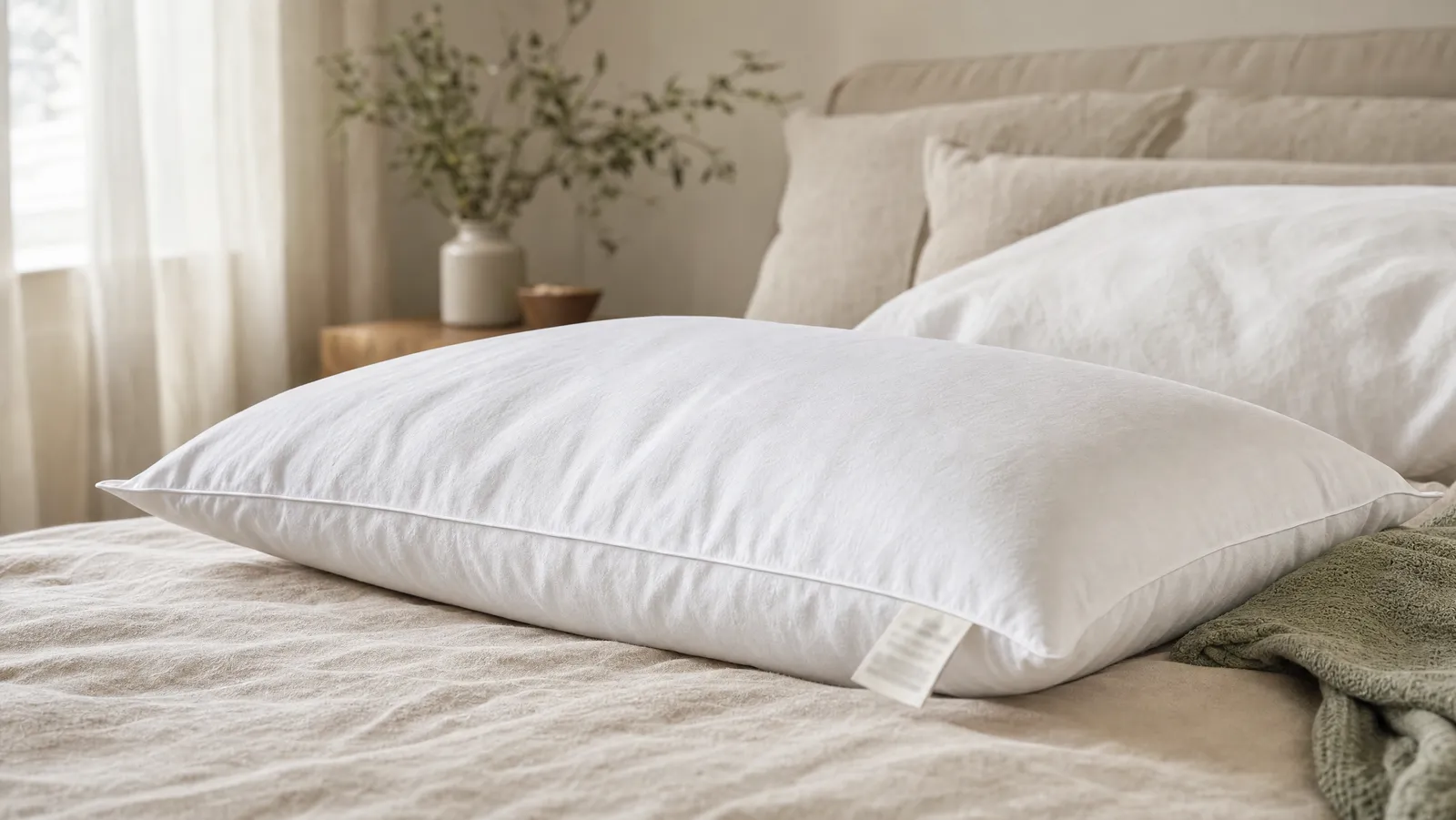
The LOFE Organic Pillow takes the top slot for an unglamorous reason: at $39.95 as of September 2026 it is the cheapest way here to get an organic cotton case and inner shell, and, per LOFE, a side zipper lets you set the height rather than accept it. LOFE says the pillow meets OEKO-TEX Standard 100 and CPSC safety requirements.
Now the caveat, in the open. The organic cotton is the case and the inner shell. The fill is polyester pearl fibre, per LOFE's own listing. That is a coherent product — a certified cotton exterior over an adjustable synthetic loft — it is just not an all-natural pillow, and the name lets you think otherwise.
Buy this if you want the cotton layer, the tunable height and the low price, and do not mind that the loft comes from polyester.
The limitation: at 20 x 26 inches it is a standard pillow, not a queen or king, and LOFE recommends washing the cover only.
Best natural fill: Cheer Collection Organic Kapok
If you want the cotton shell and a plant fill, the Cheer Collection kapok set is the cheapest way in: Cheer Collection lists 100% kapok inside a 100% cotton shell, in two 20 x 28 inch standard pillows for $59.99 as of September 2026 against a $79.99 list price. Cheer Collection describes the fill as lightweight and more breathable than cotton or wool with a down-like softness — its description, not our measurement.
Buy this if you want a two-ingredient pillow and a down-like feel from a plant, for two beds at once.
The limitation: the listing names no third-party certification at all, so the fibre content is a seller's claim rather than an audited one. And kapok settles — see the section below.
Best refillable: Bean Products Organic Kapok Pillow
The Bean Products kapok pillow is the direct answer to the previous pick's weakness. According to Bean Products it is an organic cotton shell with natural kapok fill, and the fill is removable and refillable, so loft becomes something you top up instead of something you slowly lose. Bean Products describes the materials as sustainably sourced. It is queen size at 20 x 30 inches, and $95.95 as of September 2026.
Buy this if you like kapok, sleep on a queen or king bed, and would rather maintain one pillow than replace three.
The limitation: it is the most expensive item here by a wide margin, the refill economics only pay off if you actually refill it, and like the Cheer Collection set it names no third-party certification.
Best all-cotton fill: ORGANIC TEXTILES — and it is travel size
Say the important part first: this is a travel size pillow, not a bed pillow. It is smaller than a standard, and that is the single most common way a buyer ends up unhappy with it.
With that on the table, the ORGANIC TEXTILES organic cotton pillow is the only pick that claims to deliver the phrase literally: ORGANIC TEXTILES describes organic cotton fill inside an organic cotton cover with an adjustable loft, and states the pillow is GOTS certified. It is $74.95 as of September 2026.
Cotton fill is not fluffy. The Sleep Foundation puts it plainly: cotton used as a primary fill "feels plush at first but flattens over time, making it feel firmer." That matches the product's own specification — low loft, medium-firm. Some people want exactly that. Nobody should buy it expecting a cloud.
Buy this if cotton all the way through is the point, and a small, firm, flat pillow is what you are after.
The limitation: travel size, high price for the volume, and a feel that only suits a minority of sleepers.
Best pillowcases: BIOWEAVES GOTS certified cotton
The cheapest useful purchase in this guide is not a pillow. If certified organic cotton against your skin is the actual goal, a certified case over a pillow you already own gets you most of the way there for $19.99 as of September 2026. BIOWEAVES sells these as GOTS certified 100% organic cotton in a 300 thread count sateen weave from long-staple single-ply yarn, and says they are made at Fair Trade Certified facilities. The pair is 20 x 30 inches, sized for 20 x 26 inch pillows — the same dimension as our top pick. If you want the wider field of options, our roundup of luxurious pillow cases covers weaves and fibres in more depth.
Why kapok packs down, and what to do about it
The complaint we see most often about this category is not chemistry. It is that the pillow gets flat, and with kapok that is physics rather than a defect.
Kapok is a hollow seed fibre. A 2021 review by Sangalang in the Oriental Journal of Chemistry reports a porosity of 77% — the fibre is mostly air — with a bulk density of about 0.305 g/cm³, and describes it as unsuitable for spinning into yarn because it is brittle, slippery and smooth. A very light, hollow, brittle fibre is exactly the sort of thing that compresses under a head each night and does not spring all the way back.
Two ordinary things make it liveable:
- Fluff it, deliberately and often. The Sleep Foundation notes that pillows flatten from the weight of your head, from absorbed moisture and from dirt building up in the fill, and that fluffing restores loft by aerating and redistributing the fill. With kapok that is a weekly habit, not an occasional one.
- Buy refillable if you can. This is why the Bean Products pick exists and why we rate it despite the price. A pillow whose fill you can top up sidesteps the entire problem; a sealed one does not.
If neither appeals, the honest advice is to pick a different fill rather than fight this one. Kapok's softness and its tendency to settle are the same property viewed from two angles.
Cotton shell, other fill: how the alternatives compare
Once you accept that the cotton is usually the shell, the real decision is what goes inside it — and the answers stretch well beyond this page.
- Wool is breathable and moisture-wicking per the Sleep Foundation, which also notes wool used on its own is often flat and dense and can clump; our wool pillow guide covers what to look for, including how often "wool" means a blend.
- Down and feather are the traditional soft fill and the closest thing to kapok's feel, but a natural origin certifies nothing about processing or about the shell around it. That is a separate question with a separate answer, which we work through in our piece on whether down pillows are non-toxic.
- Natural latex is the durability answer — one moulded piece, no fill to redistribute. The Sleep Foundation calls latex pillows durable and says block latex excels at shape retention. It is also the priciest route, and latex allergy matters for a small number of people; we cover non-toxic latex pillows as its own subject.
- Polyester, the fill in our top pick, is generally the cheapest of the fibre fills and the reason a cotton-shell pillow can cost forty dollars.
No fill wins on every axis. The point is to choose deliberately rather than let the word "organic" choose for you.
Care and longevity
A pillow's lifespan is shorter than most people assume, and washing the wrong part shortens it further.
- Wash the cover, not necessarily the pillow. LOFE recommends washing the cover only on our top pick; fibre fills can clump when laundered. When a maker gives you a care rule, it is usually protecting the fill.
- Dry properly. Damp fill flattens and stays flat. Whatever you wash, dry it fully.
- Use a case. A certified cotton case is the cheapest layer between your skin and the pillow, and far easier to launder weekly than any insert.
- Expect to replace it. According to the Sleep Foundation, most experts recommend replacing pillows every one to two years, with polyester fills lasting roughly six months to two years, down and feather one to three years, memory foam two to three, and latex two to four. Its listed signs of a worn pillow are the obvious ones: sagging or flattening, lumps, yellowing, and waking with a sore neck.
That last point is the strongest argument for the refillable pick: a pillow you top up is on a different schedule from one you throw away.
One thing to keep in proportion: buying organic cotton is a choice about how a fibre was grown and processed, not a health intervention. Textile Exchange's Materials Market Report 2024 put total global cotton production at 24.4 million tonnes in the 2022/23 season, with 28% of it grown under sustainability programmes — which makes this a supply-chain question at industrial scale, and a preference many people reasonably hold. If you have symptoms you associate with your bedding, that is a conversation for a clinician, not a purchase.
Who should buy what
- Most people: the LOFE Organic Pillow at $39.95 as of September 2026 — per LOFE, an organic cotton case and shell, adjustable height, polyester fill and OEKO-TEX Standard 100.
- You want a plant fill and two pillows: the Cheer Collection kapok set at $59.99 as of September 2026, accepting that no third party has certified the listing's claims.
- You want to buy once: the Bean Products refillable kapok pillow at $95.95 as of September 2026 — queen size, with an organic cotton shell per the maker and no third-party certification named.
- You want cotton all the way through: the ORGANIC TEXTILES pillow at $74.95 as of September 2026 — GOTS certified per the maker, firm, low, and travel size.
- You want the cheapest real upgrade: the BIOWEAVES organic cotton cases at $19.99 as of September 2026 — GOTS certified per the maker — over whatever pillow you already own.
If loft rather than fibre is your actual problem — you keep waking up with a stiff neck — start with geometry instead. Our guide to pillow height for neck pain is a better first read than any materials page.
The bottom line
Buy the fill statement, not the product name. In this category "organic cotton" almost always means a certified shell around something else, and knowing which of the three builds you are looking at explains nearly every price on the page. Read GOTS as what it is — an organic fibre and processing standard with a documented scope, not a test of the finished pillow — and read OEKO-TEX as the complementary mark that tests a finished textile without saying anything about organic content.
For most people we would start with the LOFE at $39.95 as of September 2026, with the fill statement read and understood. If a plant fill is the point, the Cheer Collection set is the cheap way in and the Bean Products pillow is the one you keep. If the phrase has to be literally true, the ORGANIC TEXTILES pillow is the only pick that delivers it — in travel size, firm and flat, at a premium. And if you only ever buy one thing from this page, a certified case over your current pillow is the least expensive change with the most contact time.
Some people prefer to avoid synthetic fills and added finishes on principle, and that is a perfectly reasonable preference to hold and to spend money on. It is not the same as a proven health benefit, and we would rather say so. For the wider picture — latex, wool, buckwheat, certified foam and what each certification actually covers — see our full non-toxic pillow roundup.
The shortlist
5 pillows compared — firmness, loft, and temperature side by side. The top pick is highlighted.
| Pillow | Firmness | Loft | Sleeps | Best for | Price |
|---|---|---|---|---|---|
Medium Soft | Adjustable | Neutral | An organic cotton shell at the lowest price | $39.95 Check | |
Best Natural FillCheer Collection Organic Kapok Bed Pillows (Standard, Set of 2) | Medium Soft | Medium | Neutral | Skipping foam entirely | $59.99 Check |
Best RefillableBean Products Organic Kapok Pillow (Queen, 20 x 30) | Medium | High | Neutral | A refillable pillow you can keep for years | $95.95 Check |
Best All-Cotton FillORGANIC TEXTILES 100% Organic Cotton Pillow, GOTS Certified (Travel Size) | Medium Firm | Low | Neutral | Cotton fill as well as a cotton cover | $74.95 Check |
Soft | Low | Neutral | The layer that actually touches your face | $19.99 Check |
LOFE Organic Pillow 20x26 with Organic Cotton Case

I pulled a couple of handfuls out through the zipper and it went from too tall to right, and the cotton case has washed repeatedly without going stiff or pilling.
I assumed the word organic covered the stuffing and it does not — the fill is polyester, and at 20 x 26 inches it is a standard pillow, not the queen I had been shopping for.
This is the pick we would hand to most people, and it is also the clearest illustration of what this category is. LOFE says the pillowcase and the inner shell are 100% organic cotton and that the fill is polyester pearl fibre — the maker volunteers the split rather than hiding it, which is more than a lot of listings manage.
What you are buying is an organic cotton exterior at the lowest price of any pillow on this page, plus — LOFE says — a side zipper that lets you take fill out or put it back until the height suits you. LOFE also states the pillow meets OEKO-TEX Standard 100 and CPSC safety requirements. It is 20 x 26 inches, and LOFE recommends washing the cover only. $39.95 as of September 2026, down from a $42.95 list price.
Cheer Collection Organic Kapok Bed Pillows (Standard, Set of 2)
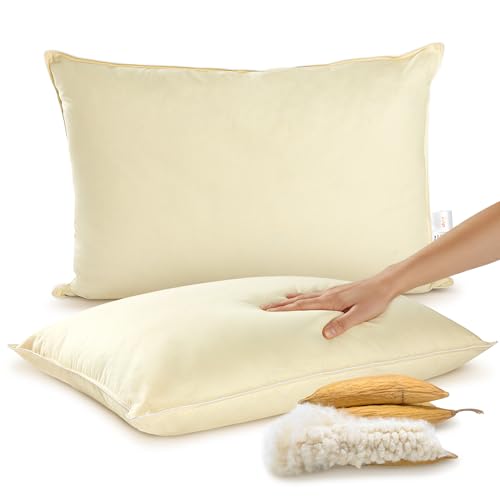
It has the give of a down pillow with none of the quills, and getting two of them for under sixty dollars felt like a mistake in my favour.
It lost noticeable height in the first month and needs a proper fluffing most mornings to look like the photo again.
If you want the cotton shell and a fill you can also name in one word, this is the cheapest route to it. Cheer Collection lists the build as two ingredients: 100% kapok fibre inside a 100% cotton shell. Cheer Collection describes the fill as lightweight and more breathable than cotton or wool, with a down-like softness — the maker's characterisation, not our measurement.
You get two 20 x 28 inch standard pillows for $59.99 as of September 2026 against a $79.99 list price, which is the best value on this page if the set size suits you. Two honest notes: the listing names no third-party certification, so you are trusting the stated fibre content, and kapok settles, so plan on fluffing.
Bean Products Organic Kapok Pillow (Queen, 20 x 30)

Adding a handful of fill twice a year has kept it at the same height for longer than any pillow I have owned, and the queen size actually covers the width of my shoulders.
It is a lot of money up front, and refilling is a messy job best done somewhere you do not mind vacuuming afterwards.
This is the answer to the one real complaint about kapok. Bean Products says it pairs an organic cotton shell with natural kapok fill and makes the fill removable and refillable, so the loft is something you top up rather than something you lose. Bean Products also describes the materials as sustainably sourced.
At 20 x 30 inches it is the largest pillow here, and at $95.95 as of September 2026 it is also the most expensive. The maths only works if you actually use the refill feature — but a pillow you can top up in year three is a different purchase from one you replace in year two.
ORGANIC TEXTILES 100% Organic Cotton Pillow, GOTS Certified (Travel Size)

It is the only pillow I have found that is cotton all the way through, and the flat, firm feel is exactly what I wanted for reading and for travel.
It is travel size, which I did not register until it arrived, and the price per inch of pillow is hard to justify next to a standard one.
Read the size line before anything else: this is a travel size pillow, smaller than a standard bed pillow. We are putting it first in bold because the listing is easy to skim past, and a reader expecting a queen will be disappointed on arrival.
With that settled, it is the rare product that claims to do what the category name implies — ORGANIC TEXTILES describes organic cotton fill inside an organic cotton cover with an adjustable loft, and states the pillow is GOTS certified. Cotton fill behaves like cotton fill: low, firm and dense rather than lofty. At $74.95 as of September 2026 you are paying a real premium for a small pillow, and buying it for the material rather than the volume.
BIOWEAVES 100% Organic Cotton Pillow Cases, GOTS Certified (Standard/Queen, Set of 2)

The sateen is smoother than the percale I replaced and it has kept its hand through a dozen washes rather than going papery.
They are generously cut for a 20 x 26 pillow, so on a slim insert there is a fair amount of loose fabric at the open end.
The cheapest useful thing in this guide. If what you want is certified organic cotton against your skin for eight hours a night, a certified case over a pillow you already own gets you most of the way there for $19.99 as of September 2026.
BIOWEAVES sells these as GOTS certified 100% organic cotton in a 300 thread count sateen weave, made from long-staple single-ply yarn, and says they are produced at Fair Trade Certified facilities. The pair measures 20 x 30 inches, sized for 20 x 26 inch pillows — which happens to be the dimension of our top pick.
How to Check an Organic Cotton Claim in Five Minutes
The word "organic" on a pillow listing is doing a specific job, and it is usually a smaller job than the shopper assumes. Five minutes of reading settles it.
Organic Cotton Pillow FAQ
Is an organic cotton pillow filled with organic cotton? Usually not. The phrase almost always describes the shell and the case. Cotton fill exists but is rare, costs more and behaves differently — the Sleep Foundation notes that cotton used as the primary fill "feels plush at first but flattens over time, making it feel firmer."
What does GOTS actually certify? Organic fibre content and processing. GOTS requires at least 95% certified organic fibres for its "organic" grade and at least 70% for "made with organic materials," and it requires certification of all processing stages from organic fibre processing through to the finished product, including approved chemical inputs, wastewater treatment and social criteria aligned with ILO conventions.
Does GOTS mean the finished pillow was emissions tested? No. GOTS is an organic fibre and processing standard, not a finished-product emissions test. OEKO-TEX STANDARD 100 is the mark that tests a finished item — every thread, button and accessory — against a list of more than 1,000 substances, and OEKO-TEX is explicit that any fibre type can carry it, so it says nothing about whether cotton is organic.
Does GOTS cover PFAS? As chemical inputs, yes. The change log for GOTS Version 7.0 lists all PFAS compounds as prohibited inputs and sets residue limits of under 0.025 mg/kg for PFOS and PFAS C9–C14. That is a rule about what may be used in processing, not a certificate that a finished pillow has been tested and found free of them.
Why does my kapok pillow keep going flat? Kapok is a hollow, thin-walled seed fibre — a 2021 review in the Oriental Journal of Chemistry reports a porosity of 77% and describes the fibre as brittle. Packing down under a head every night is the expected behaviour, which is why refillable designs exist.
How often should I replace a pillow? The Sleep Foundation says most experts recommend every one to two years, with polyester fills lasting roughly six months to two years and latex two to four.
I think my bedding is making me unwell. What now? Talk to a clinician. We can tell you what a pillow is made of and who certified what; we cannot examine you, and a different pillow is not a diagnosis.
Why you can trust us

Aimee Cannon
Sleep & bedding writer
Aimee Cannon is a sleep and bedding writer who has spent years testing pillows of every kind — memory foam, down, wool, bamboo, buckwheat, and specialty support pillows. She focuses on matching the right pillow to each sleeping position and need, and reports what actually holds up after months of nightly use. When she is not testing pillows, Aimee is usually with her husband and her dog.