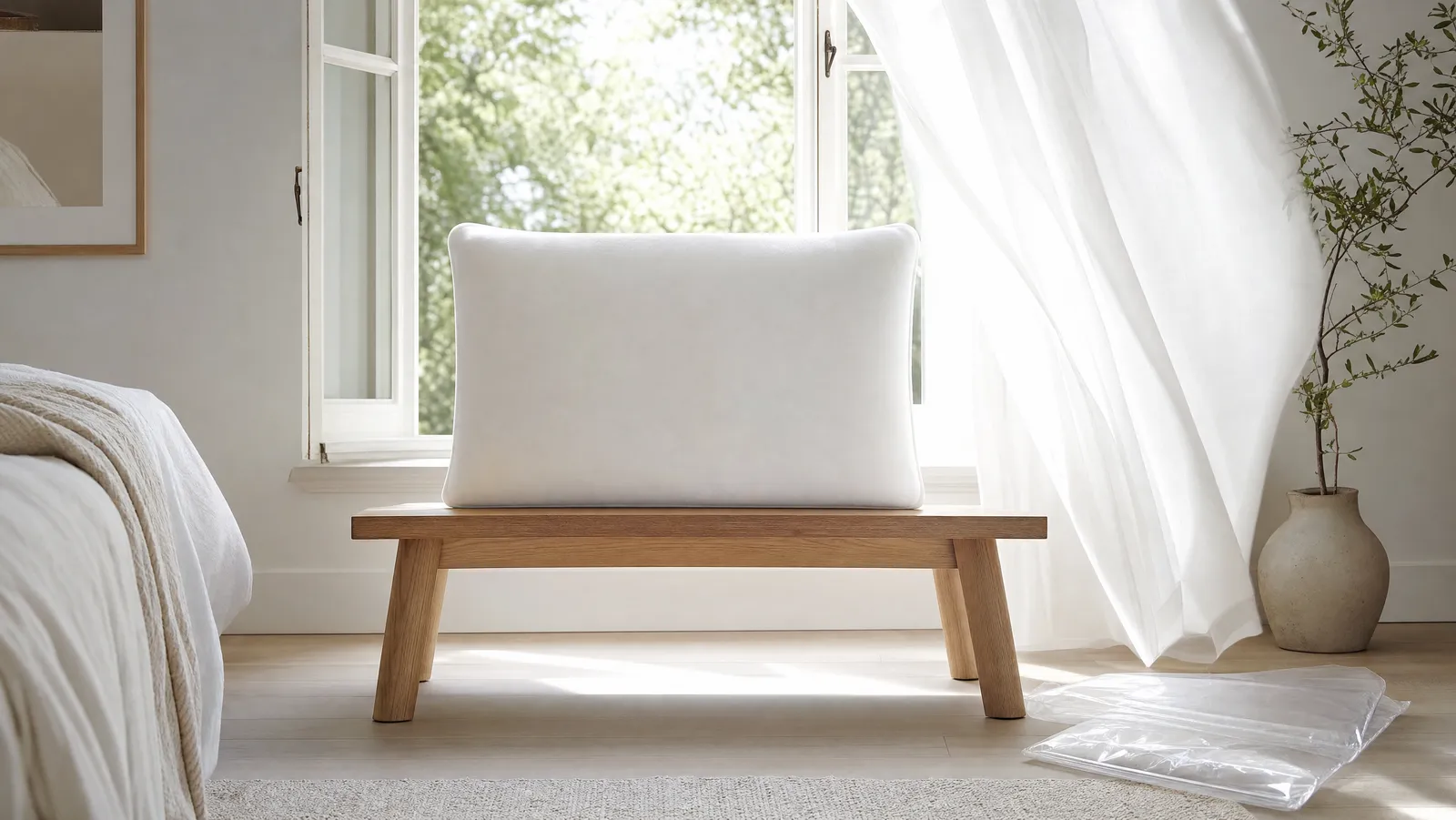
Non-Toxic Pillows for Side Sleepers: Loft Without the Chemistry
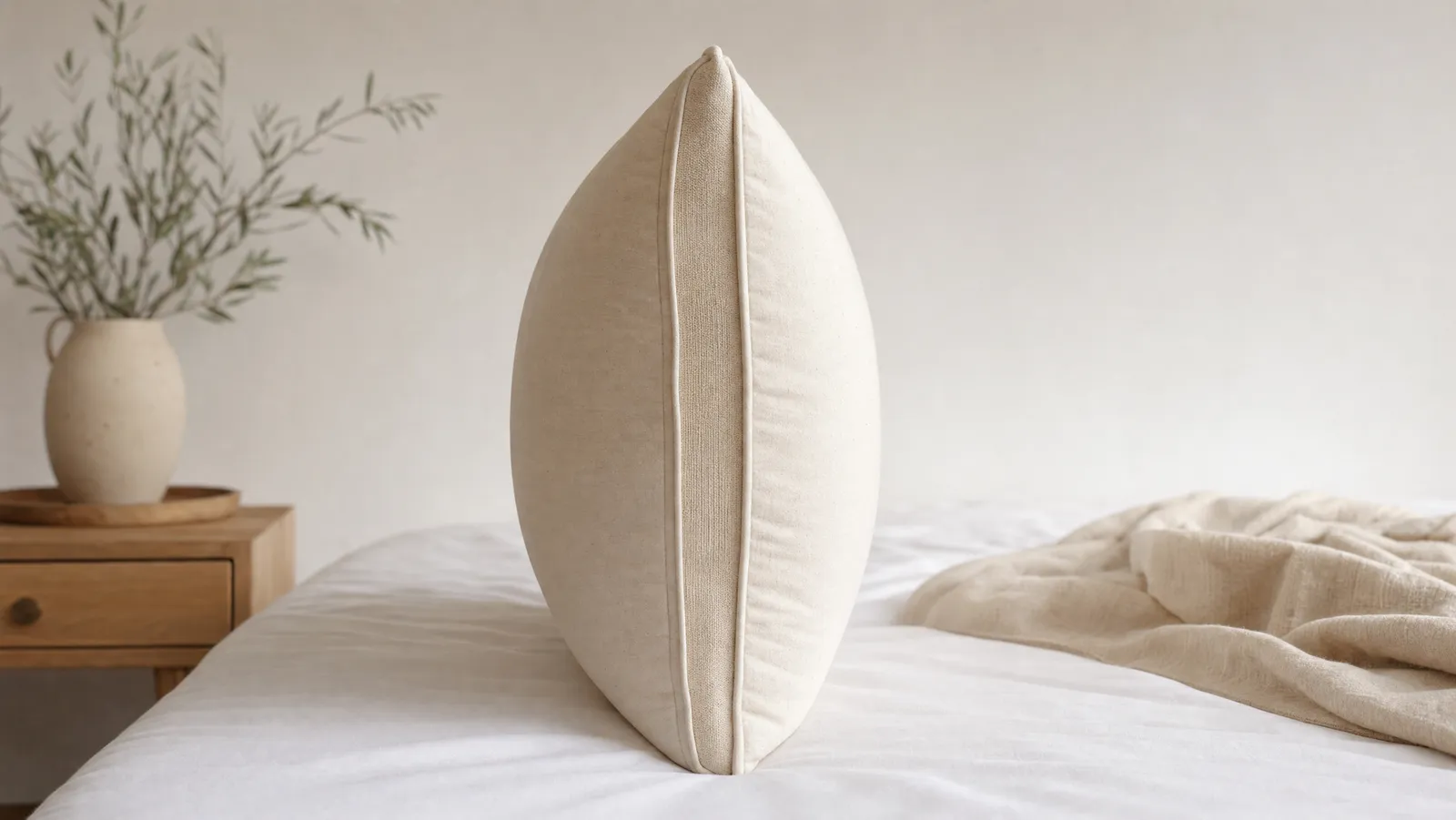
The best non toxic pillows for side sleepers are, almost without exception, latex ones. A side sleeper has to bridge the gap between ear and mattress — a gap about as wide as a shoulder — and latex is one of the very few low-chemistry fills with real compression resistance. Everything else on this page is a hedge for people who do not know their own number yet. We may earn a commission from links on this page, at no extra cost to you.
Here is the tension nobody in this category says out loud. The fills a side sleeper needs are mostly the fills the non-toxic conversation is suspicious of, and the fills that conversation prefers are mostly the ones that go flat. Memory foam holds loft and is the material this tower's readers are questioning. Kapok, cotton and down-alternative fibre are the low-chemistry favourites, and they compress under exactly the load a side sleeper applies. Latex resolves that, and an adjustable pillow buys you time while you work out what you need. If you want the materials-and-certifications groundwork first, read how to choose a non-toxic pillow and come back.
One thing we will not do here: call any of these pillows non-toxic, safe or PFAS-free as a matter of fact. Those are not checkable claims. What is checkable is what a pillow is made of, how tall the maker says it is, who certified what, and what that certificate leaves out.
Why loft is the whole problem for side sleepers
On your back, your head has to bridge an inch or two. On your side, it has to bridge the distance from the side of your head to the point of your shoulder — and then hold that bridge for seven hours while your full head weight presses down on it.
That is a compression problem before it is a comfort problem. A pillow can be the right height in the packet and the wrong height under a head, and the difference is what the fill does when you load it.
How much loft an organic pillow for side sleepers actually needs
Roughly 8 to 14 cm, or 3 to 5.5 inches, is the band the research has tested for lateral sleeping — but the honest version of that answer has your own shoulder in it.
A 2021 review in Healthcare by Lei and colleagues identifies the width from ear to shoulder as the critical measurement for side sleeping, and states plainly that pillow height for supine and lateral positions should differ, with the lateral position needing more. It also lays out how unsettled the literature is: one group it reviews recommended 10 cm as most suitable, another identified 10 cm as best for comfort in the lateral position specifically, and a third found 7 cm more comfortable lying supine. The review's own conclusion is the sentence to carry around — "there remain no firm conclusions about the optimal pillow height."
A 2025 study in Medical and Biological Engineering and Computing took on the individual version of the question. Nine healthy adults lay laterally on foam-latex pillows at four heights — 8, 10, 12 and 14 cm — with and without neck support. Rather than hunt for a universal number, they built an individualised height index from each subject's shoulder width and the pillow's absolute height, and the shape of the cervical curve tracked that index closely (R-squared of 0.80 on a flat pillow, 0.82 with neck support). The band they labelled medium individualised height, with neck support, gave the cervical curve closest to natural standing posture and the lowest simulated musculoskeletal internal force.
The differences here are not subtle. In a 2016 PeerJ study, Ren and colleagues measured ten healthy adults lying supine across pillow heights of 110, 130, 150 and 170 mm and reported average cranial pressure at the tallest height about 30% higher than at the shortest, with the cervical angle increasing 66.4% and the kyphosis distance falling 43.4% across that same range. They were supine, not lateral, so the figures do not transfer directly — but the conclusion was that cranio-cervical pressure and cervical spine alignment are height-specific, which is the argument for measuring rather than guessing.
So: measure ear to shoulder, subtract a centimetre or two if your mattress lets the shoulder sink, and shop against that. It also explains why our top pick is the one that publishes numbers. Turmerry states its High Loft standard pillow is 5 inches (12.7 cm) and the Mid Loft 4.25 inches (10.7 cm), which puts both inside the tested band and lets you choose on arithmetic rather than adjectives.
Firmness is a second axis, and side sleepers need both
A tall soft pillow is a short pillow the moment weight lands on it. This is the distinction most roundups skip, and it is why two of our picks are the same material at different firmnesses.
The engineering term for the property that matters is support factor: how much harder a material pushes back when you compress it deeply versus lightly. A 2026 study in Polymers by Vlaović and colleagues, testing foams under ISO 2439 indentation hardness, measured a latex foam's support factor at 5.4, against 2.2 and 2.7 for the two single-layer polyurethane foams tested alongside it (the layered composites in the same study ran 2.6 to 3.7). The study's own conclusion was a caution — in layered assemblies the less rigid layers governed overall performance — but the isolated figure is the reason latex behaves the way it does under a shoulder. It gets progressively harder to squash. Loose fibre does not; it packs, and then it stays packed until you fluff it.
Practical translation: if you are broad-shouldered, or a heavier sleeper, or you have bought a "high loft" pillow before and found it flat by 2am, the variable you got wrong was probably firmness rather than height.
How we picked the best non-toxic pillows for side sleepers
We ranked on things you can verify from a listing before you buy:
- A published loft or a way to set your own. Either the maker states a height in inches or centimetres, or the pillow has a zipper.
- Compression behaviour suited to the position. Three of five picks either resist compression by construction or let you add fill back.
- A legible fill statement. Every pick names what is inside it — and where the product name oversells that, we say so in the first line of the card rather than the fine print.
- Named third-party programmes where they exist. GOLS and GOTS on the Turmerry, GOTS on the ORGANIC TEXTILES cover, OEKO-TEX Standard 100 on the LOFE, GREENGUARD Gold and CertiPUR-US on the Coop foam. The kapok pick names none, and we flag that below.
- Live pricing. Every price was pulled from the Amazon Creators API on 9 September 2026 and is stated as of September 2026.
Two things we cannot offer. No star ratings or review counts — the Creators API does not return them, so nothing here is ranked by crowd sentiment. And we have not physically slept on these pillows. We recommend on published materials, stated dimensions and third-party certifications, and we attribute every maker claim to the maker.
Our pick: Turmerry Green Natural Bed Pillow, High Loft
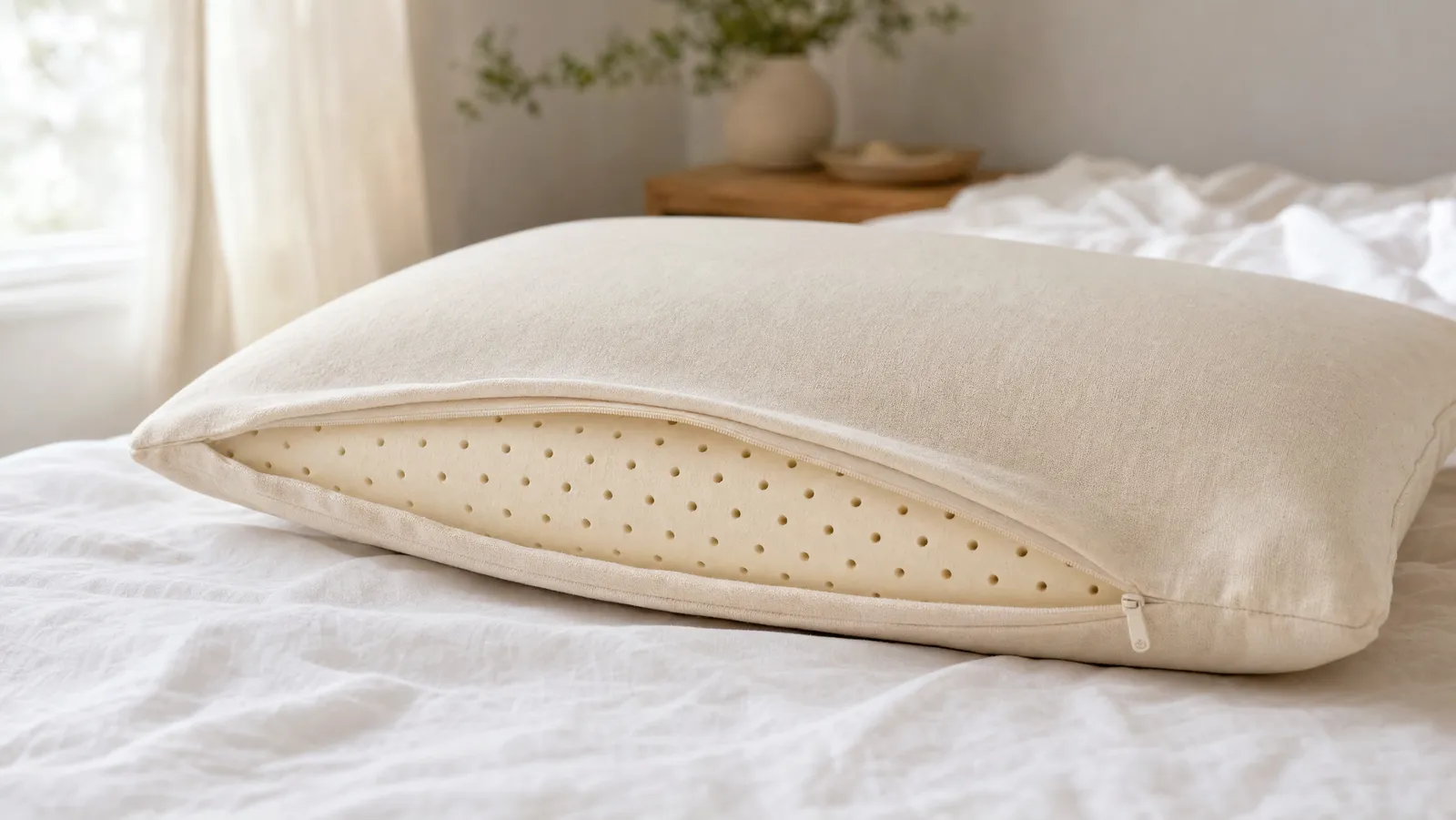
Latex is the resolution to this article's problem, and the Turmerry is the version of it that tells you its height. Five inches — 12.7 cm — of a core Turmerry says is at least 95% GOLS certified organic latex, under a cover it describes as GOTS certified organic cotton. It is $89.00 as of September 2026.
GOLS is worth understanding rather than just recognising. Control Union, which runs the standard, describes it as covering latex from plantations certified organic under USDA NOP or EU standards, with permissible limits for harmful substances, emission test requirements, specified polymer and filler percentages, and traceability by transaction certificate from plantation to retailer. Broad scope for a materials standard — and still a standard about the latex, not a verdict on the finished pillow.
Buy this if your ear-to-shoulder measurement lands near 12 cm and you want the fill named in three words. If latex is the direction you are going, our guide to non-toxic latex pillows covers the wider field, including what separates Dunlop from Talalay and why processing method changes the feel.
The limitation: the standard is 15 by 22 inches, narrower than a queen, and solid latex is heavy.
Best for broad shoulders: ORGANIC TEXTILES Natural Latex, Firm
Same material, different job. Broader shoulders open a bigger gap and load it harder, and this is the firm version of a natural latex line — the highest-support option on the page. ORGANIC TEXTILES describes the fill as pure, sustainably harvested natural latex under a removable GOTS certified organic cotton cover, with pin-hole ventilation for airflow. Queen size, $115.95 as of September 2026.
The rule that gets these pillows ruined: the maker states the latex core must not be machine washed. Wash the cover.
Buy this if you are broad through the shoulders, sleep hot, and have flattened every pillow you have owned.
The limitation: firm latex does not yield. If you like sinking into a pillow, this is an expensive way to find that out.
Best adjustable organic pillow: LOFE 20x36
Apply the honesty rule up front. On this pillow the organic cotton is the case and the inner shell. The fill is polyester pearl fibre, and LOFE says so in its own listing — and so does the card, in its first line.
It earns its place because a zipper is the cheapest route to correct loft, and correct loft is what a side sleeper is actually shopping for. At 20 by 36 inches this is the largest pick here, LOFE says it is CPSC and OEKO-TEX Standard 100 certified, and the side opening lets you tune the height rather than gamble on it. It is $58.95 as of September 2026, and LOFE notes that washing the case alone is what preserves the fill.
This is also the point where cotton-shell pillows generally need a caveat: a pillow sold on its organic cotton is usually fibre-filled, and fibre compresses. Our roundup of the best organic cotton pillows goes through which ones are cotton all the way through and which are cotton on the outside.
Buy this if you do not yet know your number, or you sleep across half the bed.
The limitation: the fill is synthetic, and pearl fibre needs occasional redistribution.
Best natural fill: Cheer Collection Organic Kapok
Kapok is the honest middle of this page. The maker states 100% pure kapok in a 100% cotton shell and describes it as lightweight and more breathable than cotton or wool. Two ingredients, both nameable. Nothing in the listing we sourced names a third-party testing programme, which is worth knowing before you buy on materials alone. It is $59.99 as of September 2026 against a $79.99 list price.
It compresses. That is not a defect, it is what a hollow seed fibre does — and researchers writing in Textile Research Journal in 2014 put a mechanism under it: kapok is light and an excellent insulator because of its high degree of hollowness, but that lumen structure is difficult to preserve under repetitive compression, so the fibre can lose its distinguishing properties fairly quickly. Their compression testing described the assembly passing through a linear elastic stage, a metamorphosis stage and finally densification. Densification is what "gone flat" means in a laboratory.
The other half of the sentence is the part side sleepers should care about: a fill that packs is a fill you can mould. You can push kapok into the wedge above your shoulder and it will hold that shape, which no solid latex core will ever do.
Buy this if you want a plant fill you can shape, and you do not mind fluffing.
The limitation: expect the loft to drift downward over months, and expect to want a top-up eventually.
If you still want foam: Coop Home Goods Eden Crescent
A real share of readers arrive here still wanting memory foam, and silence is not a useful answer. This is the documented one: Coop states the fill is gel-infused cross-cut memory foam blended with microfiber, made from 100% virgin foam rather than recycled scraps, and that it carries both GREENGUARD Gold and CertiPUR-US certification. The crescent cut-out is shaped to give a shoulder somewhere to go, extra fill ships in the box, and it is $119.00 as of September 2026.
Be precise about what those marks cover. CertiPUR-US applies to flexible polyurethane foam and, per the programme's own documentation, certifies foam made without ozone depleters, PBDEs and certain Tris flame retardants, mercury, lead and other heavy metals, formaldehyde, and phthalates regulated by the CPSC, with total VOC emissions below 0.5 parts per million measured in a standardised ISO small-chamber test after 72 hours of conditioning. GREENGUARD Gold is an emissions certification issued against UL 2818; UL Solutions says Gold certified products must limit emissions of more than 360 individual VOCs and meet a total VOC ceiling of 0.22 mg per cubic metre, and comply with the California Department of Public Health standard method known as Section 01350.
Both describe the foam and its emissions. Neither is an organic-fibre standard, neither tests for PFAS, and neither says anything about a finish on a cover. That is not a knock — it is scope. We have gone through the evidence on whether memory foam pillows are toxic separately, and we are not going to re-argue it on a page about loft.
Buy this if foam is what you like and you want an outside lab involved in the emissions question.
The limitation: foam behaviour is temperature-sensitive. The Polyurethane Foam Association notes that even slight changes in room temperature can affect a viscoelastic foam's measured firmness and recovery rate, so a cold bedroom makes it feel firmer.
How the fills compare under a shoulder's worth of load
- Natural latex. The highest measured resistance to deep compression in that testing — support factor 5.4 in the Polymers study above, against 2.2 and 2.7 for its single-layer polyurethane foams. Holds its published height. Not adjustable, not light, and not cheap.
- Memory foam. Contours rather than pushes back. The Polyurethane Foam Association's technical bulletin puts viscoelastic ball rebound below 20%, against 50 to 60% for other varieties of flexible polyurethane foam — the number behind the "dead" feel people either love or cannot stand.
- Kapok. High initial loft from a hollow fibre, then progressive densification under repeated compression. Mouldable, which is its side-sleeping advantage, and refillable designs exist precisely because of the trade-off.
- Polyester pearl fibre. Packs like any loose fibre, but it is the fill that adjusts most easily — take a handful out, put a handful back.
- Cotton fibre. The most compressible of the group. Fine under a back sleeper's head, usually too little pillow under a shoulder.
What to do if you are between lofts
Most side sleepers land between two heights, and the wrong instinct is to split the difference by buying something soft and tall.
Buy adjustable instead. A zippered pillow lets you find the number over a fortnight, and once you know it you can buy a fixed latex pillow at that height with confidence. The LOFE Adjustable Organic Pillow at $58.95 as of September 2026 is the cheap way to run that experiment; the Coop is the version that ships extra fill so you can go up as well as down.
If you would rather buy once, err slightly tall and firm rather than short and soft. A pillow that is a centimetre too high can be lived with; a pillow that collapses to nothing at 2am cannot be fixed.
Which pillow is right for you
- You measured near 12 cm and want the shortest materials list: the Turmerry Green Natural Bed Pillow, High Loft, $89.00 as of September 2026.
- You are broad-shouldered and flatten everything: the ORGANIC TEXTILES Natural Latex Pillow in firm, $115.95 as of September 2026.
- You do not know your number yet: the LOFE 20x36 — remembering the organic cotton is the case and shell, not the fill.
- You want a plant fill you can shape: the Cheer Collection Organic Kapok, with realistic expectations about fluffing.
- You want foam anyway: the Coop Eden Crescent, for the cut-out and the certifications, within their scope.
The bottom line
Side sleeping asks more of a pillow than any other position, and the low-chemistry shelf is mostly stocked with fills that cannot deliver it. Latex can, which is why our top two picks are latex at two firmnesses. An adjustable pillow is the sensible hedge if you have not measured yourself yet, and kapok is a real option provided you know it will settle.
None of that makes any of these pillows non-toxic in a legal or tested sense — no such category exists, and everything is made of chemicals. What you can do is buy materials you can name from makers who publish numbers, check the certificate rather than the logo, and remember that a standard about latex or about foam emissions is silent on everything outside its scope. If you want that groundwork laid out properly before you spend anything, Home Pillow Review's non-toxic pillow guide is the place to start.
And if you are here because your neck hurts and you are hoping a pillow fixes it, buy the pillow by all means — but take the neck to a clinician. Some people prefer to avoid particular materials on principle, and that is a perfectly reasonable thing to want. It is just not a diagnosis, and no pillow is a treatment.
The shortlist
5 pillows compared — firmness, loft, and temperature side by side. The top pick is highlighted.
| Pillow | Firmness | Loft | Sleeps | Best for | Price |
|---|---|---|---|---|---|
Medium | High | Cooling | A side sleeper who wants a certified organic latex core at real loft | $89 Check | |
Firm | High | Cooling | Side sleepers with broad shoulders needing a gap that stays filled | $115.95 Check | |
Medium Soft | Adjustable | Neutral | Setting your own loft when you do not know what you need yet | $58.95 Check | |
Best Natural FillCheer Collection Organic Kapok Pillow with Cotton Cover (Standard) | Medium Soft | Medium | Cooling | A natural fill you can shape around a shoulder | $59.99 Check |
Best Certified FoamCoop Home Goods Eden Crescent Bed Pillow, Queen, Adjustable Medium-Soft | Medium Soft | Adjustable | Cooling | Side sleepers who want foam with real emissions certification | $119 Check |
Turmerry Green Natural Bed Pillow, GOLS Certified Organic Latex (Standard, High Loft, Medium)
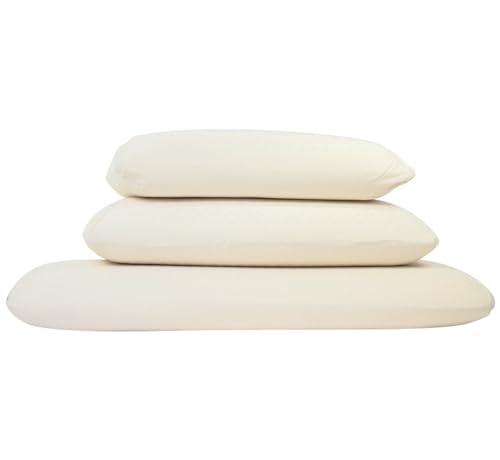
Five inches that are still five inches at two in the morning. Every fibre pillow I have owned was a different pillow by the middle of the night.
The standard is 15 by 22 inches, which is smaller than the queen it replaced, and solid latex is heavy enough that you notice it changing the pillowcase.
Start with the number, because Turmerry is one of the few makers that publishes one: the High Loft version is 5 inches, or 12.7 cm, against 4.25 inches (10.7 cm) for Mid Loft. That sits inside the band the lateral-sleeping research has actually tested, and it is the reason this is our pick rather than a softer, taller-sounding pillow.
The core is latex, which is the point. Turmerry states the pillow is crafted with at least 95% GOLS certified organic latex, that it is free of synthetic fillers and OEKO-TEX certified, and that the zippered cover is GOTS certified organic cotton; it describes the core as zoned, softer in the centre and firmer at the edges. Those are the maker's claims, and GOLS and GOTS are both programmes with public certificate databases you can check. It is $89.00 as of September 2026.
ORGANIC TEXTILES Natural Latex Bed Pillow with GOTS Certified Organic Cotton Cover (Queen, Firm)

I have broad shoulders and every pillow I have tried bottomed out by midnight. This one does not move under a shoulder the way fibre does.
Firm latex is genuinely firm. If your idea of a pillow is something you sink into, this will feel like a mistake on the first night and possibly the tenth.
This is the firm version of the line, and firmness is the axis most side sleeper roundups leave out. A broad shoulder opens a bigger gap between ear and mattress and then loads that gap harder — which is exactly the condition under which a tall soft pillow becomes a short one. Firm latex is what holds the number you bought.
ORGANIC TEXTILES describes the fill as pure, sustainably harvested natural latex under a removable, machine-washable GOTS certified organic cotton cover, and says the core is pin-hole ventilated for airflow. One handling rule matters more than any of that: the maker states the latex core itself must not be machine washed. The cover is the washable part. Queen size, and $115.95 as of September 2026 — the most expensive pick here.
LOFE Adjustable Organic Pillow 20x36 with Organic Cotton Pillowcase and Shell (King)

Twenty by thirty-six means I never roll off the end of it, and I pulled two handfuls out in the first week to get the height down where my neck liked it.
I assumed the organic part covered the stuffing. It does not — that is polyester pearl fibre, and LOFE says so if you read far enough.
Read the fill statement before the product name. LOFE says the pillowcase and the inner shell are 100% organic cotton and that the fill is polyester pearl fibre — so "organic" here describes the fabric, not the stuffing. If a natural fill is the whole point of your search, the latex and kapok picks are the ones to look at.
What earns it a place is the zipper. Loft is personal, side sleepers are the position most often mismatched, and a side opening that lets you remove or keep fill is the cheapest way to land on your own number instead of a stranger's. LOFE says the pillow is CPSC and OEKO-TEX Standard 100 certified and that it is machine washable, though washing the case alone is what protects the fill. At 20 by 36 inches it is the largest pick here, and $58.95 as of September 2026.
Cheer Collection Organic Kapok Pillow with Cotton Cover (Standard)
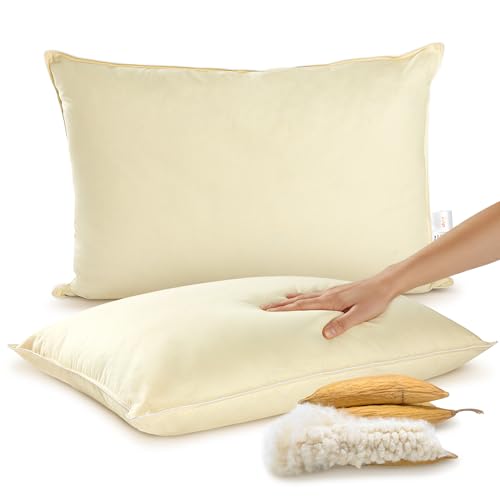
Light, cool and shapeable — I push a wedge of it into the gap above my shoulder and it stays where I put it.
It compresses. Expect to fluff it most mornings, and expect that in a year you will be thinking about topping it up.
Two ingredients: the maker states 100% pure kapok filling in a 100% cotton shell, and describes it as lightweight and more breathable than cotton or wool. That is about as short as a materials list gets, and it is why this pick is here rather than a fibre blend with a longer story.
The honest part is the compression. Kapok packs down under a head, which is normally filed as a flaw — but a fill that packs is also a fill you can push into the space under a shoulder, and that is a genuine advantage in this position. It is expected behaviour for a hollow seed fibre, not a defect, and it is why refillable kapok designs exist at all. Standard size, $59.99 as of September 2026 against a $79.99 list price.
Coop Home Goods Eden Crescent Bed Pillow, Queen, Adjustable Medium-Soft

The cut-out is the thing. My shoulder sits in the notch instead of shoving the pillow up under my ear, and the spare fill let me raise the loft rather than only drop it.
It is still memory foam. Certified for emissions, yes, but it is not the two-ingredient materials list the rest of this page is about.
This is memory foam, and we are not going to pretend otherwise. It is on the page because plenty of readers arrive at a non-toxic pillow guide still wanting foam, and the useful answer is to point at the documented one rather than say nothing. Coop states the fill is gel-infused cross-cut memory foam blended with microfiber, made from 100% virgin foam rather than recycled scraps, and that it is both GREENGUARD Gold and CertiPUR-US certified.
Understand what those two marks are: emissions and inputs testing on foam. They are not a short materials list and they are not a PFAS test, and neither says anything about a finish on a cover. What the crescent cut-out does add is shape — it gives a shoulder somewhere to go — and extra fill ships in the box, so loft goes up as well as down. Coop says the Lulltra cover is removable and machine washable with a 2-inch gusset. It is $119.00 as of September 2026.
Measure Your Own Loft in Five Minutes
Every recommendation in this category is somebody else's shoulder. Five minutes with a tape measure gets you your own number, which is the only one that matters.
Non-Toxic Pillows for Side Sleepers FAQ
What loft should a side sleeper look for? More than any other sleeping position, because the gap between the ear and the mattress is as wide as the shoulder. The published work on lateral sleeping has tested pillow heights from about 8 to 14 cm, and a 2021 review in Healthcare concludes that "there remain no firm conclusions about the optimal pillow height" — the useful variable is your own ear-to-shoulder measurement, not a universal number.
Is latex really better than fibre for side sleeping? On compression resistance, the physics favour it. A 2026 study in Polymers measured latex foam's own support factor — how much harder a material pushes back when compressed deeply rather than lightly — at 5.4, against 2.2 and 2.7 for the single-layer polyurethane foams tested alongside it. Loose fibre has no comparable behaviour: it packs and stays packed until you fluff it.
Does "organic" on the label mean the fill is organic? Often not. On the LOFE pick here the organic cotton is the case and the inner shell, and LOFE states the fill is polyester pearl fibre. Read the fill statement before the product name, every time.
Is kapok a bad choice for side sleepers? No, but know what it does. Kapok owes its loft to a hollow fibre structure, and researchers writing in Textile Research Journal in 2014 noted that this lumen structure is difficult to preserve under repeated compression, so the fibre can lose its characteristic properties fairly quickly. The Cheer Collection Organic Kapok at $59.99 as of September 2026 is a good pillow to shape around a shoulder and a poor one to ignore for a year.
Does GREENGUARD Gold mean a pillow is non-toxic? It means something narrower and more useful. UL Solutions says GREENGUARD Gold is issued against UL 2818 and requires certified products to limit emissions of more than 360 individual VOCs, with a total VOC ceiling of 0.22 mg per cubic metre. That is an emissions test on a product, not a verdict on the whole materials list, and it is not a PFAS test.
Can I wash a latex pillow? Not the core. ORGANIC TEXTILES states plainly that its latex core must not be machine washed and that the GOTS certified organic cotton cover is the removable, washable part. Treat every solid latex pillow that way unless its maker says otherwise.
My new pillow is giving me neck pain. What now? Stop using it and talk to a clinician if the pain persists or radiates. We can tell you what a pillow is made of, how tall the maker says it is and who certified what — we cannot diagnose you, and no pillow on this page is a treatment.
Why you can trust us

Aimee Cannon
Sleep & bedding writer
Aimee Cannon is a sleep and bedding writer who has spent years testing pillows of every kind — memory foam, down, wool, bamboo, buckwheat, and specialty support pillows. She focuses on matching the right pillow to each sleeping position and need, and reports what actually holds up after months of nightly use. When she is not testing pillows, Aimee is usually with her husband and her dog.