Are Bamboo Pillows Non-Toxic? What "Bamboo" Actually Means
Are bamboo pillows non toxic? For the person sleeping on one, we have found no evidence that bamboo-derived fabric is a toxicity problem — but the word is aimed at the wrong part of the pillow. On both bamboo-labelled pillows below, "bamboo" describes 40% of the cover fabric by the maker's own statement, and the fill underneath is memory foam. We may earn a commission from links on this page, at no extra cost to you.
That makes this a transparency question far more than a chemistry one, and it means the documented harm in bamboo viscose sits upstream, in the making of the fibre, rather than on your bed. What follows is what a bamboo pillow is actually made of, why US law puts the word "rayon" on the label and what the FTC has done to companies that left it off, what the viscose process involves and who it has been shown to hurt, how lyocell differs, and which certification answers the question you are really asking. If you want the shopping side first, our guide to the best non-toxic pillows works through materials and marks in order.
What is a bamboo pillow made of?
Three layers, and only one of them is regulated.
- The marketing name. "Bamboo pillow" is a category invented by sellers. Nothing requires it to describe the fill, the cover or anything else.
- The cover blend. This is where the bamboo lives, and it is almost never all of it. Both bamboo-labelled pillows here state a cover fabric of 60% polyester and 40% rayon derived from bamboo — in the QUTOOL's case, the soft side of a double-sided cover whose other face is synthetic "ice silk".
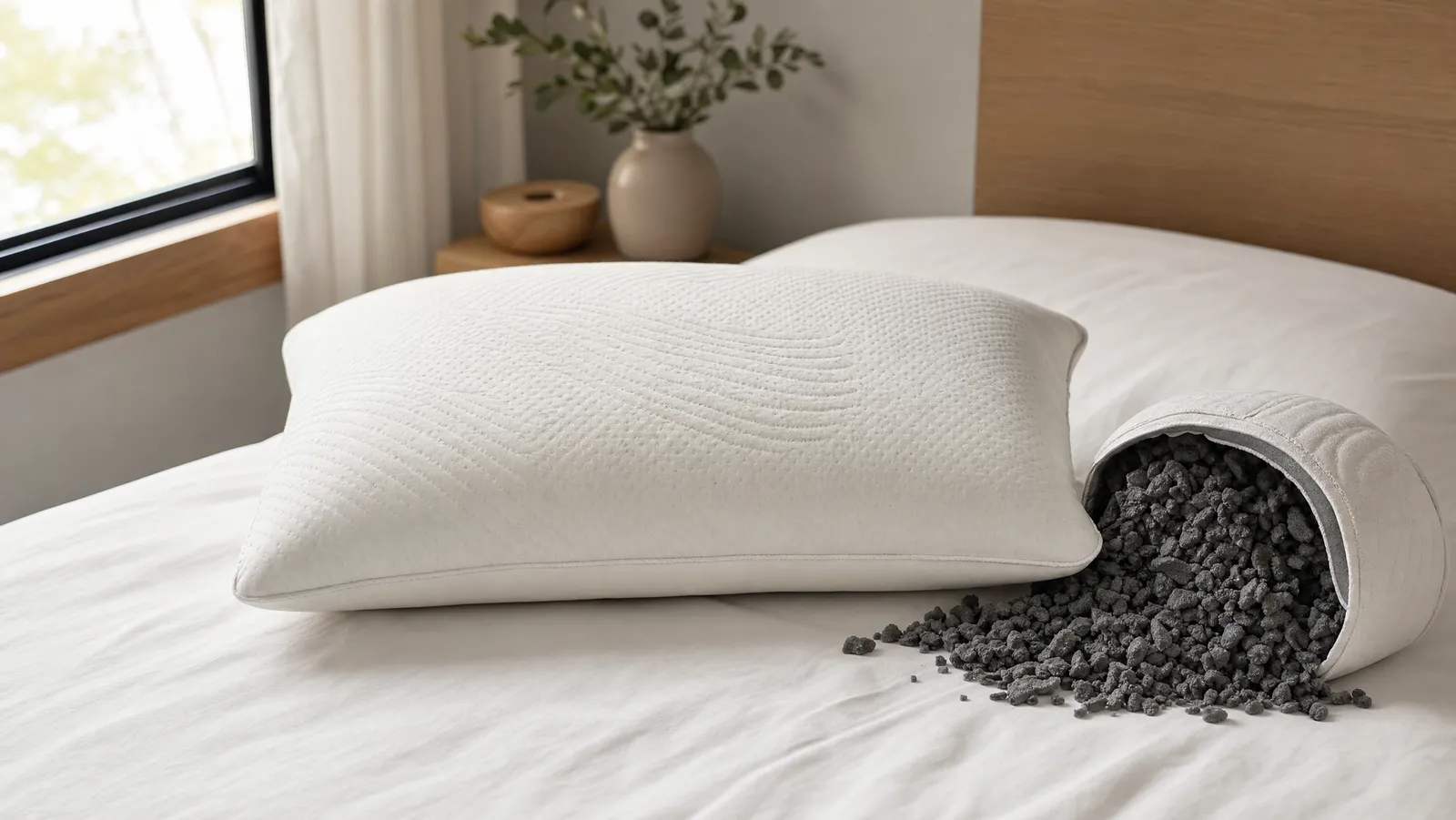
- The fill. This is what your head presses into for eight hours. In both of those pillows it is shredded memory foam.
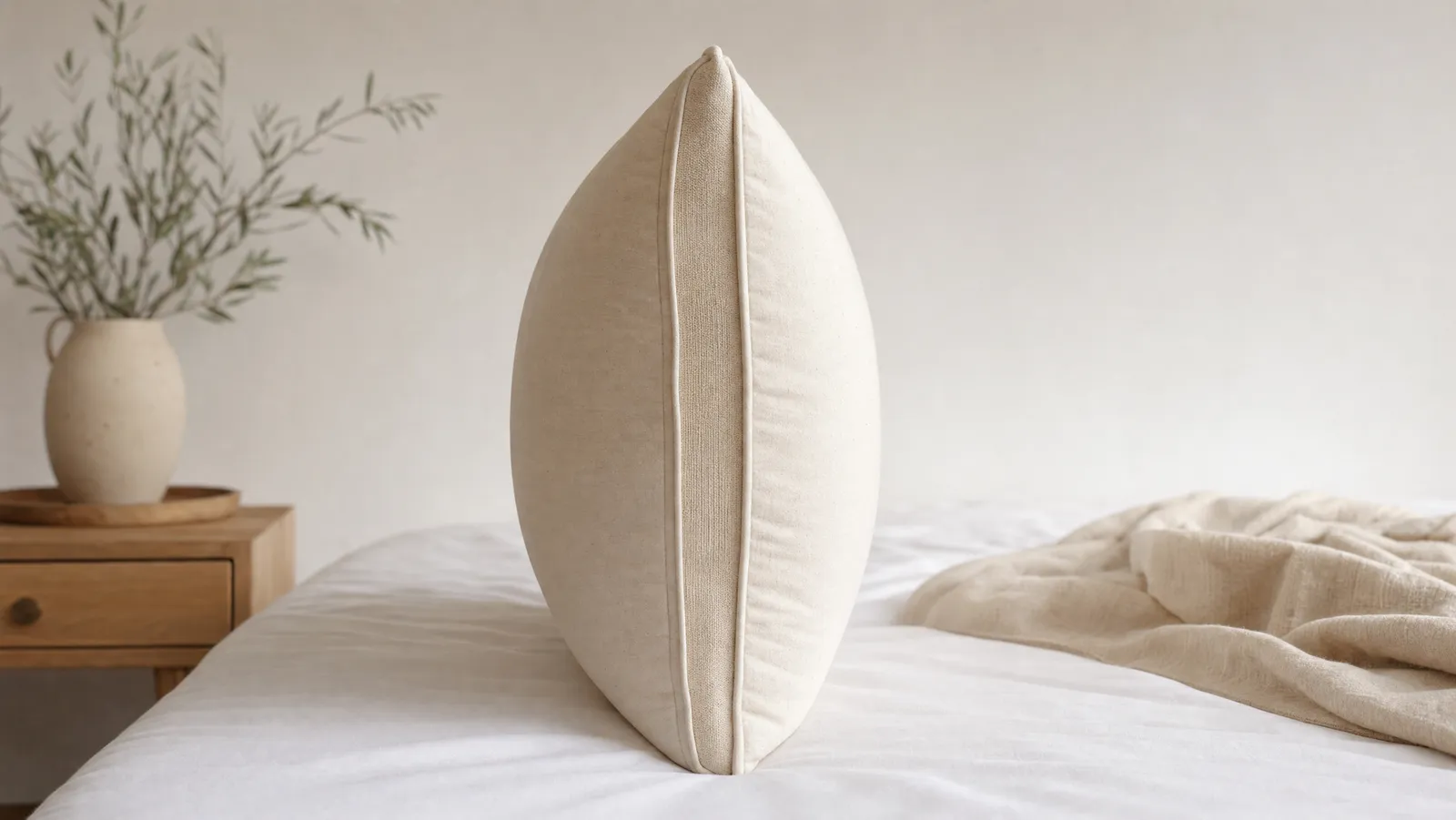
Read them in that order and the category stops being confusing. A bamboo pillow is a pillow with some bamboo-derived fibre in its cover fabric. It is not a pillow made of bamboo, and no rule obliges the name to tell you what is inside.
Our own top pick is the clearest example. OMEO's listing for the OMEO Rayon Derived from Bamboo Pillow states that each pillow is "made from 60% Polyester and 40% Rayon Derived from Bamboo Fiber", with a shredded memory foam fill. By the maker's own numbers, then, the majority fibre in the cover of our favourite bamboo pillow is polyester — so if you came to this category to get away from synthetics, are polyester pillows toxic is the more useful page. The QUTOOL pillow further down uses that same 60/40 fabric on one face of its cover.
Are bamboo pillows safe? First, why the label says "rayon"
The labelling convention that annoys shoppers is the most trustworthy thing on the page.
According to the Federal Trade Commission's bamboo textiles guidance, "textiles can only be called bamboo if they are made directly from actual bamboo fiber". Fabric made by dissolving bamboo cellulose and regenerating it into filament is a different thing, and the FTC says it "may be labeled and advertised as 'rayon (or viscose) made from bamboo'". The governing law is the Textile Fiber Products Identification Act and the FTC's Textile Rule.
This is not a dormant rule. The FTC's enforcement record on it is public and specific:
- February 2010. The FTC announced on 3 February that it had sent warning letters to 78 retailers — Wal-Mart, Target, Kmart, Amazon.com, Macy's, Sears, Kohl's, Costco and Nordstrom among the named companies — telling them to stop labelling and advertising rayon textiles as bamboo, and flagging civil penalties of up to $16,000 per violation. The line in the release is hard to misread: "Rayon is rayon, even if bamboo has been used somewhere along the line in the manufacturing process." The agency also challenged claims that such products kept the bamboo plant's antimicrobial properties, were made by environmentally friendly processes, and were biodegradable.
- 3 January 2013. Four of those companies — the FTC's own account of the case dates their warning letters to January 2010 — settled for penalties totalling $1.26 million: Sears $475,000, Amazon $455,000, Macy's $250,000 and Leon Max $80,000. The FTC's summary of the rule: "If a textile is made of rayon, sellers need to say that, even if bamboo was used somewhere along the line in the production process."
- 8 April 2022. The FTC announced actions seeking $3 million from Walmart and $2.5 million from Kohl's over marketing dozens of rayon textile products as bamboo, which it described as by far the largest penalties in this area.
So a product page that says "rayon derived from bamboo" is a page following the rules, and it deserves the benefit of that rather than suspicion. The FTC's own example phrasing is "rayon made from bamboo"; the useful red flag is the opposite case — a listing still selling you "100% bamboo" fabric.
Is bamboo viscose toxic? Keep the factory and the bedroom separate
Two different questions get welded together here, and they have genuinely different answers.
The first is what making the fibre involves. According to a 2018 peer-reviewed review in BioResources by Zhang and colleagues, the conventional viscose process dissolves cellulose with sodium hydroxide and carbon disulfide, via mercerisation and xanthation — a chemical reaction, not a physical one. Their comparison table records roughly 25 to 30% of the carbon disulfide as not recovered, alongside heavy environmental loads and high water demand. The FTC made the same point in plainer language in its 2022 case, stating that "converting bamboo into rayon requires the use of toxic chemicals and results in hazardous pollutants" — which is why it treated the retailers' eco-friendly claims as deceptive rather than merely loose.
The second is who that chemistry has been shown to harm, and on the published record, it is workers. The Agency for Toxic Substances and Disease Registry's 2025 toxicological profile for carbon disulfide states that "nearly all available human data are from occupational cohort studies, primarily in the viscose rayon industry", and identifies neurological effects — peripheral neuropathy in particular — among the most sensitive and consistent effects reported in viscose rayon workers, along with cardiovascular, ophthalmological, male reproductive and developmental effects. The historical exposure concentrations in the cardiovascular mortality studies it reviews ran from about 2.6 to 60 parts per million, by inhalation, in those occupational cohorts.
That is a serious occupational hazard. It is also not a description of a pillowcase. We have not found a published measurement of residual carbon disulfide in finished bamboo viscose bedding, and that gap is the honest limit of what anyone can tell you: the harm on record sits upstream of the shop, and the consumer-side question does not appear to have been measured. If you are weighing materials on environmental grounds, the upstream record is the substance of the argument. If you are weighing them on health grounds, the absence of a consumer measurement cuts both ways, and the certification section below is where the checkable answers are.
Bamboo rayon safety: how lyocell differs
Not all regenerated cellulose is made the same way. The same BioResources review describes the lyocell route, which dissolves cellulose directly in N-methylmorpholine N-oxide, or NMMO — a physical dissolution "without chemical reactions", in the authors' own table, as against the mercerisation and xanthation of viscose. On environment they record more than 99% of the solvent recovered and no harmful by-products formed, with the trade-off being a high energy demand for recycling that solvent. The review notes that commercial production using NMMO, known as lyocell, was established by Lenzing in Austria.
Here is the catch for shoppers. Neither bamboo-labelled pillow here tells you which process made its fibre, because "rayon derived from bamboo" is a fibre name, not a process disclosure. Unless a listing says lyocell, the label cannot answer the question.
If what you actually wanted was a plant fibre that stays a plant fibre, the best organic cotton pillows are the more direct route: cotton arrives as a fibre and is spun as one, with no dissolving and regenerating step in the middle.
Bamboo pillow chemicals: which certification answers the question
If you want one habit rather than a chemistry lesson, it is this — certifications are scoped to components, so find out which component the mark covers.
- OEKO-TEX STANDARD 100 covers the textile. OEKO-TEX describes it as "a label for textiles tested for harmful substances", in which "every thread, button and accessory have been tested against a list of over 1,000 harmful substances", with stricter limits the more intensive the skin contact. It has four product classes: Class 1, for babies and children up to three years, which OEKO-TEX says carries the strictest requirements and limit values; Class 2 for products with direct skin contact such as bed linens; and Classes 3 and 4 for items with less skin contact, such as outerwear and furnishing textiles. Because it tests the finished article against a restricted-substance list, it speaks to what is on the fabric regardless of what the fibre is called — which makes it the mark that actually addresses residual chemistry in a bamboo-rayon cover.
- CertiPUR-US covers the foam, and nothing else. Its FAQ is blunt: "We do not certify furniture, product lines or companies. We only certify flexible polyurethane foam." Within that scope, it certifies foam made without formaldehyde, ozone depleters, phthalates regulated by the Consumer Product Safety Commission, and mercury, lead and other heavy metals, with VOC emissions under 0.5 parts per million for indoor air quality, and foam "screened for" chemicals classified as carcinogens, mutagens or reproductive toxins. It also tells shoppers to look companies up in its own directory rather than trust a logo.
In a bamboo pillow, the second one covers the part you are lying on. Neither mark issues a verdict of "non-toxic" — each certifies against a published specification, which is a narrower and more useful thing. We compare the rest of them in pillow certifications explained.
What we would buy, and what each pick demonstrates
These four are here to show the buying logic rather than to rank bamboo. Full specs and prices render further down the page.
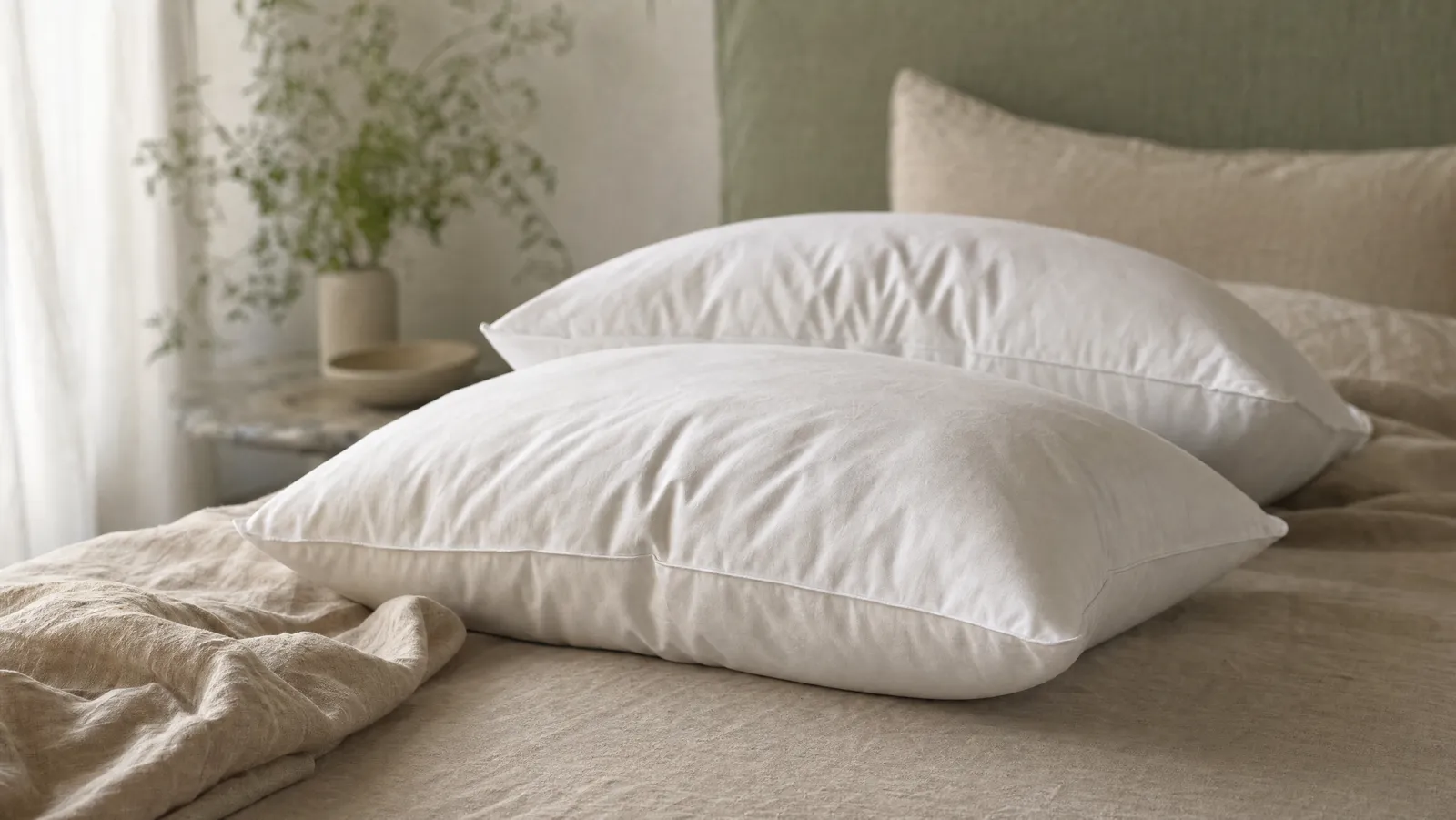
The OMEO Rayon Derived from Bamboo Pillow is our pick at $40.99 for two as of September 2026, and it earns that as much for its label as for its feel: a stated 60/40 polyester and bamboo-rayon cover over an adjustable shredded memory foam fill is the honest version of this product. The QUTOOL CertiPUR-US Shredded Memory Foam Pillow, $39.99 for two as of September 2026, puts the same 60/40 fabric on its soft face but certifies the fill instead of the trim. QUTOOL also tells buyers to air the foam out for one to two days first, which is the right instruction rather than a warning sign, and pillow off-gassing explains why. Both picks are foam-filled, so if foam is the part you are unsure about, are memory foam pillows toxic is the companion piece to this one.
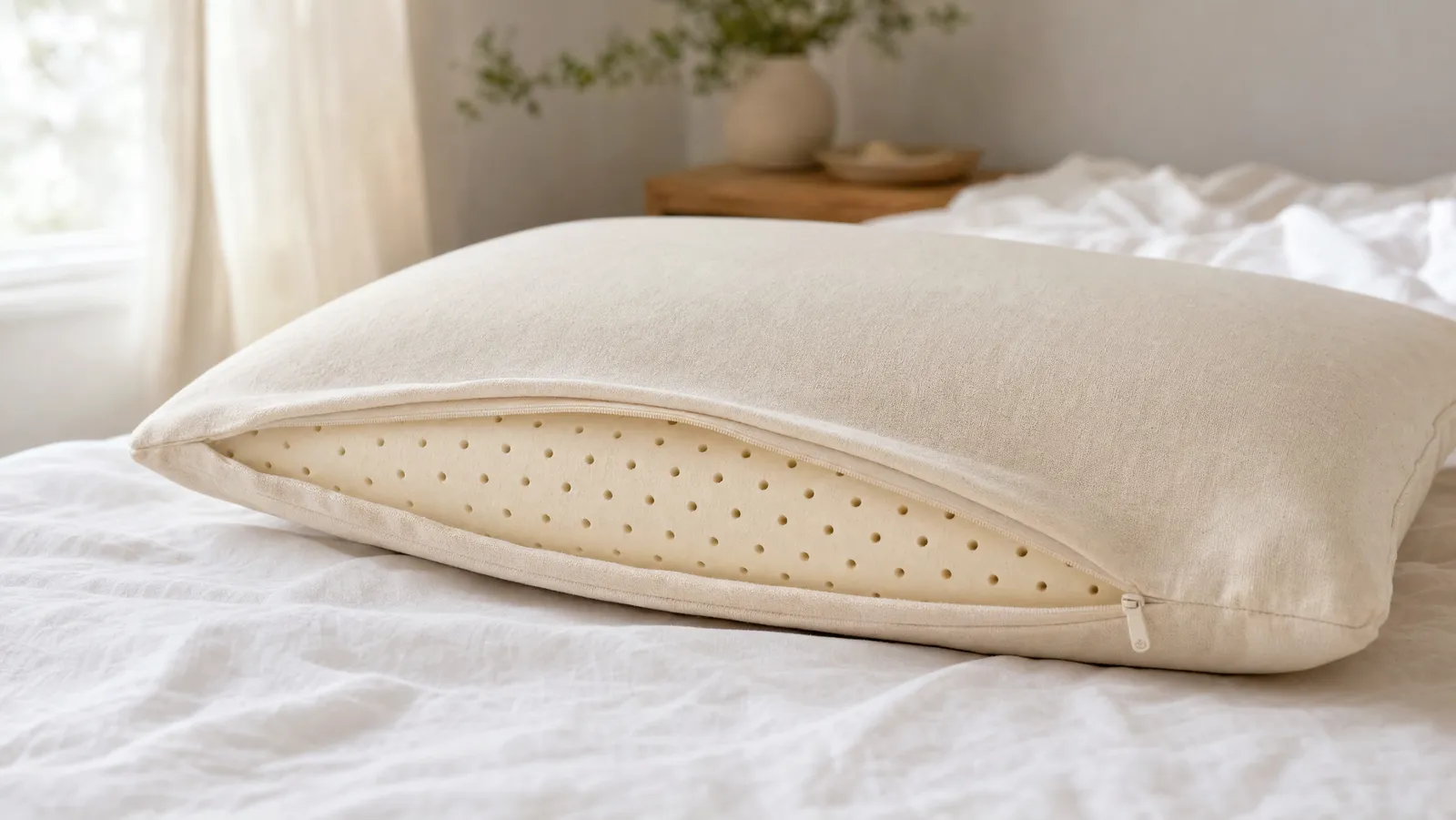
If what you wanted from "bamboo" was a plant-derived material you sleep against, the Sleep On Latex Natural Latex Shredded Foam Pillow at $49 as of September 2026 puts it in the fill: Fair Trade Sri Lankan natural latex under a machine-washable organic cotton cover, with OEKO-TEX Standard 100 Class 1 stated on the listing. Latex has considerations of its own, including allergy, and non-toxic latex pillows goes through them.
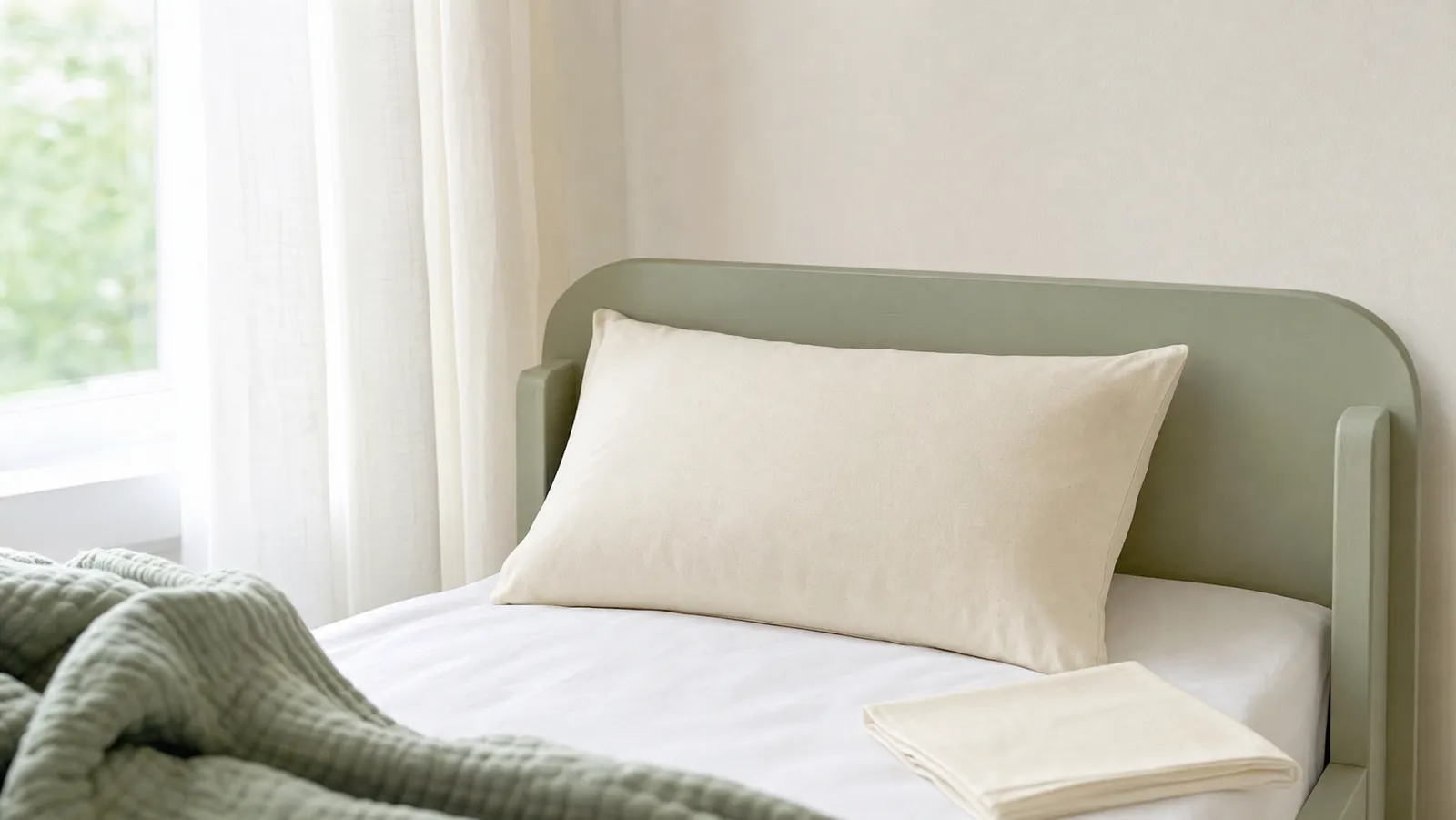
And the YOUR MOON Soft Natural Wool Pillow, $45.99 as of September 2026, is the natural-fibre option with its blend disclosed. YOUR MOON's listing describes a top layer of 100% premium wool over a bottom wool-ball layer of 51% Australian wool and 49% microfiber, inside a 100% cotton shell. That is real wool against your face and roughly half a synthetic beneath it — a compromise, stated plainly, which is exactly the reading this article is trying to teach.
The bottom line
Are bamboo pillows non-toxic? The fairer answer is that "bamboo pillow" is not a material, so it cannot carry a toxicity verdict in either direction. What the evidence supports is narrower and more useful:
- The word describes a cover blend. Both bamboo pillows here state a cover fabric of 60% polyester and 40% rayon from bamboo — one side of it, in the QUTOOL's case — over memory foam.
- "Rayon" on the label is compliance, not a dodge. The FTC requires it, and civil penalties have been obtained from companies from Sears to Walmart for leaving it off.
- The documented harm is in the factory. ATSDR's human data on carbon disulfide come almost entirely from viscose rayon workers, and no one appears to have measured the finished-bedding question.
- Buy the fill and the certificate. CertiPUR-US covers foam; OEKO-TEX STANDARD 100 covers textiles. Between them they answer more than any fibre name in a product title.
If you would rather see that logic applied to a shortlist than to a label, the non-toxic pillows we recommend are sorted by material and by what each mark actually covers. And if you are reading this because of symptoms you associate with your bedding, talk to a clinician about them — we can tell you what a pillow is made of, not what is happening to you.
The shortlist
4 pillows compared — firmness, loft, and temperature side by side. The top pick is highlighted.
| Pillow | Firmness | Loft | Sleeps | Best for | Price |
|---|---|---|---|---|---|
Medium | Adjustable | Cooling | An honestly labelled bamboo-rayon cover | $40.99 Check | |
Best Certified FillQUTOOL CertiPUR-US Shredded Memory Foam Pillow, Queen, Set of 2 | Medium Firm | Adjustable | Cooling | Certification on the fill, not the cover | $39.99 Check |
Best Natural FillSleep On Latex Natural Latex Shredded Foam Pillow, Standard | Medium | Adjustable | Cooling | A genuinely plant-derived fill | $49 Check |
Best Natural FibreYOUR MOON Soft Natural Wool Pillow, Queen | Soft | Low | Neutral | A real natural fibre, blend disclosed | $45.99 Check |
OMEO Rayon Derived from Bamboo Pillow, Standard, 2 Pack

It breathes better than the plain foam pillow it replaced, taking a handful of fill out got the height right, and the cover washes without drama.
The name is doing a lot of work for a cover that is mostly polyester over a memory foam fill, and no certification is stated for that foam.
This is our pick because of what its own listing admits. OMEO states that each pillow is "made from 60% Polyester and 40% Rayon Derived from Bamboo Fiber", and that the fill is shredded memory foam. Read those two facts together and the whole category comes into focus: the bamboo is 40% of the cover fabric, the majority fibre in that fabric is polyester, and the part your head rests on is foam.
We are not calling that a trick. It is the honest version of a bamboo pillow. The word "rayon" in the product name is there because the fibre rules require it, and a maker who writes it is telling you the truth about a process that destroyed the original plant structure. The practical product is good on its own terms too: the fill is adjustable by removing filling, the cover is removable and washable, and the standard size is 20 by 26 inches.
You get two pillows for $40.99 as of September 2026, against a $42.99 list price. Buy it for a breathable, adjustable foam pillow with a correctly labelled cover, not for the bamboo.
QUTOOL CertiPUR-US Shredded Memory Foam Pillow, Queen, Set of 2

The certified fill was the reason I bought it, and being able to pull foam out through the inner zip let me drop it to the height I sleep at.
By the maker's own advice it needs a day or two of airing out of the bag, and the cooling side is a synthetic finish, so the bamboo framing means no more here than anywhere else.
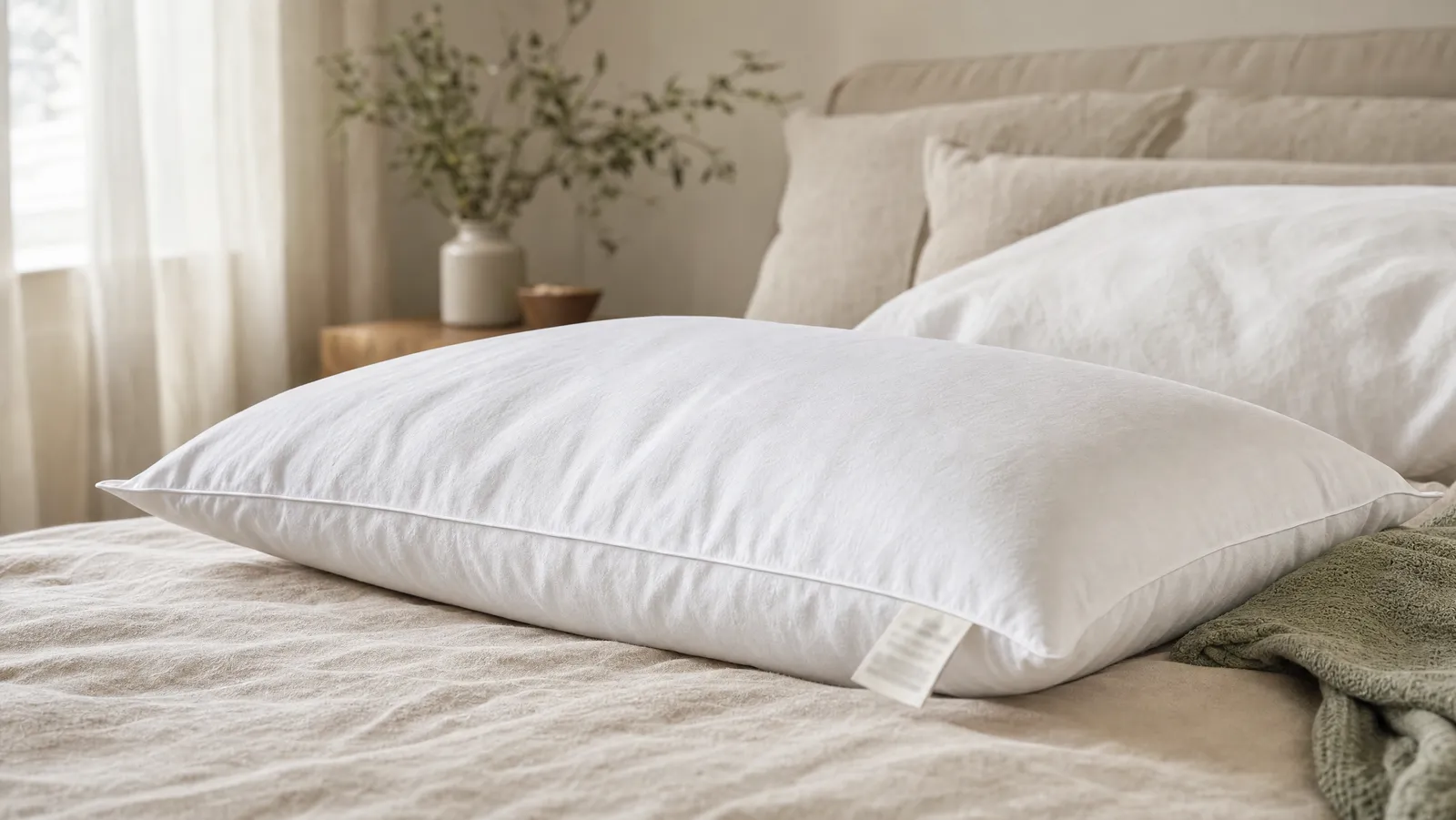
This is the instructive comparison. The soft side of QUTOOL's double-sided cover is the same 60% polyester and 40% rayon-from-bamboo fabric as our top pick, with an ice-silk cooling face on the other side. The difference is where the certification sits: QUTOOL states the foam filling is certified by CertiPUR-US, and CertiPUR-US says it only certifies flexible polyurethane foam. So the mark applies to the part you actually lie on rather than to the trim, which is the right way round.
The rest is sensible rather than exciting. Zips on the inner and outer covers let you add or remove foam to set loft and firmness, and the cover is machine washable in cold water. QUTOOL also advises airing the foam out for one to two days before use, which we would treat as a useful instruction rather than a warning.
Two queen pillows are $39.99 as of September 2026, which makes this the cheapest way here to get a named certification on a fill.
Sleep On Latex Natural Latex Shredded Foam Pillow, Standard

It has the springy support of latex rather than the slow sink of memory foam, and the cotton cover washes and goes back on easily.
It costs more than the foam picks, it is noticeably heavier, and anyone with a latex allergy has to rule it out entirely.
If the reason you went looking for a bamboo pillow was a plant-derived material you sleep against, this is the pillow that delivers it — and it delivers it in the fill rather than in a cover blend. Sleep On Latex fills it with Fair Trade natural latex foam from Sri Lanka, under a machine-washable organic cotton cover.
It is also the best-documented product on this page. The listing states OEKO-TEX Standard 100 Class 1 certification, and Class 1 is the tier OEKO-TEX defines as products for babies and children up to three years old, which it says carries the strictest requirements and limit values. That is a test of the finished article against a restricted-substance list, which is a stronger statement than any fibre name on a cover.
At $49 as of September 2026 it is the most expensive pick here, and the only one where the natural material is the thing doing the work.
YOUR MOON Soft Natural Wool Pillow, Queen

Wool feels different from foam — drier and less hot — and the cotton shell means there is nothing synthetic touching my skin.
It is about half microfiber underneath by the maker's own spec, and the low loft suits back and stomach sleepers far more than side sleepers.
Wool is the natural fibre in this lineup that arrives as a fibre and stays one, with no dissolving and regenerating step in between. YOUR MOON builds this pillow in two layers inside a quilted 100% cotton shell, and states that all of its materials are OEKO-TEX certified.
Now the part the honesty rule requires us to say out loud, because it is the same reading skill this article is about. Per YOUR MOON's own listing, the top layer is 100% premium wool, but the bottom layer is a wool-ball fill of 51% Australian wool and 49% 3.33D microfiber. So there is real wool against your face and roughly half a synthetic underneath it. The listing discloses that, which is the point: a stated blend beats an unstated one.
It is a low-loft pillow, 20 by 30 inches, machine washable, and $45.99 as of September 2026.
How to Read a Bamboo Pillow Listing in Five Minutes
Everything that matters about a "bamboo" pillow is already written on the listing. It is just written in the fibre-content statement rather than the product name.
Bamboo Pillow Safety FAQ
Are bamboo pillows non-toxic? There is no evidence we can find that bamboo-derived rayon fabric is a toxicity problem for the person sleeping on it, and there is also no published measurement we can find of residual process solvent in finished bamboo viscose bedding. What we can say is that the word "bamboo" on a pillow describes cover fabric, so it is not a claim about the fill at all.
What is a bamboo pillow made of? Usually a cover blended from polyester and bamboo-derived rayon, over a fill of shredded memory foam. Both bamboo-labelled pillows on this page state a 60% polyester and 40% rayon-from-bamboo cover fabric — on the QUTOOL, the soft side of a double-sided cover — and both are foam-filled.
Why does the label say "rayon derived from bamboo" instead of bamboo? Because US law requires it. The FTC's bamboo textiles guidance states that textiles "can only be called bamboo if they are made directly from actual bamboo fiber", and that fabric made from regenerated bamboo cellulose may be labelled and advertised as "rayon (or viscose) made from bamboo", under the Textile Fiber Products Identification Act and the FTC's Textile Rule.
Is bamboo viscose toxic? The documented harm is occupational. ATSDR's 2025 toxicological profile for carbon disulfide — one of the two chemicals used to dissolve cellulose in the conventional viscose process — states that nearly all available human data come from occupational cohort studies, primarily in the viscose rayon industry. That is a workplace exposure record, not a measurement of a pillowcase.
Is bamboo lyocell better than bamboo viscose? It is a different process. In a 2018 peer-reviewed review in BioResources, Zhang and colleagues put more than 99% of the solvent recovered and no harmful by-products on the lyocell side, against roughly 25 to 30% of the carbon disulfide not recovered on the viscose side. The catch is that a "rayon derived from bamboo" label does not tell you which route made the fibre.
Does OEKO-TEX or CertiPUR-US mean a pillow is non-toxic? Neither issues that verdict. OEKO-TEX STANDARD 100 means the textile has been tested against its list of harmful substances; CertiPUR-US states it certifies flexible polyurethane foam only. Both are specifications with a defined scope, which is more useful than a word with none.
I have symptoms I think are coming from my bedding. What should I do? Speak to a clinician about them rather than trying to work it out from a materials list. We can tell you what a pillow is made of and what a third party has tested; we cannot examine you.
Why you can trust us

Aimee Cannon
Sleep & bedding writer
Aimee Cannon is a sleep and bedding writer who has spent years testing pillows of every kind — memory foam, down, wool, bamboo, buckwheat, and specialty support pillows. She focuses on matching the right pillow to each sleeping position and need, and reports what actually holds up after months of nightly use. When she is not testing pillows, Aimee is usually with her husband and her dog.