Are Down Pillows Non-Toxic? Natural Is Not Automatic
Are down pillows non-toxic? For the most part yes — but not because down is natural. Down is a protein fibre off a bird, and the chemistry worth asking about is not in the bird at all. It is in the industrial washing, the sanitising, and whatever was done to the shell fabric. "Natural" is a marketing word, not a test result. We may earn a commission from links on this page, at no extra cost to you.
The confusion that sends most people to a page like this is a certification mix-up, and it is worth clearing up in the first paragraph. The Responsible Down Standard logo on a down pillow listing is an animal-welfare mark. It says nothing about substances. OEKO-TEX STANDARD 100 is the one that tests chemistry. Sorting those two out is most of the work in this category. The rest of this article is what down actually is, how it gets cleaned, what each mark covers and does not, and where the down-and-allergies evidence really lands. If you want the wider shopping view first, our guide to non-toxic pillow options lays out materials and certifications in order.
What is actually inside a down pillow
Down is not feathers, and the distinction is written into how the category is labelled. Only down clusters — down, nestling down and plumules — count toward a product's down content. Feathers, which have quills, do not. That is the definition the American Down and Feather Council publishes, and IDFL's guide to the US labelling standard says the same thing in reverse: only down clusters go into the down calculation, with no allowance for down fibre.
That matters for reading a listing, because the Federal Trade Commission sets expectations for the words too. Its business guidance for the feather and down industry says that for a product labelled simply "down," it is reasonable to assume consumers expect production techniques that "should yield down content of more than 70%." A product may not be called "pure down," "all down" or "100% down" — or described by any term indicating it contains only down — unless that is true. Where a label states a specific split, such as 50% down and 50% waterfowl feathers, the FTC allows only a modest deviation of no more than 5%, reflecting unavoidable manufacturing variation.
So the first thing to read is the fill ratio, not the product name. Almost every affordable "down pillow" is a feather and down blend, often with a feather core for support and down on the outside for feel. That is not deception; it is how the category works. It only becomes deception when the label says otherwise.
Where down pillow chemicals actually come from
Raw plumage does not go from a bird into a pillow. It is washed and sanitised industrially, and that process — not the fibre — is where the real-world complaints live.
According to IDFL, the independent down and feather testing laboratory, down and feathers are washed at high temperatures to remove impurities and are sterilised during the drying process. To sell down and feathers in the United States, IDFL says, a processing plant must hold a sterilisation permit, usually issued by the State of Pennsylvania.
Two lab tests describe how well that was done, and both are numbers you can ask a seller for:
- Oxygen number measures foreign organic matter on the surface of the fill. IDFL says fill must score under 10 to qualify as "clean," and 4.8 or less to support a "hypoallergenic" or "super-clean" claim.
- Turbidity measures dust. Clean products must exceed 300 mm, and hypoallergenic or super-clean claims require 500 mm or greater.
This is the useful frame for the whole topic. The complaints we see about down pillows cluster around smell and dust, and both of those are washing-quality problems with published thresholds behind them. They are not exotic chemistry. A pillow that arrives with a barnyard smell that does not fade is a badly washed pillow, and the answer is a return, not a detox.
The shell is a separate question, and a more familiar one: shells are fabric, and fabric can carry finishes. We covered the evidence on that at length in our piece on whether pillows contain PFAS, and the short version applies here too — the fluorinated chemistry that testing has found in bedding turns up in items sold on stain resistance and waterproofing, not in plain woven cotton. The same logic applies one layer out, to the pillow case you put over it.
What the Responsible Down Standard actually certifies
Here is the single most useful thing this article can tell you: the Responsible Down Standard is not a chemical-safety standard.
Textile Exchange, which owns the standard, describes the RDS as a voluntary standard that incentivises the down and feather industry to treat ducks and geese more humanely. Its scope runs across the supply chain, with a third-party certification body auditing each stage starting at the farm, and chain-of-custody documentation verifying the path certified material takes through every stage to the final product. Farms and slaughterhouses are certified against animal-welfare requirements; later stages of the chain are certified against Textile Exchange's Content Claim Standard, which is a traceability standard.
What it prohibits is specific and worth knowing. Textile Exchange states that any removal of down or feathers from live birds — live plucking or moult harvesting — is prohibited, and that force-feeding is also prohibited.
What it does not do is publish a restricted-substance list, set residue limits, or test a finished pillow for anything. That is not a criticism of the standard; it is doing the job it says it does. It is a criticism of how the logo gets used. An RDS badge on a listing about "non-toxic" bedding is answering a question nobody asked.
We take the whole landscape apart in our explainer on what pillow certifications actually mean, because this pattern repeats across every mark in the category: each one answers a narrow question and stays silent on the rest.
What OEKO-TEX STANDARD 100 adds
OEKO-TEX STANDARD 100 is the mark that covers the chemistry side, and its scope on down is more concrete than most shoppers realise.
OEKO-TEX documentation states that its laboratory tests are based on the intended use of the material, and sorts products into classes by skin contact — bedding sits in Product Class 2, products with direct skin contact. Its published test scope includes banned azo dyes, carcinogenic and allergy-inducing colourants, pesticides for natural-fibre textiles, polycyclic aromatic hydrocarbons, organic tin compounds, chlorinated phenols, phthalates, per- and polyfluoroalkyl substances (PFAS, the class that includes PFOS and PFOA), and alkylphenol ethoxylate surfactant residues.
One beat of care on those classes, because it is exactly the kind of scope detail this article is about: OEKO-TEX puts bed linen in Product Class 2, but the standard document's own worked example of Product Class 3 — products without direct skin contact — is "stuffings," which is what a pillow fill is. The class is what sets the limit values, so a casing and the fill inside it are not automatically held to the same numbers.
Two details specific to down are worth carrying to a listing. Trade reporting on feather and down certification, from a 2008 Hohenstein Institutes briefing, describes the inspection scope for fill as covering pH value, formaldehyde, heavy metals, pesticides, phenols, organic tin compounds and an odour test — that last one being a direct check on the washing quality discussed above. And OEKO-TEX's own standard document is blunt about odour: a specimen with a non-product-typical odour, such as mould or perfume, is excluded from testing immediately, with no authorisation to use the label.
The scope limit to hold onto: for a down-filled item, the "Confidence in Textiles" label may only be placed on the outside of the casing if all components — filling, casing and accessories such as zips — have been tested and certified. So "OEKO-TEX certified down" and "an OEKO-TEX certified pillow" are two different claims, and the listing will usually tell you which one it is making if you read closely.
None of this makes any pillow "safe" or "non-toxic," and we are not going to describe a product that way. It makes a specific list of substances tested for, by a named programme, on named components. That is what a certificate is.
Down-proofing: the one construction question worth asking
A down pillow leaks unless the shell stops it, and there are two routes to that: weave the fabric densely enough, or treat the surface. The finished-product tests measure the outcome rather than the method — IDFL's down-proofness rating tumbles a test pillow for 30 minutes, counts every fibre, cluster and feather that escapes, and assigns a grade from 1 for significant leakage to 5 for little or no leakage, using a rotating tumble-box method IDFL says is based on the 1956 Federal Standard FTMS 191-5530.
Which means a rating alone will not tell you whether the shell was made tight or made slick, and that is exactly the gap a reader on this page cares about. So it is genuinely useful when a maker states which route it took. Pacific Coast's standard feather and down pillow, $51.99 for two as of September 2026, is the clearest example on our list: the maker says the down-proof fabric is woven tightly rather than coated, and frames that as its alternative to a chemical finish. It is the maker's claim, not a certificate. It is still a claim with a specific, falsifiable shape, which puts it ahead of most of the category.
If you want to weigh down pillows on comfort rather than chemistry — fill power, loft, gusset height, how they behave for side sleepers — that is a different comparison, and our down pillow roundup is the page for it.
Are down pillows safe if you have allergies?
This is where the received wisdom is weakest, so we want to be careful in both directions.
True feather allergy exists, but it appears to be considerably rarer than its reputation. In a 1998 study in Allergy, Kilpiö and colleagues skin-prick tested 269 consecutive adult patients referred to a university clinic with suspected allergic symptoms. Twenty-four reacted to commercial feather extracts — but 16 of those 24 were also positive to house-dust mite by skin prick test, CAP-RAST or both, against only 23 of the other 150 atopic subjects. Nasal challenge with a feather extract was attempted in 20 cases and was negative every time. The authors' point was that feather extracts used in testing may themselves be contaminated with mite allergen, which would make a positive feather prick test look like something it is not.
The mite question also does not run the way most people assume. Rains, Siebers, Crane and Fitzharris placed pairs of new synthetic and new feather pillows together on 12 beds and measured dust-mite allergen over 12 months. Writing in Clinical & Experimental Allergy in 1999, they reported that after 12 months the synthetic pillows contained more Der p 1 (19.28 micrograms per gram) than the feather pillows (6.45 micrograms per gram), and concluded that accumulation is governed largely by the allergen concentration in the room the pillow sits in.
Read that carefully, because it is easy to over-claim. It is one small study, on 12 beds, about allergen accumulation — not a finding that down is good for asthma, and not clinical advice. What it does establish is that "switch from down to synthetic for your allergies" is not a conclusion the pillow-allergen literature supports on its own. If you have symptoms you associate with your bedding, the person to talk to is a clinician who can test you, not a product page. Old bedding of any fill, and the room it lives in, are both part of that conversation.
What we would buy, and what we would not claim
Full details on each pick render at the end of this page. Before the list, the fence: none of these pillows is certified "non-toxic" or "PFAS-free," and we will not describe any of them that way. What is checkable is narrower and more useful — what each is made of, and what a named third party has been asked to certify about it.
- The LIANLAM Hungarian goose down set is our pick at $64.79 for two queen pillows as of September 2026, because it is the listing that names both halves: LIANLAM says the down is RDS certified and that the pillow is OEKO-TEX certified. Ask for the certificate numbers.
- The Pacific Coast organic cotton feather and down set, $86.99 as of September 2026, puts an organic cotton shell over the fill — and the maker openly notes that labelling rules only let it mark the product "100% Cotton," which is the kind of caveat we like to see volunteered.
- If you would rather have a plant fibre than an animal one, the Cheer Collection Organic Kapok set at $59.99 as of September 2026 is the down-like option, with the honest catch that it names no third-party certification at all. For shells and fills in the same spirit, the best organic cotton pillows is the companion list — and non-toxic latex pillows are the other common landing spot for people leaving down behind.
We have not slept on any of these. We recommend on materials, published specifications and third-party certifications, and we attribute every maker claim to the maker.
The bottom line
Are down pillows non-toxic? Down itself is one of the least chemically complicated fills you can buy — a washed protein fibre with no foam and no adhesive, and generally no fill-side finish. The exception is worth knowing: water-repellent "hydrophobic" down is treated down, but it is an outdoor-gear product rather than a bedding one. The variables that actually matter are how well it was cleaned, which you can read in oxygen number and turbidity thresholds, and what was done to the shell around it.
Two rules will carry you through almost any listing. RDS answers a welfare question, not a chemical one. And a certificate is a scope document, not a badge — read what it covers, what components it covers, and what it stays silent about.
Some people prefer to avoid animal fill on principle, or find down too warm, or want a fill they can adjust; those are all perfectly good reasons to buy something else, and none of them requires believing down is dangerous. If you are shopping for a child, the sizing and firmness questions matter more than the chemistry, and non-toxic pillows for kids deserve their own treatment. And if you want the whole category laid out by material, start with our guide to non-toxic pillows.
The shortlist
4 pillows compared — firmness, loft, and temperature side by side. The top pick is highlighted.
| Pillow | Firmness | Loft | Sleeps | Best for | Price |
|---|---|---|---|---|---|
Medium Soft | High | Neutral | Down with both an animal-welfare and a chemical certification | $64.79 Check | |
Best Organic Cotton ShellPacific Coast Goose Feather and Down Pillows, Organic Cotton Fabric (Standard, Set of 2) | Firm | High | Neutral | An organic cotton shell over down | $86.99 Check |
Medium Firm | Medium | Neutral | Down-proofing without a coating | $51.99 Check | |
Best Down AlternativeCheer Collection Organic Kapok Bed Pillows (Standard, Set of 2) | Medium Soft | Medium | Neutral | Skipping foam entirely | $59.99 Check |
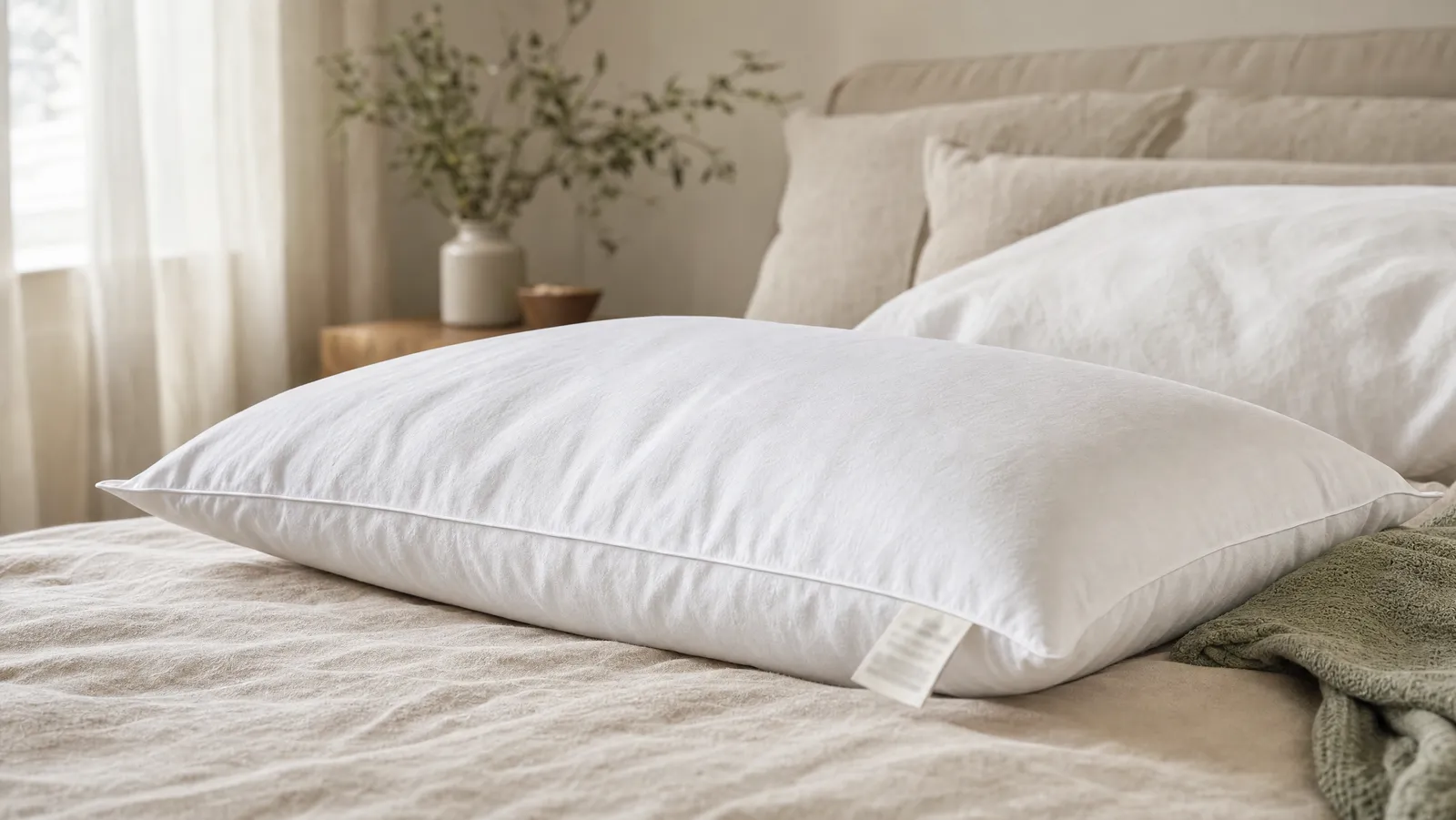
LIANLAM RDS & OEKO-TEX Certified Hungarian Goose Down Pillow (Queen, Set of 2)

They arrived flat in the bag and took a day to loft up, but there was no smell at all, which was the thing I was most worried about with down.
The feather core means the occasional quill works its way toward the surface, and at this loft it is too tall for me on my stomach.
This is the pick we point at when someone wants both halves of the question answered on one listing. LIANLAM states the down is RDS certified, with no live-plucking or force-feeding, and that the pillow is OEKO-TEX certified — the first claim is about the birds, the second is about substance testing, and most down listings name only one of them.
LIANLAM describes the construction as a three-chamber gusseted build with a feather core and down outer layers, under a down-proof cotton-blend shell. LIANLAM says the fill is washed and air-dried so it arrives odourless, and that the pillow is machine washable cold, below 40C. Two queen pillows are $64.79 as of September 2026 against a $129.99 list price. We have not tested these pillows and cannot verify either certificate for you — ask the seller for the certificate numbers and check them in the issuing databases.
Pacific Coast Goose Feather and Down Pillows, Organic Cotton Fabric (Standard, Set of 2)

The 2-inch gusset is what sold me — it holds height at the edge, so on my side I am not folding it in half to fill the gap at my shoulder.
It is firmer than I expected from a feather and down pillow, and the organic cotton claim is not printed on the pillow itself, which threw me.
The shell is the part of a down pillow that actually touches you, and this is the version of Pacific Coast's feather and down pillow with an organic cotton one. There is an honest wrinkle the maker volunteers: Pacific Coast says the cover is 100% organic cotton but that labelling rules only permit it to be marked "100% Cotton" on the product itself. That is a good sign about a listing, not a bad one — it is a company explaining a gap between its claim and its label instead of hoping you will not notice.
Pacific Coast states the feather and down is certified by RDS and OEKO-TEX, and describes the construction as a double-layer down-proof build with a 2-inch gusset aimed at side and back sleepers. It is the firmest and the most expensive pick here at $86.99 for two standard pillows as of September 2026, down from a $101.99 list price.
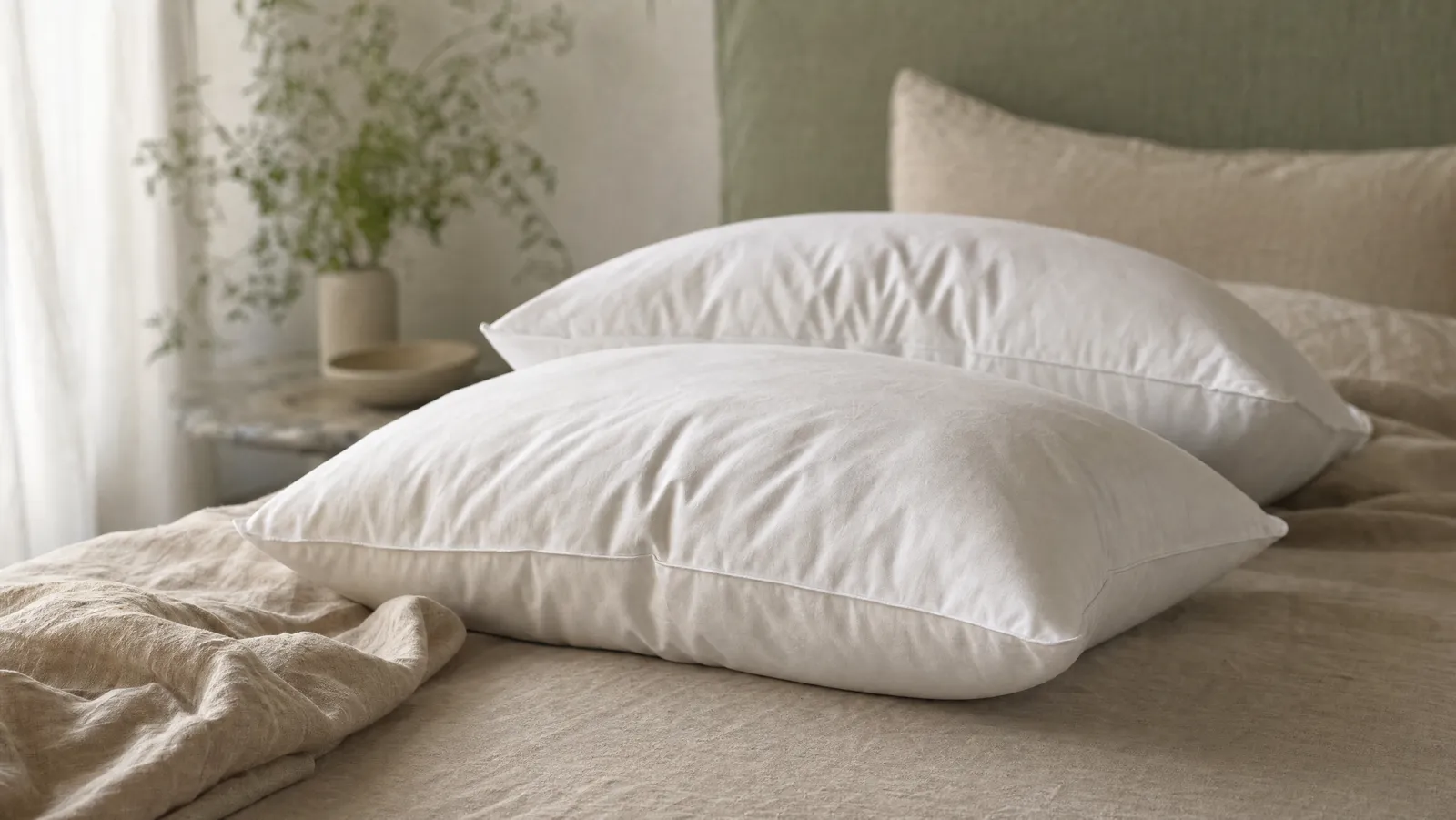
Pacific Coast Goose Feather and Down Bed Pillows (Standard, Set of 2)

Two years in and I have picked maybe three feathers off the sheets, which is better than the down pillow twice this price that it replaced.
The medium loft collapses if you like a tall pillow, and washing it means a very long drying cycle to get the fill properly dry again.
This is the pick that answers the down-proofing question directly. Pacific Coast states that the shell is made down-proof by weaving the cotton tightly rather than by coating it, and describes that as its alternative to a chemical finish. It is the maker's own claim rather than a certification, but it is a specific one, and specific claims are the ones you can hold a company to.
The rest is unfussy: a tightly woven 100% cotton shell, goose feather and down fill that Pacific Coast says is washed multiple times for cleaner fill and longer-lasting loft, ethically sourced fill the maker states is certified by RDS and OEKO-TEX Standard 100, a stitched piping seam and machine washability. Two standard pillows are $51.99 as of September 2026 against a $64.99 list price, which makes this the cheapest way here into certified fill.
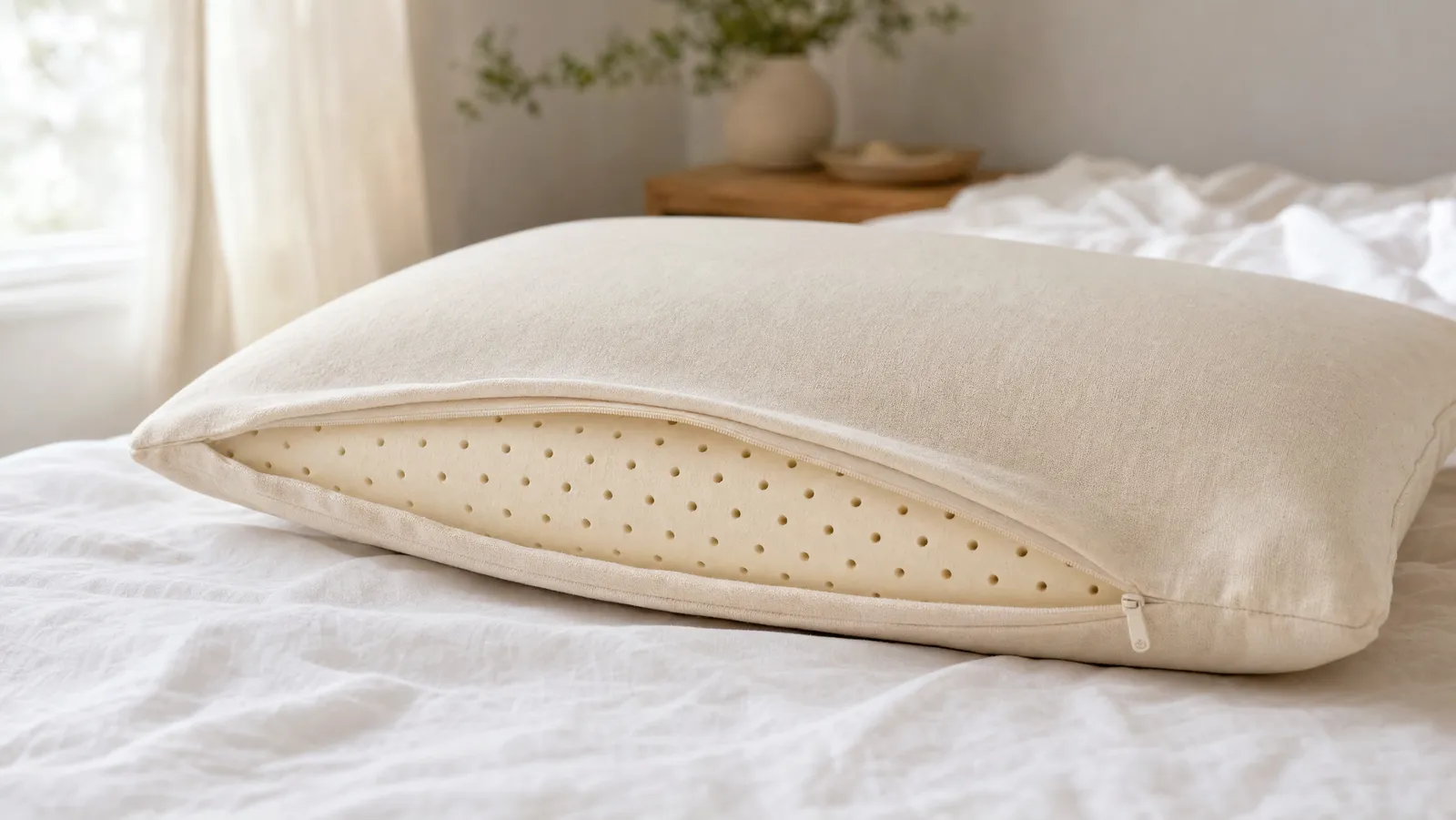
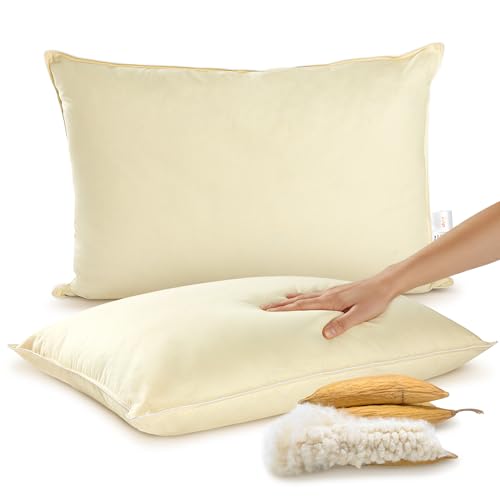
Cheer Collection Organic Kapok Bed Pillows (Standard, Set of 2)
It has the give of a down pillow with no quills and no feather smell, and I stopped noticing it was not down after about a week.
Kapok packs down over the first month and needs shaking out regularly, so it takes more maintenance than the down pillows it replaced.
Some people decide, having read all of the above, that they would simply rather not sleep on an animal fibre. Kapok is the closest plant analogue we know of: a seed fibre with a soft, collapsible feel, here as a 100% kapok fill inside a 100% cotton shell. Cheer Collection describes it as lightweight and more breathable than cotton or wool, with a down-like softness.
The trade-off is verification. There is no third-party mark named on this listing, so unlike the down picks there is no certificate to look up — you are judging it on a two-line ingredient list, which is short but unaudited. Two standard pillows measuring 20 x 28 inches are $59.99 as of September 2026, down from a $79.99 list price.
How to Read a Down Pillow Listing in Five Minutes
Down listings are unusually easy to audit, because the industry has real tests behind most of the words. Five minutes and this order of operations will tell you more than an hour of comparing marketing copy.
Down Pillows and Chemicals FAQ
Are down pillows toxic? We have not found evidence that a washed, sanitised down fill delivers a meaningful chemical dose to a sleeper, and we would not tell you otherwise. The questions with actual evidence behind them are about processing quality and about what is applied to the shell fabric, not about the down itself.
Does the Responsible Down Standard mean a pillow has been tested for chemicals? No. Textile Exchange describes the RDS as a voluntary standard that incentivises humane treatment of ducks and geese, with farms and slaughterhouses audited against animal-welfare requirements and later supply-chain stages certified for chain of custody. Its published scope is welfare and traceability. It does not publish a restricted-substance list.
What does OEKO-TEX test on down and feather fill? Per OEKO-TEX documentation, STANDARD 100 testing is based on intended use, and bedding with direct skin contact falls in Product Class 2. Trade reporting from 2008 on feather and down certification describes the scope as covering pH value, formaldehyde, heavy metals, pesticides, phenols, organic tin compounds and an odour test. OEKO-TEX also excludes from testing any specimen with a non-product-typical odour, such as mould or perfume.
Am I allergic to down? Possibly, but it is rarer than the internet suggests. In a 1998 study in Allergy, Kilpiö and colleagues skin-prick tested 269 consecutive adult patients; 24 reacted to commercial feather extracts, but 16 of those 24 were also positive to house-dust mite, and nasal challenge with a feather extract was negative in all 20 cases attempted. Talk to a clinician rather than to a product page — the distinction matters for treatment.
Do down pillows collect more dust mites than synthetic ones? The published comparison points the other way. Rains, Siebers, Crane and Fitzharris put paired new synthetic and feather pillows on 12 beds for 12 months and reported that after 12 months the synthetic pillows held more Der p 1 (19.28 µg/g) than the feather pillows (6.45 µg/g), in Clinical & Experimental Allergy in 1999.
Is a new down pillow supposed to smell? A faint natural smell that fades is common; a persistent barnyard smell usually means the fill was not washed well enough. That is a returns question, not a chemistry question.
My bedding makes me feel unwell. What should I do? Stop using it and see a clinician. We can tell you what a pillow is made of and who tested it against what list. We cannot examine you.
Why you can trust us

Aimee Cannon
Sleep & bedding writer
Aimee Cannon is a sleep and bedding writer who has spent years testing pillows of every kind — memory foam, down, wool, bamboo, buckwheat, and specialty support pillows. She focuses on matching the right pillow to each sleeping position and need, and reports what actually holds up after months of nightly use. When she is not testing pillows, Aimee is usually with her husband and her dog.