Do Pillows Contain PFAS? What the Testing Shows
Do pillows contain PFAS? Most plain pillows probably do not. The forever chemicals that testing has found in bedding come overwhelmingly from performance finishes — stain-resistant, waterproof and spill-proof treatments — and an untreated cotton, latex, wool or kapok pillow has no reason to carry one. The item to check is usually the protector, not the pillow. We may earn a commission from links on this page, at no extra cost to you.
That is the useful version of the answer, and it is more reassuring than most of what is written on this subject. The rest of this article is the evidence behind it: what independent testing actually found in bedding, why a finish rather than a fill is the vector, what regulators have and have not restricted as of August 2026, and where the evidence for pillows specifically simply runs out. If you want the shopping side of this rather than the science, our guide on how to choose a non-toxic pillow covers materials and certifications in order.
What the testing on bedding actually found
The most useful dataset we have found on PFAS in bedding comes from Toxic-Free Future, a Seattle-based research and advocacy nonprofit, in a January 2022 report called Toxic Convenience. Its researchers bought 60 products from ten major retailers and screened them for total fluorine and for specific PFAS.
Twenty of those items were bedding: four comforters, seven mattress pads or covers, and nine sheet sets or pillowcases. The findings split cleanly along one line:
- Nine of the 13 bedding items marketed as stain- or water-resistant contained PFAS. All four comforters exceeded the study's 100 ppm screening level for total fluorine, and three of the four contained older PFAS that have been phased out in some countries.
- None of the bedding items that made no stain- or water-resistance claim tested above that screening level. That is the sentence worth carrying around.
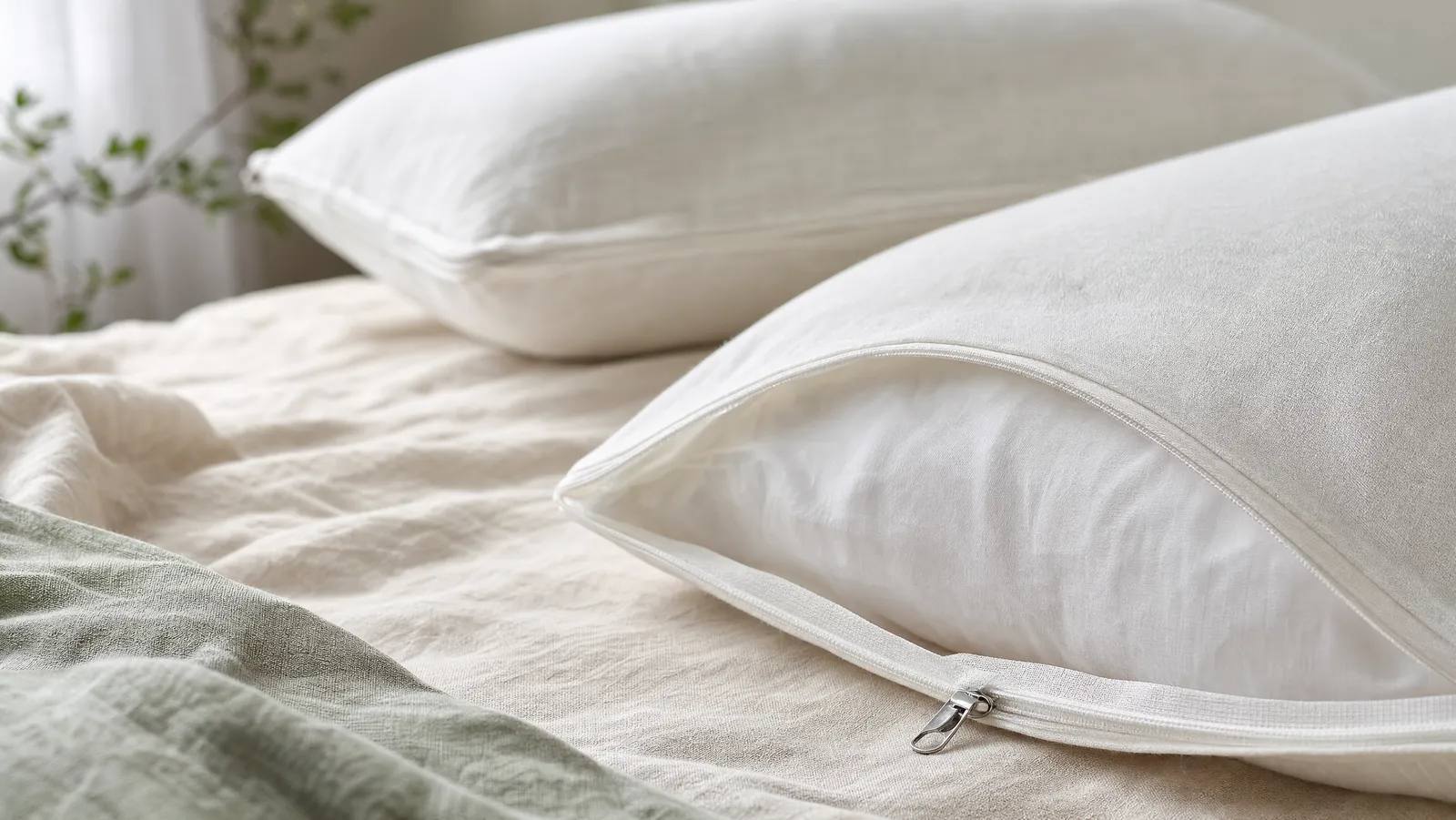
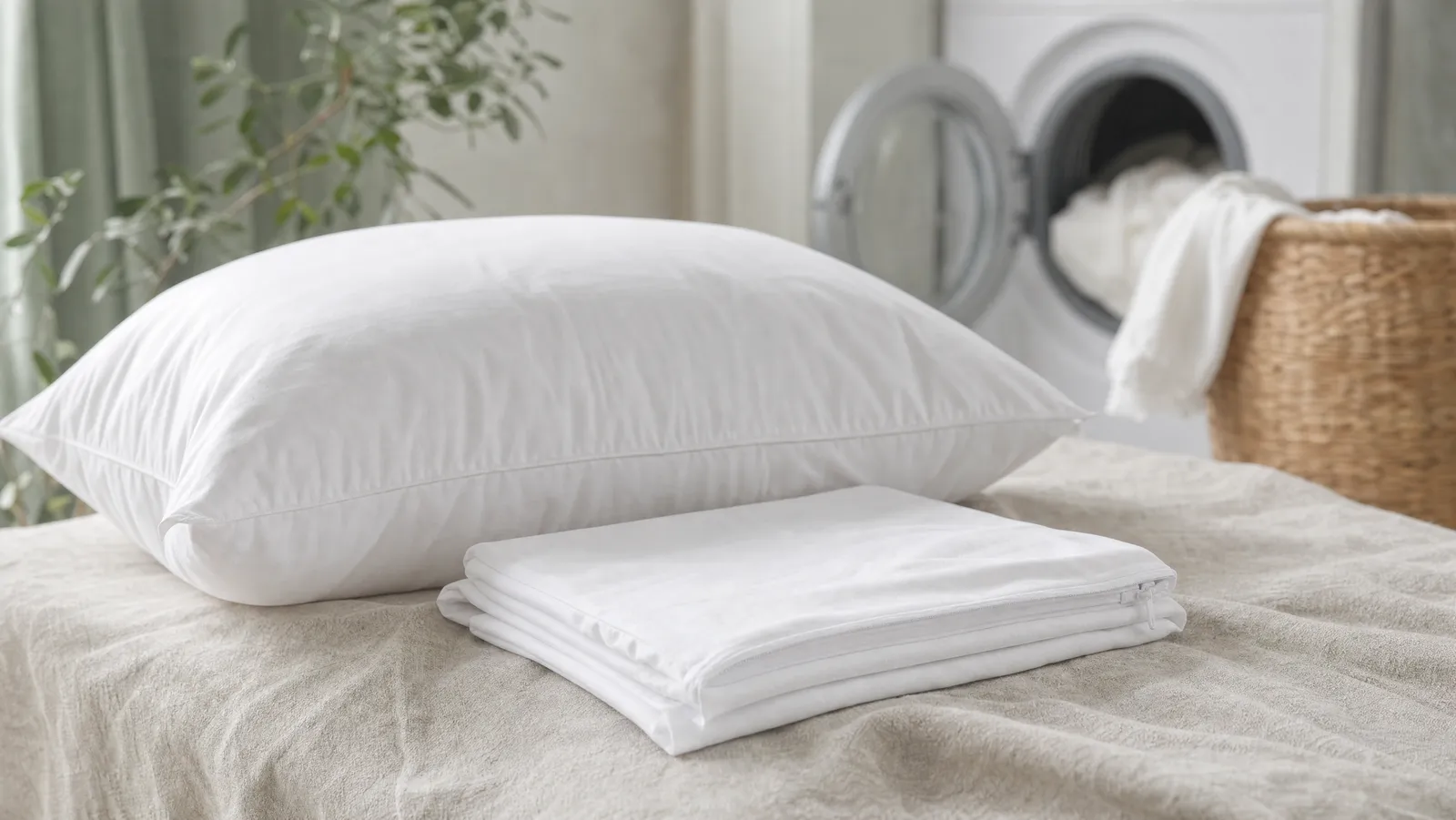
- Only one of eight sheet sets tested positive — a set of pillow protectors marketed as Teflon-treated, waterproof and stain-resistant.
- Three mattress pads had no detectable fluorine at all, and two of those three claimed stain resistance or waterproofing anyway. Their makers were achieving the function without fluorinated chemistry.
Two honest limits on that study. It was product testing by an advocacy organisation rather than a peer-reviewed journal article, and the products were purchased in autumn 2020, before the state rules described below existed. Also note what is missing from the sample: pillow inserts. We have not found published testing of bed pillow fills at all — which is itself informative, because the categories researchers screen first are the ones where a treatment is expected.
Why the finish is the vector, not the fill
PFAS are used in textiles for a specific job: they lower surface energy so that water, oil and stains bead up instead of soaking in. That is the entire commercial reason they appear in fabric. A pillow's fill — latex, kapok, buckwheat hulls, polyester fibre, foam — is not typically where that chemistry is applied, because nobody is trying to make the inside of a pillow shed a coffee spill.
So the risk profile of a pillow tracks a short list of words on the listing rather than the material itself:
- Waterproof, water-repellent, spill-proof. The single strongest signal, and the reason protectors and mattress pads dominate the positive results.
- Stain-resistant, stain-release, Teflon-treated, Scotchgard-treated. Named finish brands are the most literal version of the same signal.
- Moisture-wicking and quick-dry, where the effect is achieved with a chemical finish rather than by fibre structure or knit.
This is also why the pillowcase deserves a thought — it is the layer actually touching your face all night, and it is the layer most likely to be sold with a performance claim. If you are replacing yours, our roundup of luxurious pillow cases sticks to plain woven natural fibres, which is the right instinct here for reasons that have nothing to do with luxury.
Hazard is not the same as dose
Here is where most writing on this topic goes wrong, and where we want to be careful.
The hazard side is real and well documented. The US Environmental Protection Agency states that exposure to certain levels of PFAS "may lead to" reproductive effects such as decreased fertility, developmental effects in children, increased risk of some cancers including prostate, kidney and testicular cancers, and a reduced immune response including reduced vaccine response. Its page, updated in July 2026, keeps that hedged phrasing deliberately, and the agency notes it is genuinely difficult to assess these chemicals because thousands of them exist with differing toxicity and people are exposed by different routes at different life stages.
The exposure side, for bedding specifically, is where the evidence thins out. The ATSDR, the federal agency that assesses toxic substances, is blunt that "it is difficult to show that substances directly cause health conditions in humans" and that more research is needed. When ATSDR lists how people actually accumulate PFAS, the routes it names are contaminated drinking water, food, food packaging, contaminated soil or dust, and residue or dust from consumer products — a list that does include stain-resistant fabrics and water-resistant clothing. Treated textiles are on the list; sleeping on bedding is not singled out as a route of its own, and ATSDR puts no number on it.
Can PFAS cross skin at all? Yes, in the lab. A 2024 study in Environment International by Ragnarsdóttir and colleagues at the University of Birmingham tested 17 PFAS on three-dimensional human skin equivalent models and found 15 of them showed substantial dermal absorption of at least 5% of the applied dose; for PFOA, 13.5% passed through into the receptor fluid with a further 38% retained in the skin. That is a meaningful finding. But read the method: the compounds were dissolved in solvent and applied directly to skin models at a set dose. It establishes that skin is a possible route. It does not measure how much, if anything, migrates from a treated fabric to a sleeping person — and nobody has published that number for pillows.
So the honest statement is narrow. A treated textile can contain PFAS; skin can absorb PFAS under laboratory conditions; the dose a sleeper receives from bedding has not been quantified. Nobody can tell you a pillow caused a health condition, and we are not going to imply it.
What is actually restricted, and where
Regulation on this has moved fast, and it is state-level rather than national. Two rules matter most for bedding as of August 2026:
- California. AB 1817 prohibits manufacturing, distributing or selling textile articles containing regulated PFAS — and the statute's definition of textile articles expressly includes bedding. The prohibition took effect 1 January 2025 at a threshold of 100 parts per million total organic fluorine, dropping to 50 ppm on 1 January 2027. Outdoor apparel for severe wet conditions gets until 2028, with a "Made with PFAS chemicals" disclosure in the meantime.
- Maine. Under Title 38, section 1614, the sale of textile articles containing intentionally added PFAS has been prohibited in Maine since 1 January 2026, with outdoor apparel for severe wet conditions following in 2029. Maine's Department of Environmental Protection also runs a "currently unavoidable use" process through which specific products can be exempted, so the ban is not absolute.
Two things this does not mean. There is no nationwide US ban on PFAS in consumer bedding. And a state prohibition applies to what may be sold there going forward — it does not retroactively clean out the linen closet, and enforcement thresholds are measured in parts per million, not zero. Other states have passed their own restrictions and reporting requirements on staggered schedules; if you want the position in your own state, your state environmental agency is the source to check rather than a brand's blog.
What certifications cover — and what they do not
This is the part that gets oversold, so read the scope, not the logo. We unpack the whole landscape in our explainer on what pillow certifications actually mean, but three marks come up constantly on pillow listings:
- OEKO-TEX Standard 100 bans the intentional use of PFAS across its certifications, and as of 2026 certified products must meet a limit of 25 ppb for each regulated PFAS substance, with the total fluorine limit dropping from 100 ppm to 50 ppm in line with California's rule. OEKO-TEX tests the PFAS defined as textile-relevant in the EN 17681-1 standard, because identifying every individual compound is not technically feasible. Crucially, OEKO-TEX states plainly that certification means a product has been tested for the listed substances — it does not certify a product as "PFAS-free."
- GOTS, the Global Organic Textile Standard, goes further on paper. Version 7.0 of the standard, dated March 2023, lists per- and polyfluoroalkyl substances as prohibited chemical inputs — "all PFAS compounds," naming PFOA, PFOS, fluorotelomer alcohols and PTFE — and sets residue limits of under 0.025 mg/kg for PFOA- and PFOS-related substances. Its "organic" label grade requires at least 95% certified organic fibre; "made with organic" requires at least 70%. GOTS certifies the textile, so on a pillow it typically covers the cover, not the fill.
- CertiPUR-US is the mark most commonly cited on memory foam pillows, and its scope is narrower than shoppers assume. The programme certifies flexible polyurethane foam made without formaldehyde, ozone depleters, prohibited phthalates, and mercury, lead and other heavy metals, with VOC emissions below 0.5 ppm. PFAS are not among the substances it lists. We made the same point in our best cervical pillows roundup: it certifies the foam, not the cover, and not this question.
Which is worth saying directly, since the question comes up whenever memory foam is mentioned: the published concerns about polyurethane foam bedding are about VOC emissions and, historically, flame retardants in pillows and foam furniture — a separate chemistry from PFAS, with separate evidence. If you are weighing whether memory foam pillows are toxic, that is the literature to read, not this one, and our memory foam pillow roundup covers what those foams are certified against.
Pillows built without performance finishes
Full details on each pick render at the end of this page, so we will keep this brief — and precise. None of these four is certified or lab-tested PFAS-free, and we are not going to describe any of them that way. What is true and checkable is narrower: their construction does not depend on the added stain-, water- or moisture-wicking finishes that testing has identified as the PFAS vector in textiles.
- The ORGANIC TEXTILES Natural Latex Pillow is our pick at $109.95 as of August 2026 — natural latex fill under what the maker lists as a GOTS certified organic cotton cover, a standard that prohibits PFAS as an input.
- The Cheer Collection Organic Kapok set is $59.99 for two as of August 2026: kapok fibre in a cotton shell, and a down-like feel without down. Note that the maker's "without any chemicals" line is marketing, not a certification.
- The LOFE Organic Pillow at $39.95 as of August 2026 is the only pick citing a testing programme — LOFE says it meets OEKO-TEX Standard 100 — with an organic cotton shell over an adjustable polyester pearl fibre fill.
- The LOFE Organic Buckwheat Pillow, $38.99 as of August 2026, is the firm option: heat-treated buckwheat hulls in an organic cotton shell, adjustable by the handful, with a rustle the maker openly warns about.
We have not slept on these pillows, and we do not have lab results for them. What we can do is read listings carefully and tell you which claims are certified, which are the maker's own, and which are neither.
The bottom line
Do pillows contain PFAS? Some bedding does, and the pattern in the testing is consistent enough to act on: the fluorine turns up in items sold as stain-resistant, waterproof or Teflon-treated, and it did not turn up above the study's screening level in any of the untreated items. Comforters, mattress pads and pillow protectors are where the evidence points. We have not found published testing of bare pillow fills at all.
If you want to lower your odds, the move is unglamorous — skip the performance finishes, buy plain fibres you can name, and treat certificates as scope documents rather than badges. If you want that shopping list assembled for you, start with our guide to the best non toxic pillows. And if you are here because you feel unwell and suspect your bedroom, please take that to a clinician rather than to a checkout page. Some people prefer to avoid these finishes on principle, and that is a perfectly reasonable thing to want. It is just not the same as a diagnosis.
The shortlist
4 pillows compared — firmness, loft, and temperature side by side. The top pick is highlighted.
| Pillow | Firmness | Loft | Sleeps | Best for | Price |
|---|---|---|---|---|---|
Medium | Medium | Cooling | Natural materials and durability | $109.95 Check | |
Medium Soft | Medium | Cooling | A plant-based alternative to down | $59.99 Check | |
Best Tested & BudgetLOFE Organic Pillow 20x26 with Organic Cotton Case | Medium | Adjustable | Neutral | Substance-tested materials on a budget | $39.95 Check |
Best Firm OptionLOFE Organic Buckwheat Pillow with Organic Cotton Pillowcase | Firm | Adjustable | Cooling | Firm, fully adjustable support | $38.99 Check |
ORGANIC TEXTILES Natural Latex Pillow with GOTS Organic Cotton Cover (Standard, Medium)

It is dense and springy rather than sinky, and after two years it still has the same shape it arrived with — which is more than I could say for the two pillows it replaced.
Latex is heavy and has a faint rubbery smell for the first week, and you cannot wash the core, so the cover does all the cleaning work.
This is the pillow we point to when someone wants the shortest possible materials list. The fill is natural latex, which the maker describes as sustainably harvested, and the maker lists the removable cover as GOTS certified organic cotton — a standard whose version 7.0 rulebook lists PFAS among the chemical inputs it prohibits outright. Nothing about the construction depends on a stain-repellent or moisture-wicking finish, which is the documented route by which PFAS end up in textiles.
The maker says a pin-hole ventilated core improves airflow and resists the sagging that flattens other latex pillows. Two practical notes: the cover is machine washable but the latex core is not, and at $109.95 as of August 2026 this is the most expensive pick here.
Cheer Collection Organic Kapok Bed Pillows (Set of 2, Standard)
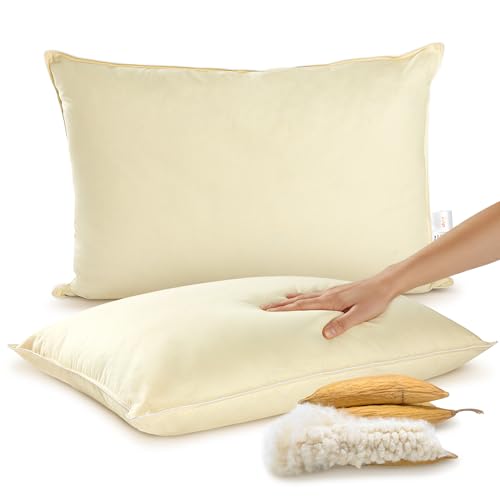
It has the give of a down pillow without the feather quills, and the two of them cost less than one boutique pillow.
Kapok compresses over the first month and needs regular fluffing to keep its loft, so it takes a little maintenance to keep the feel it arrived with.
Kapok is a seed fibre, and it is the closest plant-based analogue to down we know of: Cheer Collection describes the fill as lighter and more breathable than cotton or wool, with a down-like softness and gentle firmness. The shell is 100% cotton. Again, the appeal here is subtractive — a fill and a shell, with no performance finish doing any of the work.
You get two standard pillows, 20 x 28 inches, for $59.99 as of August 2026 against a $79.99 list price. One caution on the marketing: the maker says the pillow supports you "without any chemicals," which is a slogan rather than a certification. There is no third-party mark on this listing, so judge it on its stated fibre content.
LOFE Organic Pillow 20x26 with Organic Cotton Case

I pulled out about a third of the fill and it went from too puffy to exactly right, and the cotton cover washes without going stiff.
It is smaller than a standard pillow, so my old pillowcases bag around it, and the maker warns against washing the fill itself.
This is the only pick that names a substance-testing programme: LOFE says the pillow meets OEKO-TEX Standard 100 and CPSC requirements and is tested free of 100-plus harmful substances. That matters here because OEKO-TEX bans the intentional use of PFAS across its certifications and applies a 25 ppb limit per regulated PFAS substance as of 2026 — though OEKO-TEX is explicit that its label does not certify anything as "PFAS-free."
Read the fibre content carefully. The cover and inner shell are 100% organic cotton; the fill is polyester pearl fibre, so "organic" describes the shell, not the stuffing. A side zipper lets you add or remove fill to set the loft. At $39.95 as of August 2026, down from a $42.95 list price, it is the cheapest way here to get a named certification — just note the 20 x 26 inch size runs smaller than a standard pillow.
LOFE Organic Buckwheat Pillow with Organic Cotton Pillowcase

Being able to pour out a cup of hulls at a time meant I finally got the height right, and it stays cool in a way foam never did for me.
The rustle takes a week to tune out, and a full buckwheat pillow is genuinely heavy compared with anything fibre-filled.
Buckwheat is the most literal answer to "what is actually in my pillow": hulls in a cotton bag. LOFE says the tartary buckwheat hulls are heat-treated before packing, the shell is 100% organic cotton, and an extra organic cotton pillowcase comes in the box. A side zipper lets you pour hulls in or out until the height is right, which makes it the most tunable pillow on this page.
It is also the most acquired taste, and the maker says so: expect a rustling sound when you move and a faint natural odour from the hulls. At $38.99 as of August 2026 it is the least expensive way to get a firm, fully adjustable pillow whose construction does not rely on any performance finish.
How to Audit Your Own Bedding in Five Minutes
You cannot detect PFAS at home — it takes a lab and a total-fluorine screen. What you can do is find the items most likely to have been treated, because in the Toxic-Free Future testing the treated items were the ones that came back positive.
PFAS and Pillows FAQ
Do all pillows contain PFAS? No. In Toxic-Free Future's 2022 "Toxic Convenience" testing, none of the bedding items that made no stain- or water-resistance claim tested above the study's 100 ppm screening level for total fluorine. The positives clustered in treated items.
Does OEKO-TEX Standard 100 mean a pillow is PFAS-free? No, and OEKO-TEX says so itself: certification means a product has been tested against the listed substances, not that it is certified "PFAS-free." OEKO-TEX bans the intentional use of PFAS across its certifications and, as of 2026, applies a limit of 25 ppb for each regulated PFAS substance.
Is memory foam a PFAS source? We have not seen testing that establishes that. The published concerns about polyurethane foam bedding are mostly about VOC emissions and older flame retardants — different chemistry, different questions. CertiPUR-US, the foam programme most memory foam pillows cite, does not list PFAS among the substances it screens for at all.
Are PFAS banned in bedding? In some states, on staggered schedules. California's AB 1817 has prohibited regulated PFAS in textile articles — a category that expressly includes bedding — since 1 January 2025, and Maine's sales prohibition on textile articles with intentionally added PFAS took effect 1 January 2026. There is no equivalent nationwide consumer ban.
Will washing a pillow remove PFAS? We have not found evidence that it would, and we would not tell you it does. A durable finish is designed to survive laundering.
I think my bedding is making me ill. What should I do? Talk to a clinician. Symptoms you associate with a bedroom have many possible causes, and neither we nor a product page can examine you or test your blood.
Why you can trust us

Aimee Cannon
Sleep & bedding writer
Aimee Cannon is a sleep and bedding writer who has spent years testing pillows of every kind — memory foam, down, wool, bamboo, buckwheat, and specialty support pillows. She focuses on matching the right pillow to each sleeping position and need, and reports what actually holds up after months of nightly use. When she is not testing pillows, Aimee is usually with her husband and her dog.