Are Down Pillows Bad for Allergies?
Are down pillows bad for allergies? Mostly no, and the evidence points the other way from the advice. Published comparisons of pillows sharing the same beds have repeatedly measured more dust mite allergen in synthetic pillows than in feather ones. The exception is real and comes first: anyone with a confirmed allergy to feather or down protein should avoid down. We may earn a commission from links on this page, at no extra cost to you.
That is the counterintuitive part, and the rest of this page earns it — the study designs, the sample sizes, the one published letter that found no difference, and the randomised trial that complicates everybody's story. The mechanism is the useful bit: the barrier is the shell, not the stuffing. If you want a shortlist rather than the evidence, our guide to choosing a pillow for allergies runs this same filter over a set of picks.
First, the exception: allergy to down pillows is a real thing
The argument below does not get to overrule a diagnosis.
True allergy to feather and down protein exists. It is also over-attributed, for a specific reason. The AAAAI's Ask the Expert page on feather allergy describes true feather allergy as "quite rare" and says positive feather test results are typically likely secondary to underlying dust mite sensitivity — feather extracts can carry mite allergen, so a positive test often reflects the bedding's mites rather than the bird.
That cuts both ways. "I react to my down pillow" is not proof of a down allergy. But if a clinician has established one, no cleverness about ticking is relevant: avoid down. Separating those two cases is the job of our piece on whether your pillow is causing your allergies.
One further, separate risk deserves correct scoping. Feather duvet lung is a form of hypersensitivity pneumonitis triggered by bird protein in bedding. A 2019 case report in BMJ Case Reports by Liu-Shiu-Cheong and colleagues describes a 43-year-old non-smoker with strongly positive blood avian precipitins and a ground-glass mosaic pattern on CT, whose symptoms, chest radiograph and lung function improved after all feather bedding was removed — though the report also records that he was started on oral corticosteroid therapy, so the bedding was not the only thing that changed. A 2022 paper in Archivos de Bronconeumología (published online in 2021) calls feather duvet lung an underestimated form of acute and chronic hypersensitivity pneumonitis. It is documented and uncommon; unexplained breathlessness is a reason to see a clinician.
What the pillow studies actually measured
- Paired new pillows, one year, three times the allergen in the synthetic one. In Clinical & Experimental Allergy in 1999, Rains, Siebers, Crane and Fitzharris of the Wellington Asthma Research Group put pairs of new synthetic and new feather pillows together on 12 beds and measured Der p 1 in dust from each after 12 months. The synthetic pillows held 19.28 micrograms per gram (95% confidence interval 9.76 to 38.07) against 6.45 in the feather pillows (2.96 to 14.05).
- The same pattern for pet allergen, from a different group. Custovic and colleagues in Manchester published in Pediatric Allergy and Immunology in 2000 on 14 pairs of pillows, each pair having shared a bed for at least two years. Total cat allergen was 6.7-fold higher in the synthetic pillows and dog allergen 8-fold higher, both p = 0.01. Their own stated interpretation is the one this article is built on: the results support "the view that tightly woven encasements surrounding feather pillows act as a barrier for allergens."
- It is not unanimous, and pretending otherwise would be the same trick. A 2005 research letter in Annals of Allergy, Asthma & Immunology by Purohit, Shao, Lieutier-Colas, Pauli and de Blay is titled "Evaluation of group 1 mite allergen levels in synthetic and feather pillows: absence of difference". We could not read past the paywall to its sample size, and will not describe a design we have not seen. But a published comparison found no difference, and that sets the ceiling: the honest claim is "the assumption behind the label is unsupported", not "feather pillows are better".
The clinical bodies land in the same place, less cautiously. The 2013 practice parameter Environmental Assessment and Exposure Control of Dust Mites, produced by the Joint Task Force on Practice Parameters for the AAAAI and ACAAI in Annals of Allergy, Asthma & Immunology, runs these two sentences consecutively: "Nonallergenic pillows are not a substitute for covering them with allergy-proof encasements. Foam pillows are not less prone to dust mite allergens than are feather pillows." That is the switch-to-synthetic advice set aside in a document written for allergists — roughly what happens to the whole vocabulary under inspection, as we found taking apart what a hypoallergenic pillow really is.
Why it is the ticking, not the fill
The mechanism was tested directly, and it is almost mundane.
Siebers, Nam and Crane published in Clinical & Experimental Allergy in 2004. Twenty live adult house dust mites were seeded on three pillow fabrics — a standard polyester covering, a newer polyester-cotton covering and a feather pillow covering — in sealed culture dishes at 23°C and 70% relative humidity, with food below. After 24 hours, all 20 mites had penetrated the standard synthetic covering. None had penetrated the feather or the newer synthetic covering at 24 hours or at 48. Fine house dust told the same story: 0.88% of applied dust passed the standard synthetic covering, against 0.07% for both the feather and the newer synthetic, and 0.02% for a commercial occlusive pillow cover.
That is a fabric result, not a fill result. A down or feather pillow has to be sewn in a shell tight enough to keep quills from working through, or it sheds — which is why the trade sells "down-proof ticking" as its own textile. The specification is public and unremarkable: one fabric supplier lists down-proof ticking as 100% cotton at 220 thread count, tightly woven with a smooth finish, whose job is to prevent feathers and down from working through the cover. A cheap polyester pillow has no such requirement to meet.
One flag, because this page leans on it. No source we found states that a down-proof textile specification is a mite-proof one. That connection is our inference from two separate facts — the trade builds feather pillows in tight ticking, and tight ticking stopped mites in Siebers' dishes. Custovic's group drew a version of it themselves, which is reassuring, but it remains an inference.
The 2004 result also corrects any triumphalism about feathers: the newer polyester-cotton synthetic covering performed exactly like feather ticking. Down-proofness was never the requirement. A tight weave was.
Down vs down alternative and asthma: where the story gets messier
If the mite story stopped there, this page would be simple. The respiratory literature refuses to let it be.
The observational evidence runs strongly against synthetic bedding. In the BMJ in 1995, Strachan and Carey ran a population-based case-control study in Sheffield of 486 children with severe wheeze against 475 controls, and found non-feather bedding independently associated with severe wheeze — foam pillows especially, odds ratio 2.78 (95% CI 1.89 to 4.17). In Epidemiology in 2003, Ponsonby and colleagues found synthetic pillow use at one month of age associated with frequent wheeze at seven in a Tasmanian cohort, adjusted relative risk 2.5 (CI 1.2 to 5.5).
Then there is the confounder that will not go away: people with allergies are told to buy synthetic pillows. If asthma drives the bedding choice, the choice will look like it drives asthma. Strachan and Carey knew it, restricted their estimates to families who denied changing the bedroom because of allergy, and still ended on a fork — either the questionnaire missed the avoidance, or there is some undetermined hazard related to foam pillows.
Two later papers suggest the confounder won anyway.
- In Journal of Asthma in 2005, Behrens and colleagues analysed 3,529 six- to seven-year-olds from the ISAAC Phase III survey in Münster. Synthetic pillows were positively associated with a high number of wheezing attacks, prevalence ratio 4.44 (95% CI 2.84 to 6.94). Excluding the 440 participants who reported an allergy-related change of pillow, the association disappeared for every outcome studied.
- The randomised trial arrived in 2025. In Pediatric Allergy and Immunology, Halley and colleagues at the University of Otago Wellington randomised 460 infants to synthetic, wool or feather sleepsacks from 3 months to 2 years of age — 147, 150 and 144 respectively — with parents told the study was about warmth rather than the real hypothesis. They found no significant differences in reported or doctor-diagnosed wheezing by material, and for frequency of wheezing presentation at a GP surgery a significantly increased rate for feather against synthetic, relative rate 2.00 (95% CI 1.14 to 3.52). They attribute the observational findings to selection bias, with parents of at-risk children avoiding feather bedding.
So the best-designed study here does not support "feather bedding protects against wheeze", and one outcome points the other way. It used sleepsacks rather than pillows, which limits how far it travels — but it lands where this page was heading anyway. The fill is close to the wrong argument.
The one real strike against down, and it has nothing to do with feathers
There is a concrete, non-speculative reason to hesitate over a down pillow. It is not built for the laundry routine the mite guidance describes.
The practice parameter's laundering advice is deliberately undramatic. Noting that domestic hot water presents a scalding danger to children, and that allergen removed from blankets by washing generally reappears within a month, it concludes that "a reasonable approach to controlling dust mite exposure would be to wash bedding weekly in warm water, without aiming for a specific and potentially dangerous temperature." That removes most, not all, mites and mite allergen.
Weekly warm laundering is not how a down pillow is cared for — and the limit is frequency, not an outright ban. The Sleep Foundation's pillow-washing guide says down and feather pillows can be machine washed on a delicate setting in cool or warm water, cautions that "many feather and down pillows can only be dry cleaned", and puts the frequency at about twice a year. Weekly is roughly twenty-five times that.
Some labels rule water out entirely. The ANSSO Canadian Goose Down Pillow, $149.99 as of September 2026, is one: the maker states an 800 thread count pure cotton shell certified to Standard 100 by OEKO-TEX — the spec the barrier research points at — and in the same breath states spot cleaning and dry cleaning only. The pillow with the best ticking here is the one that can never go through a wash. That is the most concrete anti-down argument on this subject — and it is an argument about care labels, not about allergy to birds.
What "down" on a pillow listing usually means
There is a quieter problem before anyone spends anything: the word on the front of the box does not always describe what is inside it.
The Cosybay Goose Feather Down Pillows, $69.99 for a standard pair as of September 2026, are the clearest teaching example we found. The maker states the top and bottom layers hold goose feather down fibre and that the inner layer is 80% polyurethane foam plus 20% polyester fibre blend, with a shell blended 61.8% cotton and 38.2% polyester. Cosybay publishes all of it, which is more than most listings manage, and states the pair is machine washable in cold water under 104F — a real advantage over the ANSSO.
Notice who gets misled anyway. A reader avoiding down buys a pillow with feather down fibre in two of its three layers; a reader who came for tight cotton ticking gets a shell over a third polyester. Materials and processing are a separate subject, covered in whether down pillows are non-toxic.
What we would actually spend the money on
If the fill is the wrong argument, the barrier is the right one — and it is cheaper than either pillow here.
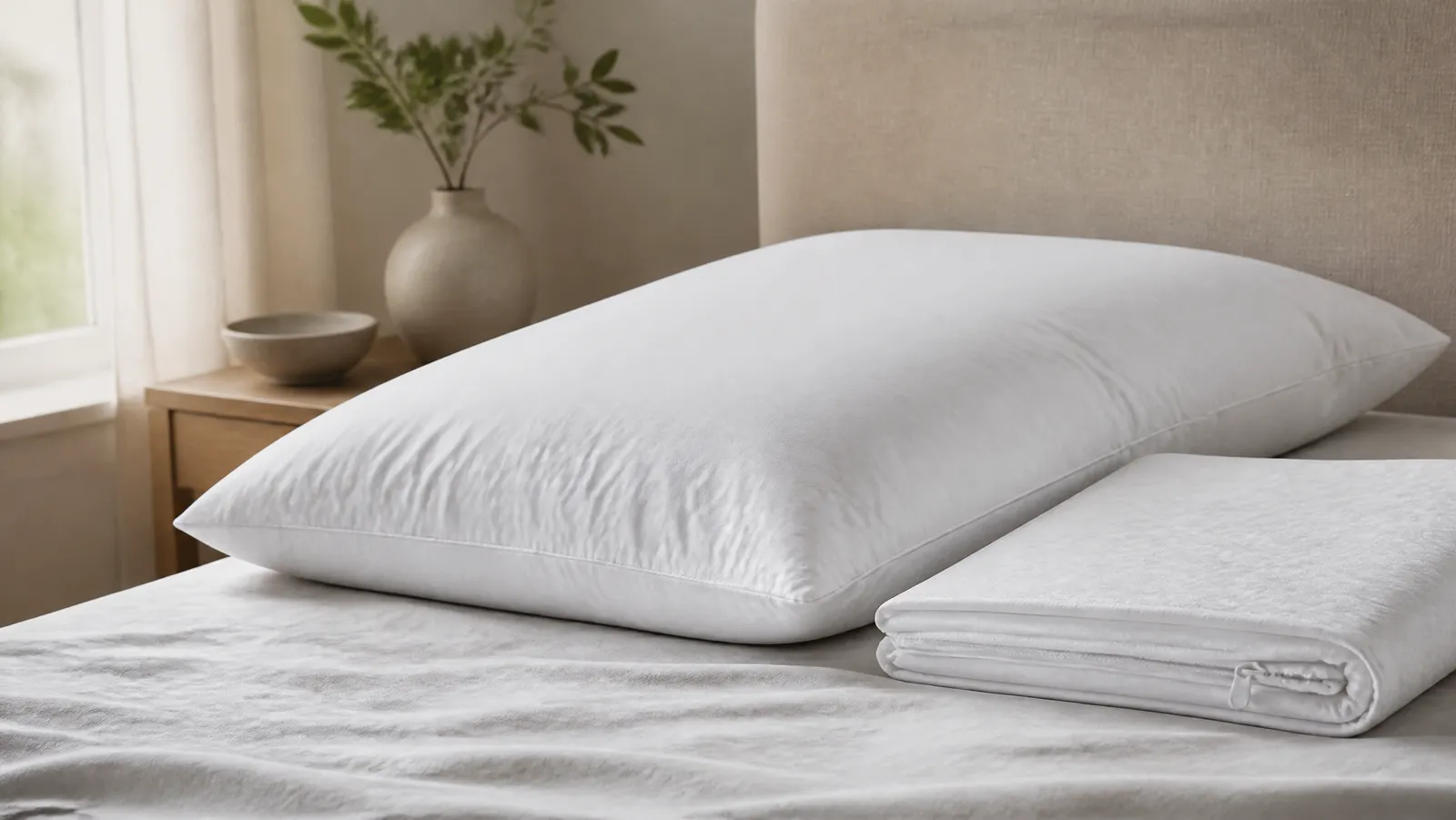
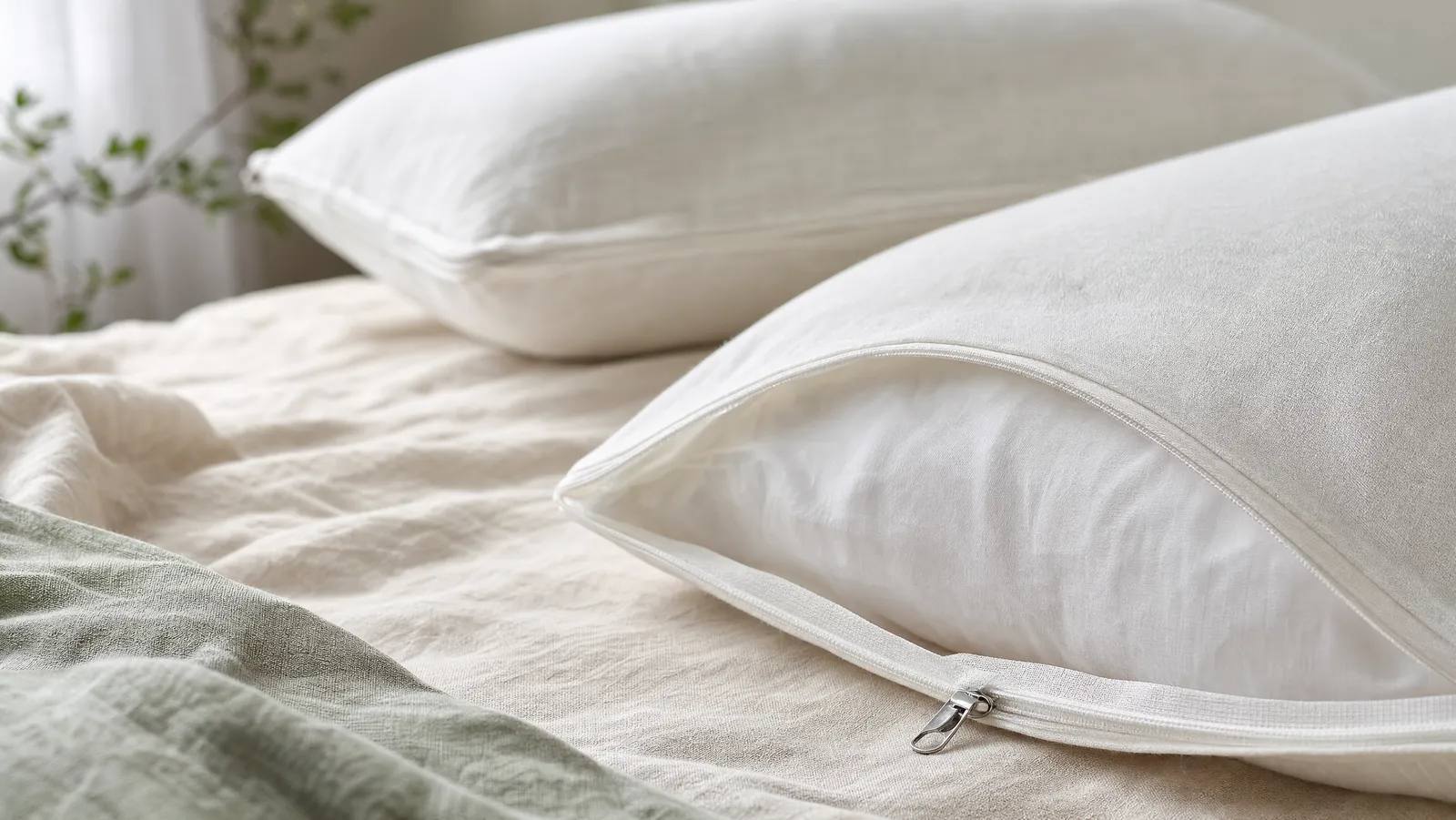
The practice parameter is direct about it: "The most effective way to prevent mite colonization is to encase a mattress, box spring, or pillow in a mite allergen–impermeable encasing." And, crucially for anyone holding a down pillow they like: "Existing mattresses, box springs, and pillows can be kept if they are encased in allergen-impermeable covers to entrap already-present mites and mite allergens." Recommendation 17 is to use mite allergen-proof encasings to decrease exposure — strength of recommendation strong, B evidence. The same document reports that woven microfiber fabrics with a mean pore size smaller than 10 micrometres effectively block Der p 1, and that nonwoven encasings are not recommended.
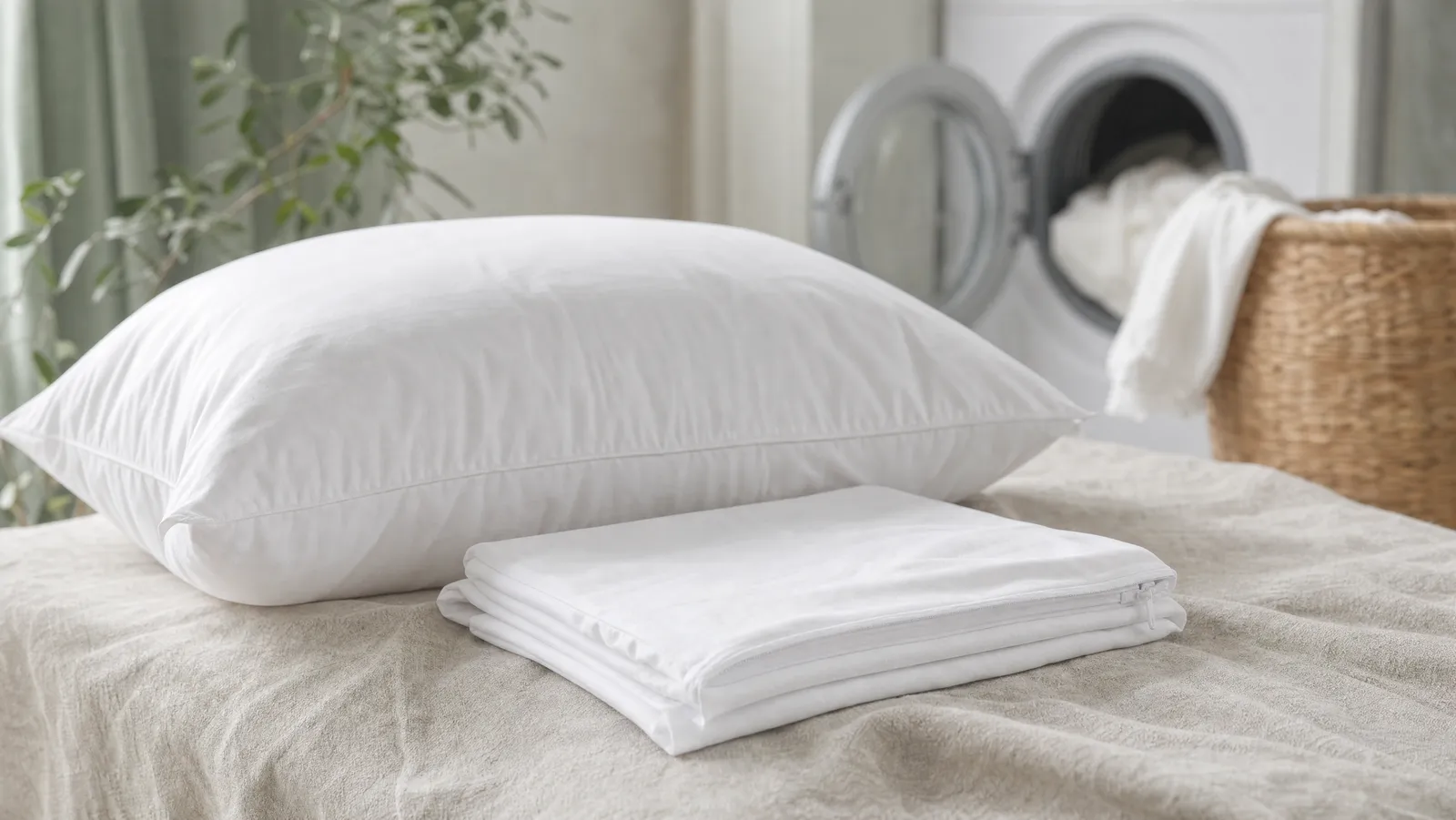
The HOSPITOLOGY Sleep Defense System Zippered Pillow Encasement is the cheapest thing here at $24 for two standard encasements as of September 2026, around a sixth of the ANSSO, and it fits whichever pillow is already on the bed. Be clear-eyed about its claims: HOSPITOLOGY states it is 100% waterproof with a breathable membrane, machine washable and tumble dry low, with a 5-year limited warranty. Waterproof is not an allergen test, and no laboratory or pore size is named — so the category evidence above is not a test result for this product.
And the limit the same authors insist on: "in many cases mite covers alone are unlikely to achieve a clinical benefit unless they are used as part of a more comprehensive multifaceted avoidance plan", and elsewhere that this single measure does not significantly alleviate clinical symptoms in patients with allergic rhinitis. A cover is an exposure measure, not a treatment.
The bottom line
- The pillow measurements do not support "down is bad for allergies". Rains 1999 found roughly three times the Der p 1 in synthetic pillows paired on the same beds; Custovic 2000 found 6.7-fold more cat allergen in synthetic pillows. One 2005 letter found no difference, and nothing we read found more mite allergen in feather pillows.
- The mechanism is the shell. In Siebers 2004, all 20 seeded mites crossed a standard synthetic covering within 24 hours; none crossed feather ticking, or a newer polyester-cotton ticking. Tight weave was the variable, not the fill.
- Do not overcorrect into buying feathers for your lungs. The 2025 Halley trial of 460 infants found no respiratory benefit from feather bedding and a higher rate of GP wheeze presentations in the feather arm.
- The honest strike against down is laundering frequency. Down-care guidance runs to roughly twice a year, and some labels are spot-clean or dry-clean-only — either way a down pillow sits outside the weekly warm wash the practice parameter describes.
- True down and feather allergy is real, if uncommon and over-attributed. The AAAAI calls it quite rare and says positive feather tests are typically likely secondary to dust mite sensitivity. A confirmed diagnosis settles it: avoid down.
- The evidence points at a cover, not a fill swap. The practice parameter calls encasing the most effective way to prevent mite colonisation and says existing pillows can be kept if encased — while warning covers alone are often not enough.
So read the shell spec, read the care label, and stop arguing about the stuffing. For the picks that come out of that filter, the Home Pillow Review allergy pillow guide is where to go.
If allergy or asthma symptoms brought you here, take them to a clinician. We can tell you what a pillow is made of and what researchers measured; nothing here is a diagnosis or medical advice, and no pillow should replace care you are already receiving.
The shortlist
3 pillows compared — firmness, loft, and temperature side by side. The top pick is highlighted.
| Pillow | Firmness | Loft | Sleeps | Best for | Price |
|---|---|---|---|---|---|
What Tight Ticking Looks LikeANSSO Canadian Goose Down Pillow, Queen 20x30, 80% Down / 20% Feathers, 800 Thread Count Cotton Shell | Medium Soft | High | Neutral | Showing that the shell weave matters more than the down percentage | $149.99 Check |
How to Read a Fill BreakdownCosybay Goose Feather Down Pillows, Standard 20x26, Set of 2 | Medium | Medium | Neutral | Learning to read a fill breakdown instead of a product name | $69.99 Check |
The Cheapest Thing on This PageHOSPITOLOGY PRODUCTS Sleep Defense System Zippered Pillow Encasement, Standard 20x26, Set of 2 | — | — | Neutral | Addressing mite allergen without replacing a pillow you like | $24 Check |
ANSSO Canadian Goose Down Pillow, Queen 20x30, 80% Down / 20% Feathers, 800 Thread Count Cotton Shell
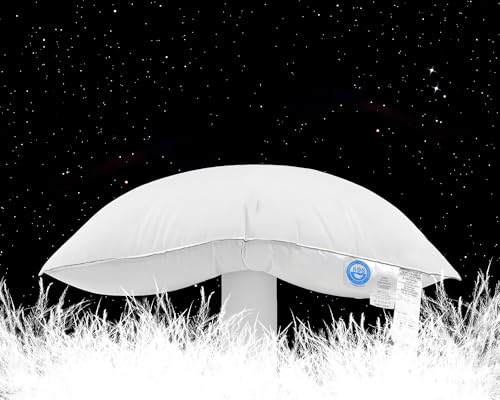
The spec sheet answers the question I actually had — an 800 thread count cotton shell and an OEKO-TEX Standard 100 certification I could go and look up, rather than a badge with nothing behind it.
It is the priciest thing here by a wide margin, the maker says spot clean and dry clean only so it cannot take the weekly laundering the mite guidance describes, and the listing makes a sleep-quality claim nothing supports.
This pick is here to show you where to look on a listing, not to argue that down is an allergy strategy. ANSSO states 80% white goose down and 20% goose feathers in a queen 20 x 30 inch pillow, claiming a 1550+ fill power we would treat sceptically, and a triple-layer filling design. Skip past all of that and read the next line instead: the maker states an 800 thread count pure cotton outer shell, and says that shell is certified to Standard 100 by OEKO-TEX. ANSSO also states the down is humanitarian certified.
The shell figure is the one that bears on the research on this page. A down-filled pillow has to be sewn in a shell tight enough to keep quills from working through, and the published mite work found that tightly woven feather ticking was the barrier a standard synthetic casing was not — though a newer polyester-cotton casing matched it. An 800 thread count cotton shell is what that spec looks like when a listing actually publishes it. We are inferring the connection from two separate findings, and no source we read certifies a thread count as mite-proof.
Two cautions. The listing also carries an unsupported marketing claim about sleep quality, which we will not repeat and which is a fair reminder to read listing copy sceptically. And ANSSO states spot cleaning and dry cleaning only. At $149.99 as of September 2026 this is the most expensive product on the page, and it is the one that can never go through a wash.
Cosybay Goose Feather Down Pillows, Standard 20x26, Set of 2

A washable pair at a fair price, and unusually the maker publishes the layer-by-layer fill breakdown instead of hiding behind the word "down".
It is named a goose feather down pillow while the maker's own spec puts polyurethane foam in the middle layer and 38.2% polyester in the shell, so it is neither the down nor the tight cotton ticking a reader might be shopping for.
This is the most useful card on the page, and the reason is the gap between the name and the specification. It is sold as a goose feather down pillow. Cosybay states that the top and bottom layers are filled with goose feather down fibre and that the inner layer is 80% polyurethane foam plus 20% polyester fibre blend, and that the shell is a blend of 61.8% cotton and 38.2% polyester.
Read that against the two reasons anyone lands on this page. A reader avoiding down because of a suspected feather reaction is buying a pillow with feather down fibre in the outer layers and foam in the middle. A reader who came for the tightly woven cotton ticking the barrier research points at is getting a shell that is more than a third polyester. Neither shopper is being cheated — the maker publishes all of it, which is more than most listings do — but neither gets what the product name implies.
Taken on its own terms it is a sensible buy: two standard 20 x 26 inch pillows for $69.99 as of September 2026, with Cosybay stating a three-layer fabric construction with double stitching and navy piping, and machine washable on a gentle or delicate cycle in cold water under 104F. Being washable is a genuine advantage over the pillow above. The lesson is narrower than a complaint: find the fill breakdown and the shell composition, and ignore the noun on the front.
HOSPITOLOGY PRODUCTS Sleep Defense System Zippered Pillow Encasement, Standard 20x26, Set of 2

It costs a fraction of either pillow, it zips over the pillow I already liked, and it targets the thing the research keeps pointing at rather than the thing the label argues about.
The maker claims waterproofing rather than a named allergen test with a laboratory behind it, and a waterproof membrane is likely to run warmer against the face than a cotton shell does.
If the fill is close to the wrong argument, this is where the money goes instead. Two fully zippered standard 20 x 26 inch encasements for $24 as of September 2026 — a sixth of the down pillow above — and they go over the pillow you already own, including the one you were thinking of throwing out. That matches what the 2013 AAAAI/ACAAI dust mite practice parameter actually recommends: encasing the pillow you have, rather than swapping its stuffing.
The maker-stated facts: HOSPITOLOGY says these are 100% waterproof with a breathable membrane, machine washable and tumble dry low, describes the fabric as an extra-soft polyester knit that will not retain heat, and states a 5-year limited manufacturer's warranty.
Now the honest reading of that. Waterproof is not an allergen test. HOSPITOLOGY names no third-party laboratory and no measured Der p 1 figure, and the practice parameter's own analysis of encasings is about woven microfiber pore size — smaller than 10 micrometres to block Der p 1 and smaller than 6 to block cat allergen — which is not the specification published here. So treat the encasement evidence as being about the category, not a test result for this product. And we would expect a membrane cover to sleep warmer than plain woven cotton ticking, whatever the listing says about heat.
What to Read on a Pillow Listing Instead of the Fill
If the barrier is the shell rather than the stuffing, then the down percentage is the least useful number on the page. These are the lines worth finding instead, in the order we look for them.
Down Pillows and Allergies FAQ
Are down pillows bad for allergies? Not for the reason usually given. Published comparisons of pillows on the same beds have repeatedly measured more dust mite allergen in synthetic pillows than in feather ones, and one 2005 research letter found no difference between the two. We found nothing measuring more mite allergen in down. Anyone with a confirmed allergy to feather or down protein is a separate case and should avoid them.
Is down alternative better for allergies? The evidence does not support that as a general rule. In Clinical & Experimental Allergy in 1999, Rains and colleagues found roughly three times as much Der p 1 in synthetic pillows as in feather pillows paired on the same 12 beds for a year. The 2013 AAAAI/ACAAI dust mite practice parameter states plainly that "Foam pillows are not less prone to dust mite allergens than are feather pillows."
Can you be allergic to down? Yes. The AAAAI's Ask the Expert page describes true feather allergy as "quite rare" and notes that positive feather test results are typically likely secondary to underlying dust mite sensitivity. That is a reason to get tested rather than to guess, and it is a question for a clinician, not a product page.
What is feather duvet lung? A rare form of hypersensitivity pneumonitis triggered by bird protein in feather bedding. A 2019 BMJ Case Reports case describes a 43-year-old non-smoker whose breathlessness, chest radiograph and lung function improved after all feather bedding was removed and oral corticosteroid treatment was started. A 2022 paper in Archivos de Bronconeumología (published online in 2021) calls it an underestimated form of acute and chronic hypersensitivity pneumonitis. It is documented and it is uncommon; unexplained breathlessness is a reason to see a doctor, not a reason to panic about your pillow.
Can you wash a down pillow? Often yes, but not weekly. The Sleep Foundation's guide says down and feather pillows can be machine washed on a delicate setting in cool or warm water, warns that many can only be dry cleaned, and puts the frequency at about twice a year. Some labels — including one of the pillows on this page — say spot clean or dry clean only. The practice parameter's laundering advice is to wash bedding weekly in warm water, which no down pillow is built for.
Should I throw out my down pillow? Nothing we read supports that as a default. The same practice parameter says existing pillows can be kept if they are encased in allergen-impermeable covers, which costs far less than replacing bedding. If you have symptoms, the useful next step is a clinician who can tell you what you are actually sensitised to.
Why you can trust us

Aimee Cannon
Sleep & bedding writer
Aimee Cannon is a sleep and bedding writer who has spent years testing pillows of every kind — memory foam, down, wool, bamboo, buckwheat, and specialty support pillows. She focuses on matching the right pillow to each sleeping position and need, and reports what actually holds up after months of nightly use. When she is not testing pillows, Aimee is usually with her husband and her dog.