Dust Mites in Pillows: What Is Actually Living in There
Are there dust mites in your pillow? Almost certainly a few, and for most people that is close to irrelevant. Dust mites are microscopic relatives of spiders that eat shed skin, do not bite, and live in anything soft enough to hold warmth and moisture. The thing people react to is not the animal but what it leaves behind. We may earn a commission from links on this page, at no extra cost to you.
That is the calm version, and this subject needs one. The popular account of dust mites in pillows rests on a single statistic — that after two years, a third of a pillow's weight is mites, their droppings and dead skin — which we spent most of this article trying, and failing, to source. What follows is what has actually been measured: the allergen, the numbers attached to it, the humidity that governs the population, and the one intervention with a real mechanism behind it. If you want the shopping side instead, our guide to the best pillow for allergies works through it in order.
The statistic everyone repeats about dust mites in bed
You have met this claim: a third of the weight of a two-year-old pillow, or a tenth, or half. The number drifts between retellings, which is the first sign that nobody is reading a source.
We went looking for one. The closest thing to a paper trail runs through a sibling claim — that a mattress doubles its weight in ten years from mites and their debris. According to GoodBed's account of that claim's history, it traces to a 2000 Wall Street Journal article that referenced Ohio State University dust mite researcher Emmett Glass without quoting him. Glass later told Fox 13 in Tampa Bay that he had been misquoted and that his research had been used for scare tactics, and the NYU microbiologist Philip Tierno, who had repeated the doubling claim on CBS in 2005, recanted it in the same 2011 segment, saying there is no study he knows of and no scientific literature supporting it.
So what about the pillow version? We searched PubMed for a published measurement of what proportion of a used pillow's weight is mites and mite debris. There is no such study indexed; the searches return work on pet allergen in pillows and on infant eczema risk — different questions.
We could not find a published measurement supporting the figure. We will not tell you it is false — proving a negative from an absence is its own kind of sloppiness. But a statistic repeated for decades by major outlets, with no citation any of them will produce, does not deserve to be the main thing you know about your bedding.
The pillow study that does exist measured fungus, not mites
There is a real, published study of used pillows, and it gets folded into the mite story constantly. It is about mould.
Woodcock and colleagues at the University of Manchester published "Fungal contamination of bedding" in Allergy in 2006, after it appeared online on 15 October 2005; the work was funded by the Fungal Research Trust. They dissected ten pillows in regular use, aged from 18 months to more than 20 years, feather and synthetic, and cultured what they found.
The results are genuinely striking. Aspergillus fumigatus was isolated from all ten pillows, Aureobasidium pullulans and Rhodotorula mucilaginosa from six each, and a further 47 species from the pillows and their vacuum dust. Manchester's announcement of the work reported several thousand fungal spores per gram of used pillow — more than a million spores per pillow — with four to sixteen species per sample and higher counts in the synthetic ones. Professor Ashley Woodcock's stated conclusion was that "since patients spend a third of their life sleeping and breathing close to a potentially large and varied source of fungi, these findings certainly have important implications for patients with respiratory disease."
Note what it is and is not: ten pillows, cultured for fungi, with no mite counts and no weight measurements at all.
What dust mites are, and what the allergen actually is
Dust mites are not insects and not parasites. According to the American Lung Association, they "are not parasites that bite, sting or burrow into our bodies"; they feed on dead human skin cells and live in bedding, mattresses, upholstered furniture, carpets and curtains. The 2013 dust mite practice parameter published by Portnoy and colleagues in Annals of Allergy, Asthma and Immunology, on behalf of the AAAAI, ACAAI and JCAAI, describes them as translucent white animals of 0.2 to 0.4 mm — barely visible to the naked eye — that are photophobic and so live deep inside soft substrates such as pillows and mattresses.
Their biology is unusual in a way that matters. The same document reports that dust mites are about 75% water by weight and do not drink or urinate — they take water in as vapour from the air, which corrects a good deal of published copy about mite urine in your bed.
The allergen is faecal. The practice parameter states that mites produce 20 faecal pellets a day, that they measure 20 to 40 micrometres across, and that they are "a rich source of digestive enzyme-derived allergens." The named allergens — Der p 1 and Der f 1, from the two commonest household species — are cysteine proteases from mite gut, with cast skins a secondary source. The pellets are light enough to become airborne when their substrate is disturbed, the parameter says, by "making a bed, walking on a carpet, or moving on a pillow," settling again within 20 to 30 minutes.
That is the whole mechanism. No bites, no burrowing, no infestation in the pest-control sense — and a person who is not sensitised to Der p 1 can share a bed with these animals indefinitely and never know it.
How many dust mites are in a pillow? Researchers count the allergen instead
We could not find published mite headcounts per pillow, and there is a good reason for that: allergen concentration in settled dust correlates well with the number of mite bodies present, and an assay is far easier than a census.
The units are micrograms of allergen per gram of dust, and two numbers circulate. The practice parameter reports that exposure above 2 µg/g has been associated with increased risk of sensitisation and asthma development in susceptible children, and that in one cohort the relative risk of asthma was nearly five times greater in children exposed above 10 µg/g.
Three cautions before anyone treats those as a pass mark.
- They are levels in settled dust, not "in your pillow." Samples come from mattresses, floors and bedding, weighed under a protocol. The parameter does list consumer options, but they are not equivalent: the in-home dipstick and rapid-test kits it names are qualitative, reporting roughly three bands of low, medium and high, while a numeric figure in micrograms per gram requires a dust-collection kit posted to a laboratory.
- The authors decline to use them as thresholds. Cutpoints "are not used in this practice parameter because there does not appear to be a level of exposure that does not offer at least some risk of developing asthma or rhinitis," the document says, citing an Australian study in which risk rose linearly with exposure and no cutoff appeared.
- The units moved. A revision of the international allergen standards means 2 µg/g on the newer universal standard would have read as 3.4 µg/g for Der p 1 under the older one. A number copied out of a 1990s paper may not mean what it appears to.
Does pillow fill change the mite population? The evidence is not what you would guess
This is where the received wisdom fails outright. The assumption is that synthetic fill is the clean choice and feather the allergy risk. The measurements say the opposite, at least for mites.
Rains and colleagues at the Wellington Asthma Research Group put paired new synthetic and new feather pillows on 12 beds for 12 months and measured Der p 1 in dust from each. After a year the synthetic pillows carried 19.28 µg/g against 6.45 µg/g for the feather ones — roughly three times as much — and accumulation correlated strongly with how much Der p 1 was already in the mattress underneath. A Manchester group reported the same pattern for cat and dog allergen in 2000, noting they had recently found significantly higher dust mite allergen in synthetic pillows too.
The mechanism was pinned down in 2004. Siebers and colleagues seeded 20 live house dust mites on three pillow fabrics and counted how many got through. After 24 hours all 20 had penetrated a standard polyester pillow covering; none penetrated the feather ticking or a newer polyester-cotton covering at 24 or even 48 hours. Fine house dust told the same story: 0.88% passed the standard synthetic covering against 0.07% for both the feather ticking and the newer synthetic, and 0.02% for a commercial occlusive cover.
So it was never the feathers. A feather pillow needs a tightly woven, downproof ticking or it sheds quills, and that ticking is an accidental mite barrier; loose polyester casings had no such job to do. The newer synthetic covering in that 2004 test performed like feather ticking: the fabric specification is the variable, not the fill.
This is not a recommendation to buy feather bedding, and anyone who reacts to feather or down has a separate question to answer; our piece on whether down pillows are non-toxic covers that fill. The practice parameter is blunt that swapping fill is not the lever anyway: "foam pillows are not less prone to dust mite allergens than are feather pillows," and "nonallergenic pillows are not a substitute for covering them with allergy-proof encasements" — which is the word on the label doing less work than it looks, as we explain in what a hypoallergenic pillow really is.
Humidity is the lever that actually moves the population
Mites cannot drink. That single fact makes ambient humidity the strongest control anyone has over how many of them a house supports.
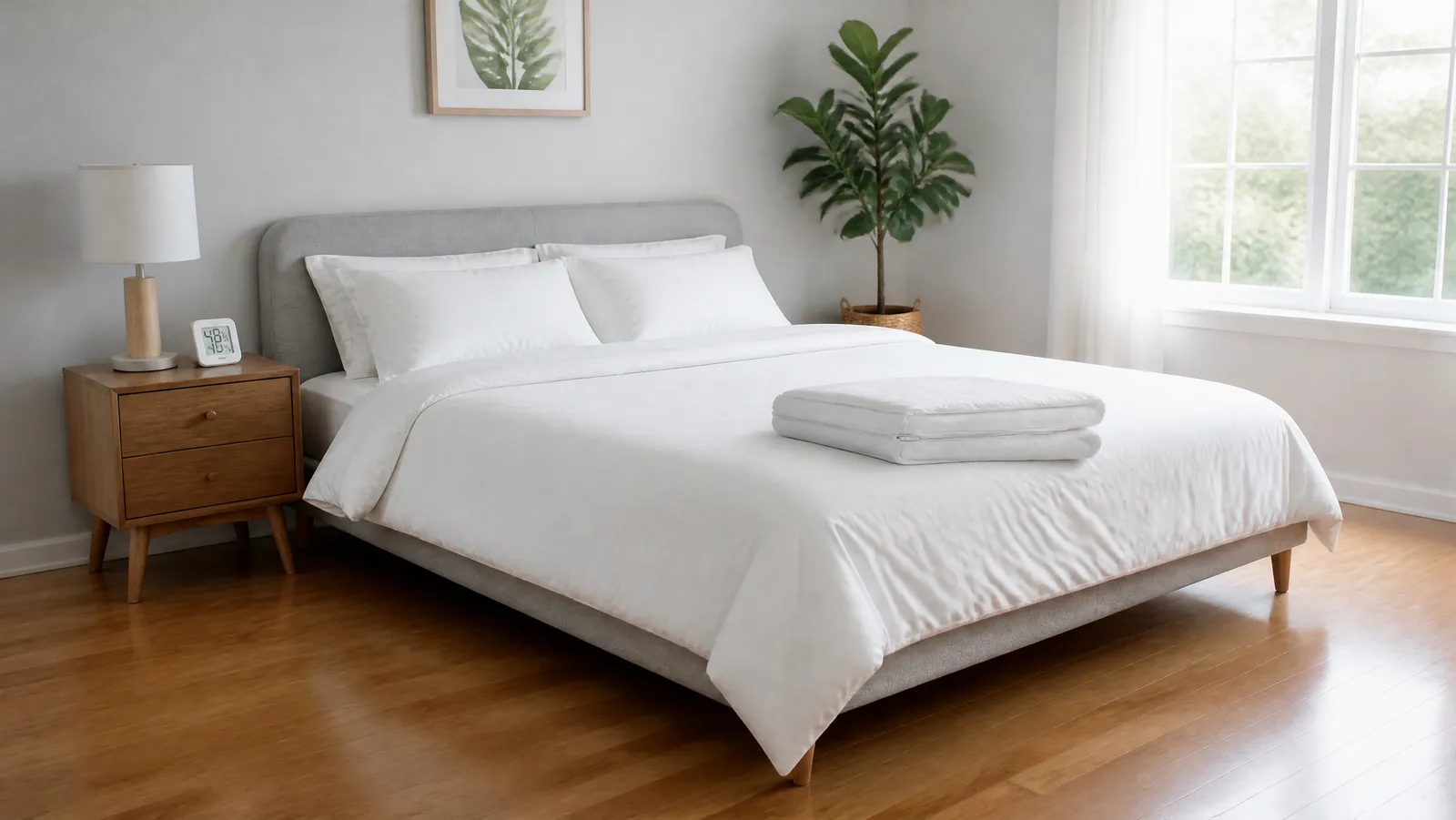
The practice parameter states that mites absorb water vapour when relative humidity is at least about 65%, lose water below roughly 55%, and thrive best at 75% to 80% RH. Below 50%, proliferation slows and survival falls, and very few mites grow below 45% at an indoor temperature of 22°C. The recommendation that follows is to hold indoor RH between 35% and 50%, since homes kept in that band continuously carry lower mite allergen than homes where humidity swings. The American Lung Association gives the same target in rounder terms: keep the home below 50% humidity.
Two realities keep this from being a switch. Mites can survive for weeks in a dry room, and a humidity rise lasting as little as 1.5 hours a day — cooking, a shower — can be enough for them to persist. And the clinical payoff is not guaranteed: a series of studies in Manchester found free-standing dehumidifiers ineffective, and whole-house dehumidification effective at lowering allergen but not at improving symptoms.
What actually reduces exposure, and what it does not promise
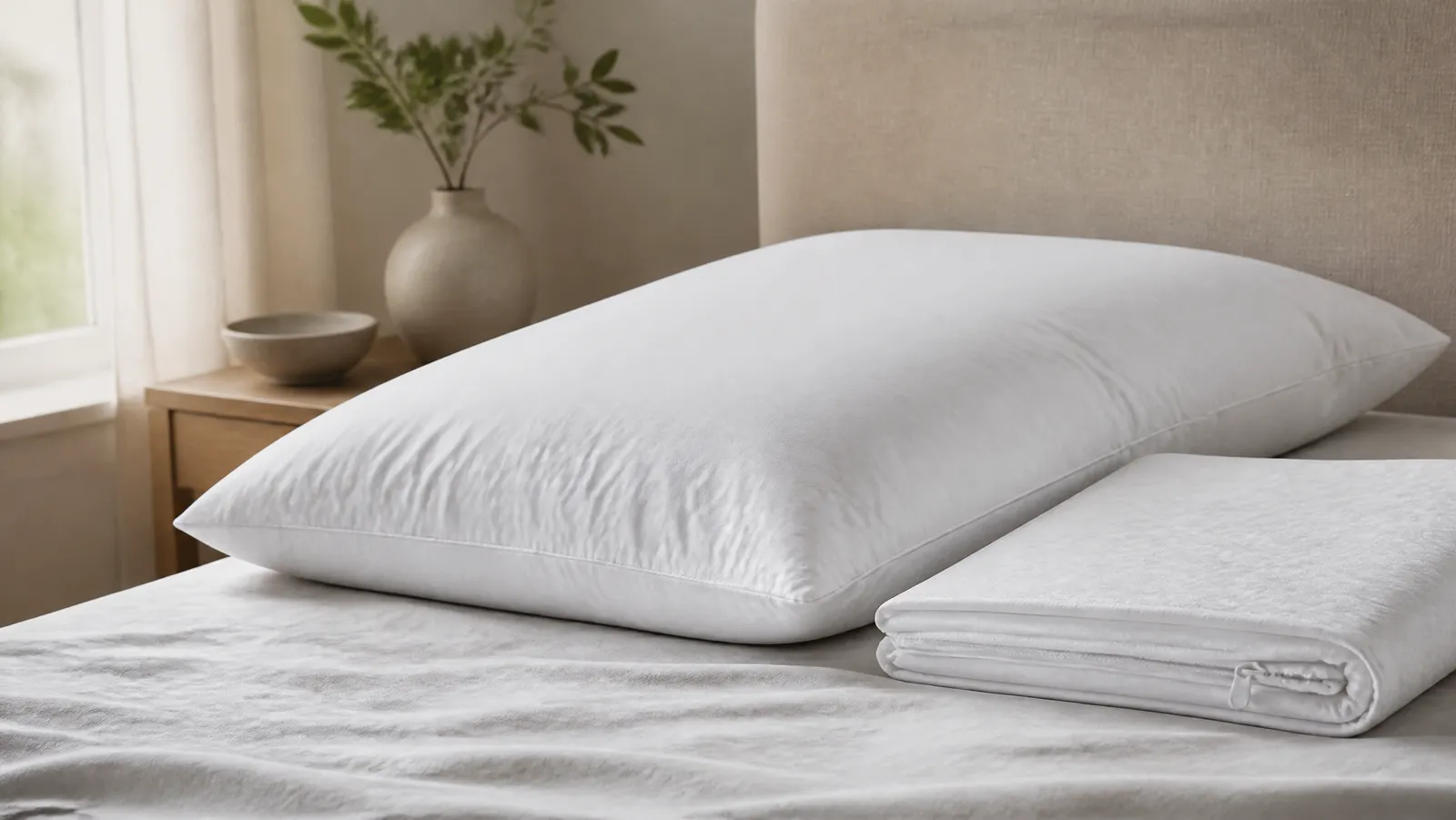
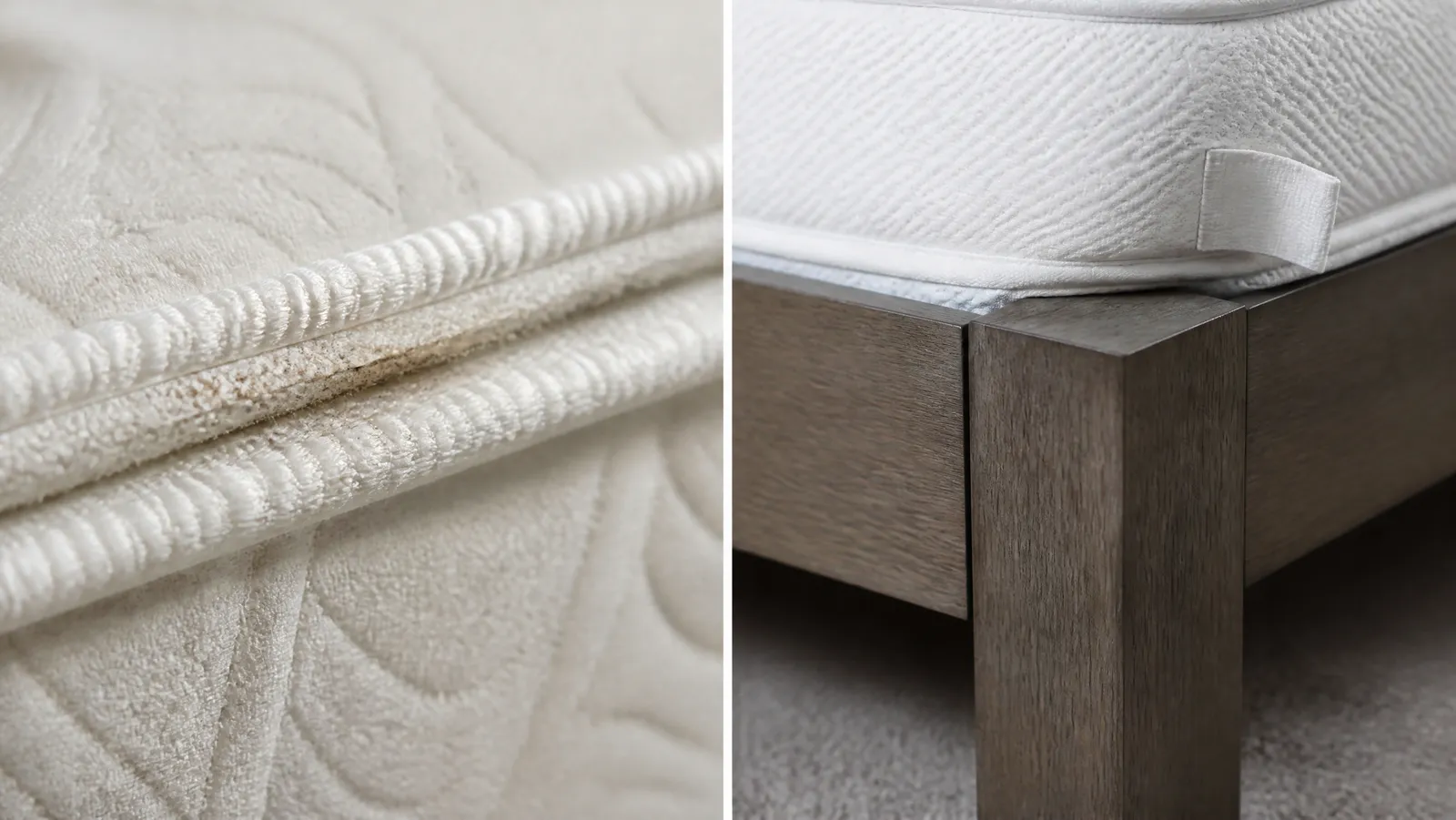
If you take one action from this page, the evidence points at the barrier rather than the pillow. The practice parameter calls encasing a mattress, box spring or pillow in a mite-allergen-impermeable cover "the most effective way to prevent mite colonization," and says existing pillows can be kept if they are encased, trapping what is already inside. The fabric specification matters more than the marketing: woven microfibre with a mean pore size smaller than 10 micrometres blocks Der p 1, while nonwoven encasings are specifically not recommended, because allergen accumulates between their randomly laid fibres and ends up on the surface the sleeper lies on — and they are not washable.
Washing is the other half, and the familiar 130°F rule is shakier than it sounds — it comes from immersing mites in capsules to find the temperature that scalds them, not from laundering bedding. When an item is actually washed, the parameter notes, it makes no difference whether mites are scalded, drowned or rinsed down the drain: cited studies found 90% to 98% mortality even in cold water, and cold water with detergent removed 95% of mite allergen from duvets and blankets. Weighed against the scalding risk of a supply set above the 120°F the US Consumer Product Safety Commission recommends, the parameter's conclusion is to wash bedding weekly in warm water "without aiming for a specific and potentially dangerous temperature."
And the honest limit, from the same authors: mite-proof covers reduce measured exposure, but this "single avoidance measure does not lead to a significant alleviation of clinical symptoms in patients with allergic rhinitis," and allergen removed by washing generally reappears within a month. Exposure control is a programme, and whether it is worth running is a conversation with a clinician who knows whether you are sensitised at all. A label will not answer that, which is also why we wrote up what pillow certifications actually cover — most of them address chemistry, not biology.
The three things we would actually put on a bed
Full details render below. None carries a published allergen-blocking test, and we will not call any of them allergy-proof.
- The HOSPITOLOGY Sleep Defense System encasements, $24 for two as of September 2026, are our pick: fully zippered and washable, though the maker claims waterproofing rather than a tested pore size.
- The AllerEase 100% cotton protectors, four for $13.52 as of September 2026, cover every pillow in a house at once. Tightly woven cotton is a coarser barrier than woven microfibre, and it breathes better.
- The downluxe down alternative pillows, $29.99 a pair as of September 2026, are for when the pillow itself is finished — which resets its age, not the bedroom's biology.
The bottom line
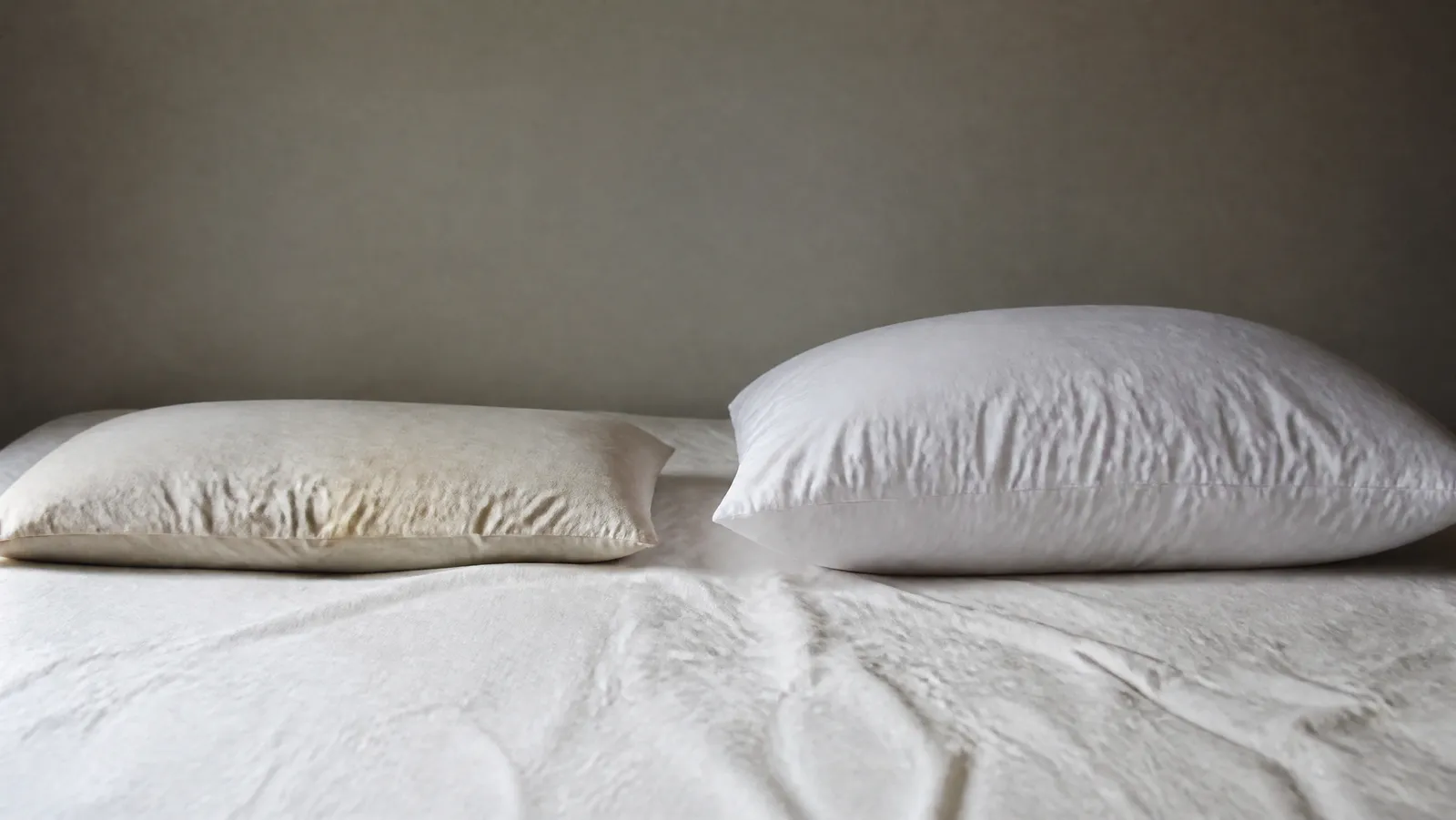
Dust mites in pillows are real, near-universal, and close to uninteresting unless you are sensitised to them. They do not bite, they do not live on people, and their presence is not a hygiene failure. The viral weight statistic has no published measurement behind it that we can find, and the used-pillow study everyone half-remembers was about Aspergillus, not mites.
What is measurable is narrower and more useful. The allergen is a faecal pellet 20 to 40 micrometres across, counted in micrograms per gram of settled dust by researchers, not at home. Pillow fill is the wrong lever; the fabric around it is the right one, and a tightly woven ticking outperformed loose polyester in a direct test. Humidity is the only thing that reliably moves the population. And nobody who has studied this will promise that any one step resolves symptoms.
If you are shopping on the back of this, our guide to choosing a pillow for allergies is the next page. If you are here because you wake up congested and want to know why, that is a question for a clinician who can test you — a better use of the next hour than another article about what is living in your pillow.
The shortlist
3 pillows compared — firmness, loft, and temperature side by side. The top pick is highlighted.
| Pillow | Firmness | Loft | Sleeps | Best for | Price |
|---|---|---|---|---|---|
| — | — | Neutral | Sealing an existing pillow behind a washable zippered barrier | $24 Check | |
Best Value Multi-PackAllerEase 100% Cotton Allergy Pillow Protectors, Standard, 4 Pack | — | — | Neutral | Covering every pillow in the house at once | $13.52 Check |
If You Are Replacing the Pillowdownluxe Down Alternative Pillows, Standard 20x26, Set of 2 | Medium Soft | Medium | Neutral | Starting over when a pillow is past its useful life | $29.99 Check |
HOSPITOLOGY PRODUCTS Sleep Defense System Zippered Pillow Encasement, Standard 20x26, Set of 2

Two fully zippered, washable encasements for the price of one premium single, and the zip actually runs the full length rather than stopping halfway.
The maker claims waterproofing rather than a tested allergen-blocking figure, and a waterproof membrane sleeps warmer than a plain cotton protector.
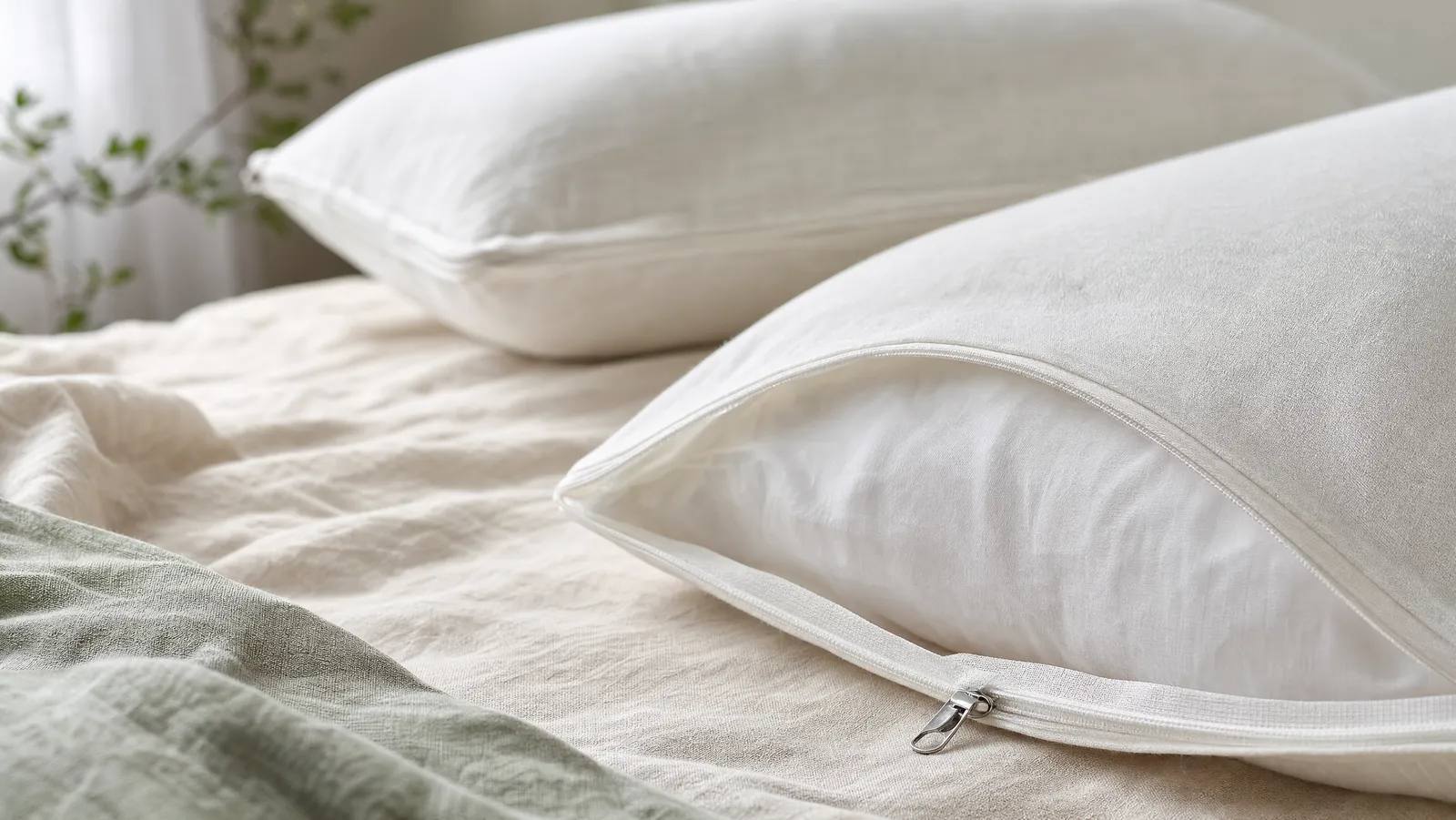
If the argument of this article is that the fabric around a pillow does more work than the stuffing inside it, this is the product that follows from it. HOSPITOLOGY sells these as fully zippered encasements rather than slip-on protectors, which is the distinction that matters: a zip closes the pillow off on all six sides. They are standard size, 20 x 26 inches, and come as a pair, so one box covers one bed.
Read the maker's claims precisely, because they are not quite the claims an allergist's encasing makes. HOSPITOLOGY states the fabric is 100% waterproof with a breathable membrane, describes it as an extra-soft polyester knit that will not retain heat, says it is machine washable and tumble dry low, and backs it with a stated 5-year limited warranty. What the listing does not give you is a third-party allergen-blocking test or a pore-size figure — the measurement the 2013 AAAAI/ACAAI practice parameter actually uses to judge a barrier fabric. Waterproof is a real property and a useful one; it is not the same claim. At $24 as of September 2026 for two, it is the cheapest way we know to put a zip between a pillow and a face.
AllerEase 100% Cotton Allergy Pillow Protectors, Standard, 4 Pack

Four zippered cotton protectors for under fifteen dollars meant I did every pillow in the house in one afternoon, and they breathe far better than the plastic-backed one I had before.
A tight weave is a weaker barrier than a tested allergen encasing, and the maker offers no third-party test to back the claim.
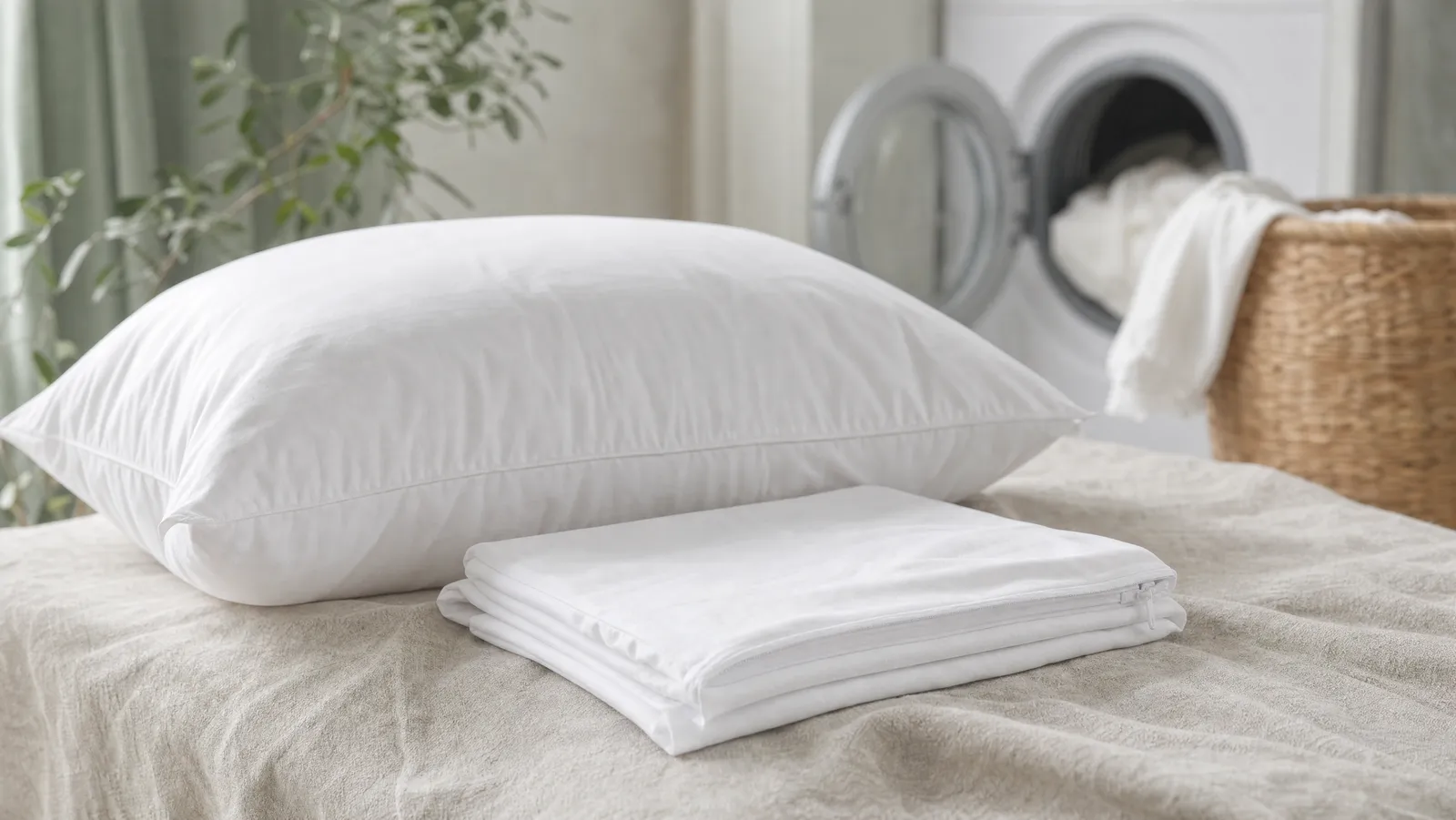
The problem with doing this properly is that a house has more pillows than a bed. Guest pillows, the spare on the sofa, the one the dog has claimed — mites do not care which pillow they are on, and a partial job is close to no job. Four zippered protectors for $13.52 as of September 2026, down from a $17.99 list price, makes covering all of them a decision rather than a project.
Aller-Ease describes a tightly woven 100% cotton fabric intended to keep household particles out of the pillow, with a zippered closure, and states that it does not retain heat and that fully encasing a pillow extends its life. Two honest caveats. A tight cotton weave is a coarser barrier than the woven microfibre fabrics the practice parameter discusses, and there is no third-party test published on the listing to say where this one lands. What cotton does have over a membrane is breathability, which is why we would put these on the pillows nobody is losing sleep over.
downluxe Down Alternative Pillows, Standard 20x26, Set of 2
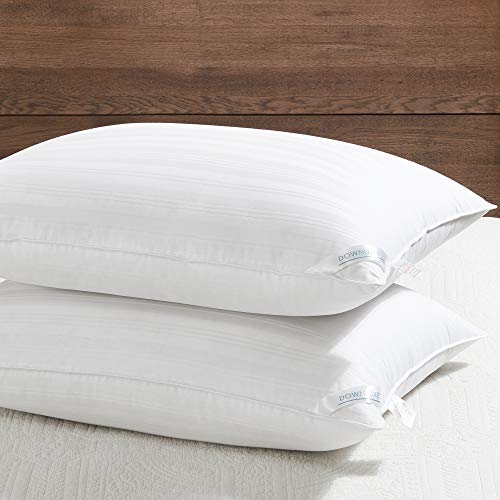
Cheap enough in a pair that replacing a tired pillow stopped feeling like a decision, and they went through the wash without clumping.
Soft and low on support if you want a firm pillow, and they arrive roll packed and need a day before you can judge the loft.
Sometimes the honest answer is that the pillow is finished and an encasement is good money after bad. A flat, yellowed pillow that has lost its support is not a dust mite problem, it is an old pillow, and this is the cheap way to start the clock again: polyester blend down alternative fill, no feather or down content, standard 20 x 26 inches, sold as a pair for $29.99 as of September 2026 against a $36.99 list price. downluxe states they are machine washable, which matters more here than the fill type does.
Keep the expectations modest, because the evidence does. Replacing a pillow resets its age; it does not allergy-proof a bed, and a new synthetic pillow is not a mite-free pillow — measured Der p 1 accumulation on new synthetic pillows tracked the allergen already in the mattress underneath them. The encasement still goes on afterwards. downluxe also notes these arrive roll packed and asks for 24 hours to loft back out.
Lowering Dust Mite Exposure in a Bedroom, in Order of Evidence
None of this is medical advice, and none of it is a substitute for seeing a clinician about allergy or asthma symptoms. These are the measures the 2013 AAAAI/ACAAI dust mite practice parameter sets out, ordered by us according to how directly that document backs each one — the parameter’s own numbered recommendations run in a different order, putting humidity control (statement 10) before weekly washing (13) and encasings (17). Either way, it is not the order the internet puts them in.
Dust Mites in Pillows FAQ
Are there dust mites in my pillow? Probably some. The AAAAI/ACAAI practice parameter describes mattresses, box springs and pillows as major sources of mites and mite allergen, and notes that mites are photophobic and live deep inside soft substrates. It also estimates that 84% of US homes have detectable dust mite allergen.
How many dust mites are in a pillow? We have not found a published count for pillows specifically. Researchers measure the allergen rather than the animal, because allergen concentration in dust correlates well with the number of mite bodies present, and it is far easier to assay.
Do dust mites bite? No. The American Lung Association states that dust mites "are not parasites that bite, sting or burrow into our bodies." They eat shed skin and other organic detritus.
Is a third of my old pillow's weight really dust mites? We could not find a published measurement supporting that figure, or the 10% version of it. Searches of PubMed for a study measuring what fraction of a used pillow's weight is mites and mite debris return nothing on the question.
Are synthetic pillows better than feather for dust mite allergy? Not according to the measurements. In a 1999 Clinical and Experimental Allergy study, new synthetic pillows accumulated about three times more Der p 1 than new feather pillows over 12 months on the same beds.
Does washing a pillow get rid of dust mites? Washing removes most mites and most allergen from bedding, but the practice parameter notes that allergen removed by washing "generally reappears within 1 month." It is maintenance, not a cure.
What humidity kills dust mites? The parameter says survival and reproduction decline below 50% relative humidity and that very few mites grow below 45% at 22°C, but it describes this as a slow decline rather than a kill switch — mites can survive for weeks in a dry room, and a humidity rise of as little as 1.5 hours a day from cooking or bathing can be enough for them to persist.
I think my bedroom is making me unwell. Please talk to a clinician. Allergy and asthma are medical conditions, and a pillow is not a diagnosis.
Why you can trust us

Aimee Cannon
Sleep & bedding writer
Aimee Cannon is a sleep and bedding writer who has spent years testing pillows of every kind — memory foam, down, wool, bamboo, buckwheat, and specialty support pillows. She focuses on matching the right pillow to each sleeping position and need, and reports what actually holds up after months of nightly use. When she is not testing pillows, Aimee is usually with her husband and her dog.