New Pillow Smell: How Long Off-Gassing Lasts and How to Speed It Up
How long does a memory foam pillow off gas? Days, not months. The closest peer-reviewed measurement of how that smell fades over time — a 2022 study in Chemosphere of two new memory foam mattresses — recorded VOC concentrations peaking on the first day and then decaying, with short-term emission half-lives of roughly 4 to 12 hours. Unwrap the pillow fully, get air moving across it, and most of the smell should be gone in two to three days. We may earn a commission from links on this page, at no extra cost to you.
The second question — the one people are really asking at 11pm with a smelly pillow on the bed — is whether the smell means harm. The evidence on the nearest comparable product does not support that framing, and we go through exactly what has and has not been measured below. If you would rather buy differently next time than rescue tonight, our guide to choosing a non-toxic pillow works through materials and certifications in order.
How long does a memory foam pillow off gas, really?
Here is the awkward part: nobody has published an off-gassing decay curve for a bed pillow. The nearest pillow data, a 2021 BPB Reports study by Oshima and colleagues, sampled the VOCs coming off 20 pillows once after unpacking rather than tracking them over time. For a timeline you have to use mattress data, and the best of it is that 2022 Chemosphere paper by Beckett and colleagues, which tracked two new memory foam mattresses in a simulated consumer-use environment over 32 days.
The findings that matter to you:
- Concentrations peaked on day one. The chemicals the authors associated with the mattresses — 2-propanol, acetone, chloromethane, toluene, and total VOCs — were highest on the first day after installation and decayed progressively over the following 31 days.
- The fast decay is measured in hours. Short-term emission half-lives for individual chemicals were on the order of approximately 4 or 12 hours.
- The slow tail is measured in weeks. The long-term half-life was around 24 days, which is the part responsible for the faint trace you can still catch a fortnight later if you push your face into it.
Now the inference, stated as an inference. A queen mattress contains many kilograms of foam; a pillow contains a few hundred grams. Emission scales with the amount of material and the surface exposed, so a pillow should run a shorter, smaller version of the same curve — and a shredded-fill pillow, spread out, should clear faster still than a solid block. That is reasoning from mattress data, not a pillow measurement, and we would rather say so than dress it up.
The most useful corroboration is commercial rather than scientific. The listing for the QUTOOL Cooling Shredded Memory Foam Pillow, $29.99 as of September 2026, instructs buyers to allow the pillow to air out for about one or two days. When a maker with every commercial reason to say "sleep on it tonight" tells you to wait two days, that number is worth trusting.
How to air out a foam pillow: the procedure
There is no trick here, which is itself the finding: time and airflow do the work. Everything below maximises the second so you need less of the first.
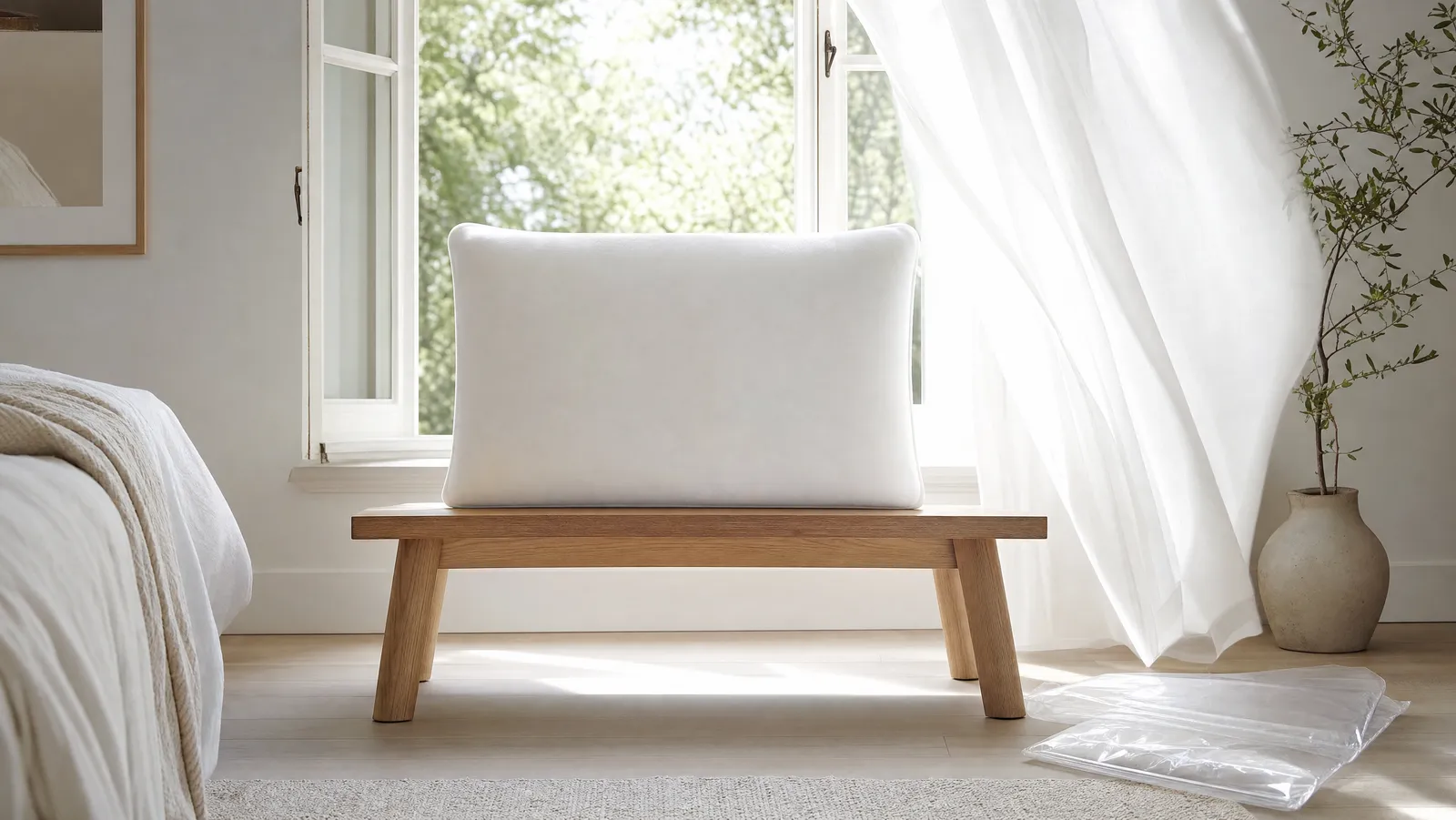
- Unwrap it completely, including the inner plastic. Compressed foam pillows often ship inside a sealed sleeve inside the outer bag. A pillow that is still in any plastic is not airing out at all, and a lot of "it smelled for two weeks" stories start here.
- Open the pillow up. If the cover unzips and the fill is shredded, tip it out or at least break up the clumps. Air has to reach the middle, not just the outside.
- Lay it out in a single layer. Flat on a drying rack, a spare bed or a clean sheet on the floor. Not stacked, not folded, and not inside a pillowcase.
- Point a fan at it, not just near it. Ventilation lowers indoor pollutant concentrations by bringing outdoor air in, as the EPA puts it, but a box fan moving air across the pillow's surface does more than an open window on the other side of the room. Turn it once a day so both faces get the flow.
- Use a room you are not sleeping in, and let it be warm. This is the counterintuitive bit, and it is worth understanding rather than memorising — see the next section.
- Wash the cover if it comes off. Much of what you smell on day three is packaging odour that has soaked into fabric, and fabric is washable. Foam is not: QUTOOL, like most makers, says the cover is machine washable and the foam is not.
- Check at 24, 48 and 72 hours rather than hovering. Your nose adapts within minutes of entering a room, so leave, come back, and judge from the doorway.
- Crack a window for the first few nights of use. You are on the long tail of the curve by then, and dilution is cheap.
Why warmth and airflow speed it up
Two separate mechanisms, and mixing them up is why the advice online contradicts itself.
Heat raises the emission rate. The EPA's formaldehyde guidance states plainly that the rate at which formaldehyde is released is accelerated by heat, and recommends a dehumidifier and air conditioning to maintain a moderate temperature and reduce emissions. Chamber research on building materials points the same way: Zhou and colleagues, writing in IOP Conference Series: Materials Science and Engineering in 2019, found that increases in ambient temperature and relative humidity promote the release of total VOCs, with the effect on formaldehyde more pronounced still.
Ventilation lowers the concentration. The EPA's advice for anything that emits VOCs is to increase ventilation, and it notes that concentrations of many VOCs are consistently higher indoors — up to ten times higher — than outdoors.
Put those together and the logic falls out. The EPA is telling you how to keep levels low in a room you live in: cool and ventilated. You want the opposite of half of that. In a spare room you are not occupying, warmth pushes the pillow through its emission curve faster and airflow vents what comes off. Warm plus stuffy is the worst of both.
The folk remedies, sorted by whether there is evidence
This is where most articles on new pillow smell lose the plot. Where the evidence runs out, we say so.
- Baking soda: no evidence for this use. The mechanism people cite is real chemistry — sodium bicarbonate is a base and neutralises acidic odour compounds — but the published work is about acidic food waste. One study found roughly 70% odour reduction from 50 grams of baking soda in an 8-litre food waste bin, and even that literature notes the effect has not been extensively proven. Foam emissions are a different problem: 2-propanol, acetone and toluene are not acids, and an acid-base powder has nothing to react with. Sprinkling it on will not hurt the pillow. We would not expect it to do anything either.
- Direct sunlight: we would avoid it. UV light degrades polyurethane. Foam industry technical guidance describes UV exposure breaking polymer bonds and producing the familiar yellowing, and research on solar exposure of polyurethane foam reports the surface hardening and becoming increasingly friable as exposure increases. The yellowing itself is largely cosmetic, but a hardening, crumbling surface on something you put your face on is not what you want. A shaded balcony, porch or open window with a breeze gives you the airflow without the UV.
- Vinegar: widely repeated, unevidenced. We have not found published work supporting vinegar for foam VOCs, and the practical objection is obvious: you would be adding acetic acid vapour to cover something else. Do not spray liquid into foam in any case — a damp core takes days to dry.
- Dryer sheets and essential oils: masking, not removal. These add fragrance compounds rather than removing anything. If your goal was fewer volatile organics in your bedroom, adding scent is moving in the wrong direction.
The honest summary: time and airflow are the only two things we can point to evidence for. That is less satisfying than a hack, and it is what the evidence supports.
Is the smell dangerous?
This is the question underneath the others, so be precise about what is known.
The EPA describes health effects associated with VOCs generally: eye, nose and throat irritation, headaches, loss of coordination and nausea, damage to liver, kidney and central nervous system, and notes that some organics cause cancer in animals and some are suspected or known human carcinogens. That is a hazard statement about a very broad class of compounds across all exposure levels and routes. It is not a statement about a pillow.
The dose side is where the specific evidence sits, and it is more reassuring. The Chemosphere authors modelled average total VOC concentrations over their 32-day period of roughly 20 and 33 micrograms per cubic metre for the two mattresses, falling to modelled one-year averages of 2.7 and 4.2. Their conclusion was that the concentrations measured and modelled were well below available health-based benchmarks for individual chemicals and within available indoor air quality recommendations for total VOCs, and that it was unlikely the mattress models evaluated would pose a health risk to consumers.
Read the limits with the finding. That is two mattress models tested by one team, not every foam product on the market, and nobody has published the same 32-day measurement for a pillow. A substance being hazardous at some dose is a different claim from a pillow delivering that dose to a sleeper. We go through the broader literature in our piece on whether memory foam pillows are toxic.
Some people prefer to avoid polyurethane foam anyway, and that is a perfectly reasonable preference. It just is not the same as a demonstrated harm.
What certification caps before the pillow reaches you
Emissions programmes will not make a new pillow smell of nothing, but they do put a tested ceiling on the foam. Two names come up on pillow listings, and their scopes differ.
CertiPUR-US certifies flexible polyurethane foam made without formaldehyde, ozone depleters, prohibited phthalates, mercury, lead and other heavy metals, and requires low VOC emissions for indoor air quality of less than 0.5 parts per million. It certifies the foam, not the cover and not the finished pillow. UL GREENGUARD Gold is broader on emissions specifically: UL says certified products limit emissions of more than 360 VOCs and total chemical emissions, and must comply with the California Department of Public Health Standard Method — California Section 01350 — with testing carried out to UL 2818.
The Coop Home Goods Original Adjustable Pillow, $75.65 as of September 2026, is the pick here that cites both: Coop states the pillow is CertiPUR-US and GREENGUARD Gold certified. That is Coop's claim about Coop's product. The CertiPUR-US directory lists participating companies and brands rather than individual models; UL's SPOT database lists certified products themselves. We unpack what each mark does and does not cover in our explainer on what pillow certifications actually mean.
Formats that clear faster, and formats with nothing to clear
If you have not bought yet, construction changes the timeline more than brand does.
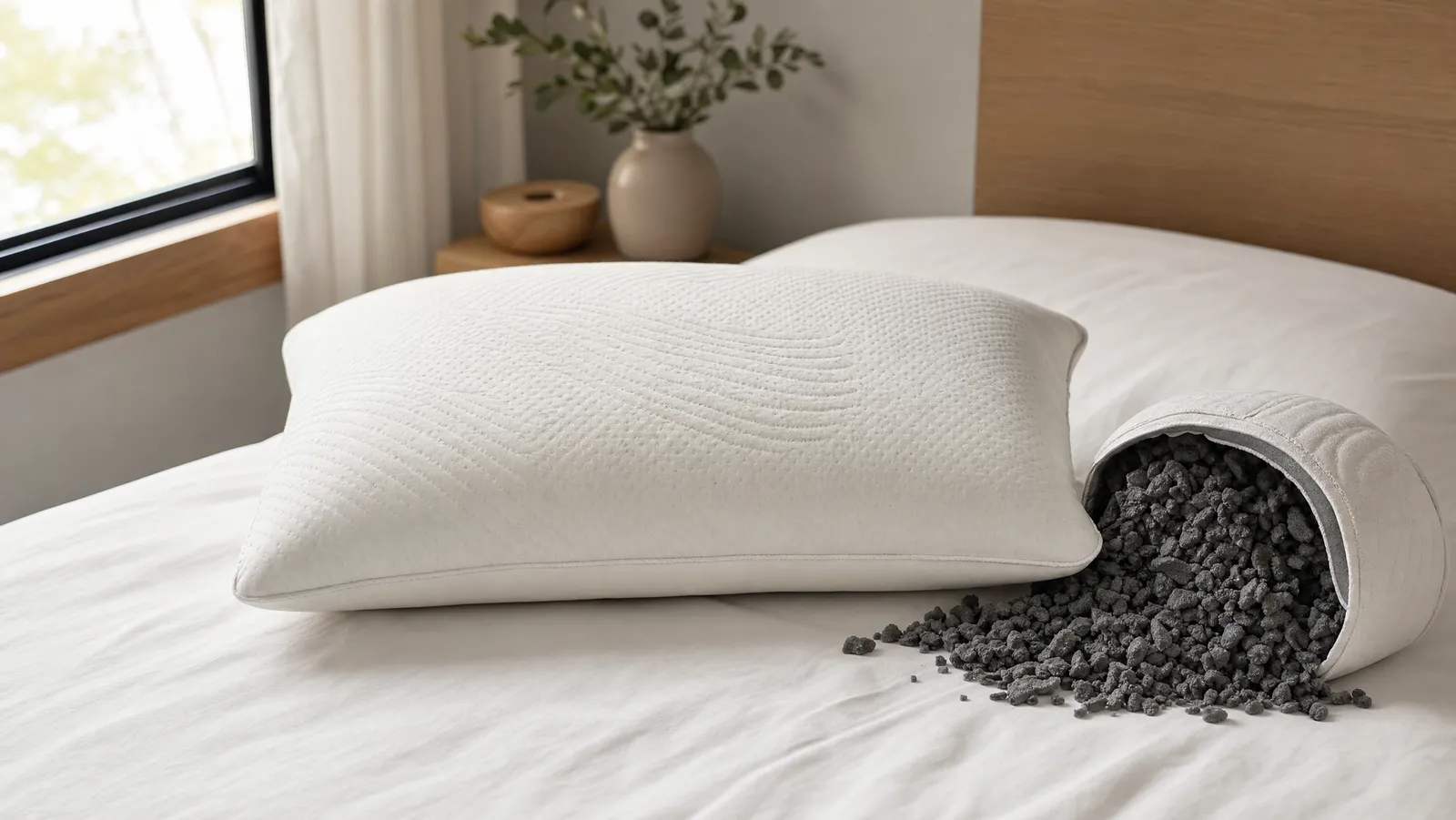
Shredded fill beats a solid block. Cross-cut or shredded foam in an unzippable cover can be tipped out and spread thin, which is the whole game for airing out. Coop's fill is a cross-cut memory foam and microfibre blend the company calls "Oomph"; QUTOOL's is shredded gel memory foam. Both open up, and our memory foam pillow roundup covers the format more broadly.
Latex swaps the smell rather than removing it. Latex is the usual next stop for people who want out of polyurethane altogether, and non-toxic latex pillows are a category with their own trade-offs. The ORGANIC TEXTILES 100% Talalay Latex Pillow at $115.95 as of September 2026 pairs a Talalay core the maker calls sustainably harvested with a cover ORGANIC TEXTILES states is GOTS certified organic cotton. It has its own faint rubbery scent for the first week. What it does not have is a polyurethane emissions curve.
Plant fills skip the question. The Cheer Collection Organic Kapok set — two standard pillows for $59.99 as of September 2026 — is listed as 100% kapok fibre in a 100% cotton shell. No foam means no foam emissions curve. It does not mean no smell at all: fibres and packaging have their own faint scent, and a day of air suits them too.
We have not slept on any of these. What we can do is read the construction and say which parts open up and which claims are certified rather than the maker's own.
When to stop waiting
The airing-out advice has an end point, and it matters more than any tip above. If a strong smell is still there after a few weeks of proper airing — unwrapped, spread out, air moving across it — that is outside the timeline the mattress data would predict, and the right response is to stop using it and contact the seller while the return window is open. Do not spend a month sleeping on something you are unhappy about in order to avoid a return.
And if you develop headaches, a rash, a scratchy throat, wheezing or any other symptom you associate with new bedding, stop using it and talk to a clinician. We can tell you what the published emissions data shows and what a certificate covers. We cannot examine you, and no product page can either.
The bottom line
New pillow smell is a days-long problem with a two-part solution: unwrap it completely and move air across it. The mattress data that gets us closest shows emissions peaking on day one with short-term half-lives of hours, and a pillow's smaller foam mass should run that curve faster. Warmth in a room you are not using speeds it up; ventilation carries it away; baking soda, vinegar and dryer sheets have no evidence behind them for this job, and direct sun risks damaging the foam.
On the safety question, the peer-reviewed study that gets closest concluded concentrations were well below available health-based benchmarks — with the honest caveat that it covered two mattresses and no pillows at all. If you would rather not run the experiment on your own bed, shredded fill airs out fastest, and latex or kapok removes the polyurethane question entirely. For the full shopping version of that decision, start with our non-toxic pillow guide.
The shortlist
4 pillows compared — firmness, loft, and temperature side by side. The top pick is highlighted.
| Pillow | Firmness | Loft | Sleeps | Best for | Price |
|---|---|---|---|---|---|
Airs Out FastestCoop Home Goods Original Adjustable Pillow (Queen) | Medium Firm | Adjustable | Neutral | Certified foam with published emissions testing | $75.65 Check |
Best Budget PickQUTOOL Cooling Shredded Memory Foam Pillow (Queen, Single) | Medium | Adjustable | Cooling | Hot sleepers on a budget | $29.99 Check |
Lowest-Odour AlternativeORGANIC TEXTILES 100% Talalay Latex Pillow, GOTS Organic Cotton Cover (Queen, Medium) | Medium | Medium | Neutral | A low-odour alternative to foam | $115.95 Check |
No Off-Gassing At AllCheer Collection Organic Kapok Bed Pillows (Standard, Set of 2) | Medium Soft | Medium | Neutral | Skipping foam entirely | $59.99 Check |
Coop Home Goods Original Adjustable Pillow (Queen)

I unzipped it, spread the fill on a spare bed with a fan on it, and by the second evening I could not smell anything with my face in it.
Getting the loft right took me three goes with the extra fill bag, and the foam bits do escape when you are refilling it.
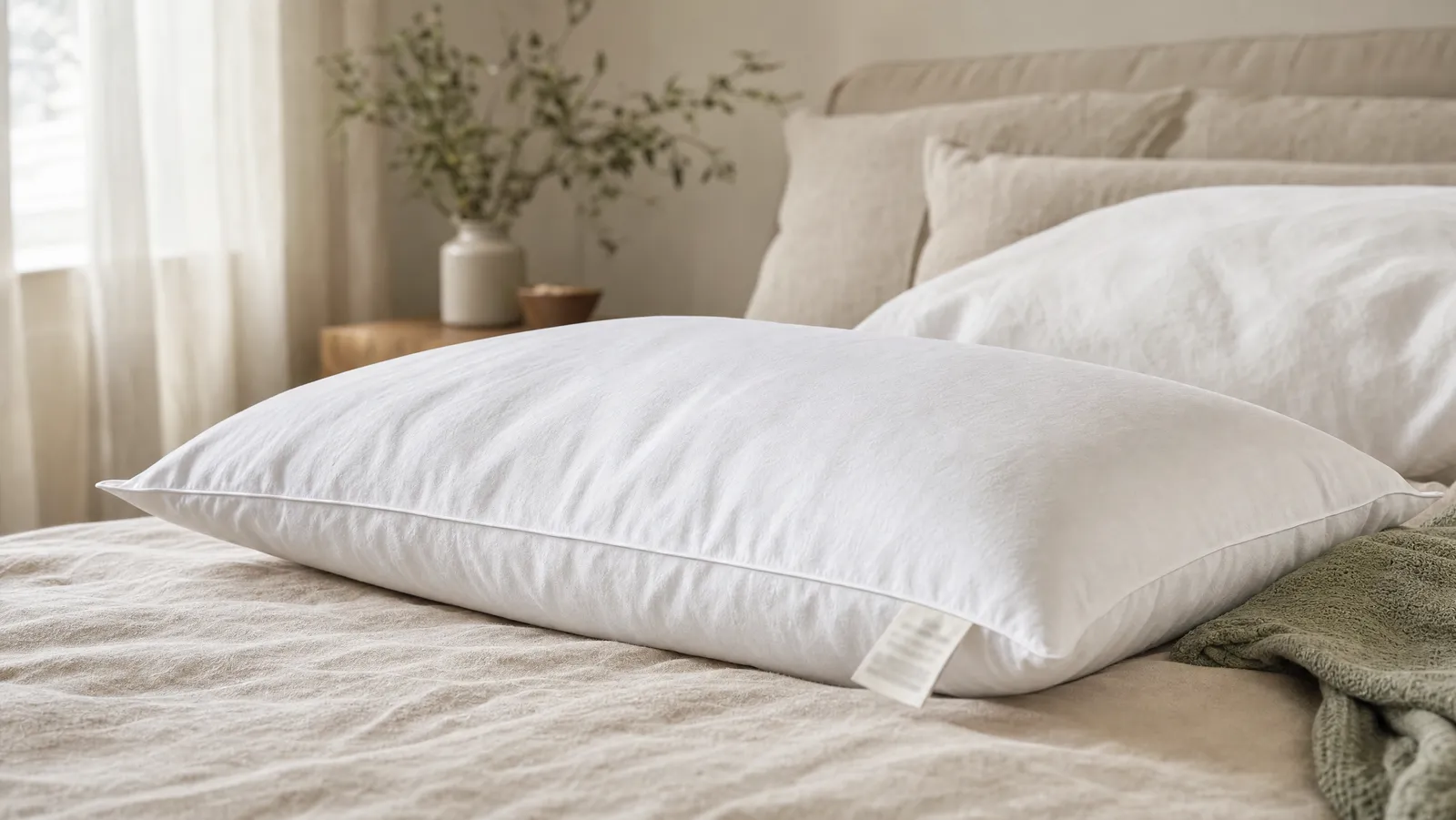
Two things about this pillow's construction are relevant to off-gassing, and both are checkable. The fill is a blend of cross-cut memory foam and microfibre that Coop calls "Oomph", and the cover unzips, so you can tip the fill out and spread it into a single loose layer. Surface area is what airing out actually depends on, and shredded fill has far more of it than a solid moulded block.
The second is documentation. Coop states the pillow is both CertiPUR-US and GREENGUARD Gold certified, which makes it the only pick here citing a programme built specifically around chemical emissions testing. Coop also says it uses only freshly manufactured memory foam, never repurposed or recycled. Those are the maker's claims, and neither certification promises the pillow arrives odourless. At $75.65 as of September 2026, against an $89 list price, it also ships with an extra bag of fill so you can set the loft.
QUTOOL Cooling Shredded Memory Foam Pillow (Queen, Single)

I did what the listing said and left it open on the guest bed for two days, and it went from strongly chemical-smelling to nothing.
The cooling side is only really cool for the first few minutes, and you cannot wash the foam if anything gets on it.
We like this listing for a reason that has nothing to do with the pillow: it tells you the truth about the timeline. QUTOOL instructs buyers to allow the pillow to air out for about one or two days, which is a maker conceding exactly what every foam pillow needs and most listings leave out.
The rest is straightforward budget shredded foam. QUTOOL states the foam is CertiPUR-US certified and can be verified on the certifier's site. The cover is double-sided, with a cooling face and a face made of 60% polyester and 40% bamboo-derived rayon, and both the outer and inner covers zip, so fill comes out by the handful to set the loft. That zip is also what makes it easy to air: open it, spread the fill, walk away. The cover is machine washable and the foam is not. At $29.99 as of September 2026 it is the cheapest way here to get shredded fill and a named foam certification.
ORGANIC TEXTILES 100% Talalay Latex Pillow, GOTS Organic Cotton Cover (Queen, Medium)

It smelled faintly of rubber for about five days and then stopped, and it is springier under my head than any foam pillow I have owned.
Latex is heavy, the rubbery smell is real even if it is mild, and the core cannot go anywhere near a washing machine.
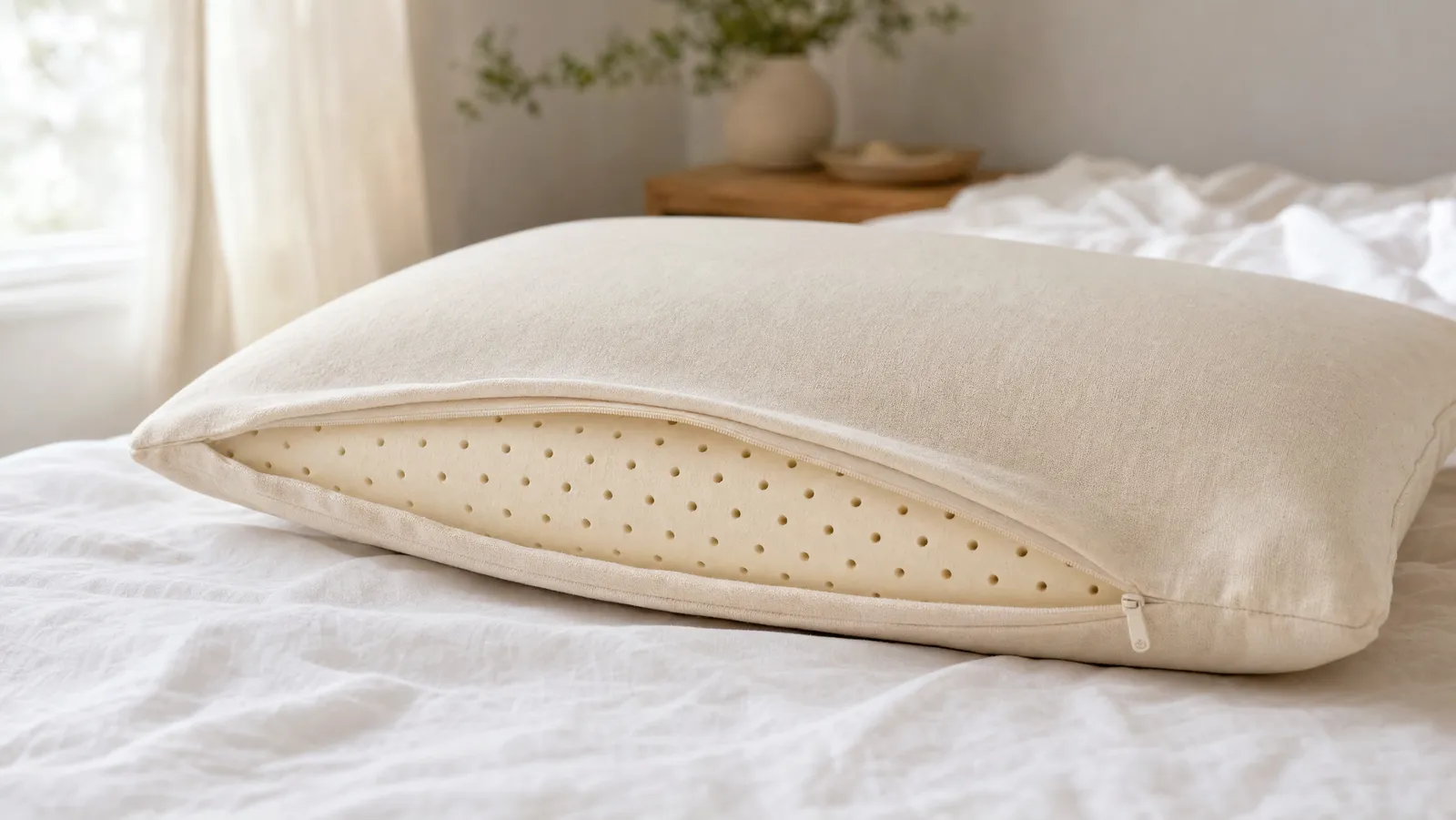
If the polyurethane smell is the thing you want out of your bedroom, latex is the usual substitution. This one is a Talalay latex core the maker describes as sustainably harvested, under a removable cover the maker states is GOTS certified organic cotton. ORGANIC TEXTILES describes the core as pin-hole ventilated for airflow, which helps the material breathe generally and is not a bad thing when a new pillow is settling in.
Be clear-eyed about what changes and what does not. You are swapping one material's smell for another's: latex has its own faint rubbery scent for the first week or so, and plenty of people notice it. What you are not doing is waiting out a polyurethane foam emissions curve, because there is no polyurethane foam in it. The cover is machine washable, the latex core is not, and at $115.95 as of September 2026 this is the most expensive pick here.
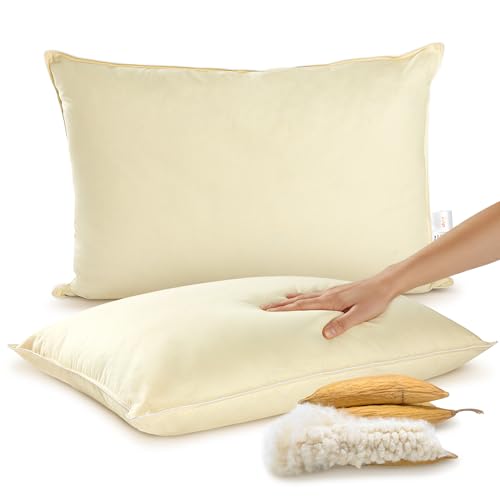
Cheer Collection Organic Kapok Bed Pillows (Standard, Set of 2)
It came out of the bag smelling like fabric and nothing else, and it was on my bed the same night.
Kapok packs down over the first month, so you have to fluff it properly or it goes flat under your head.
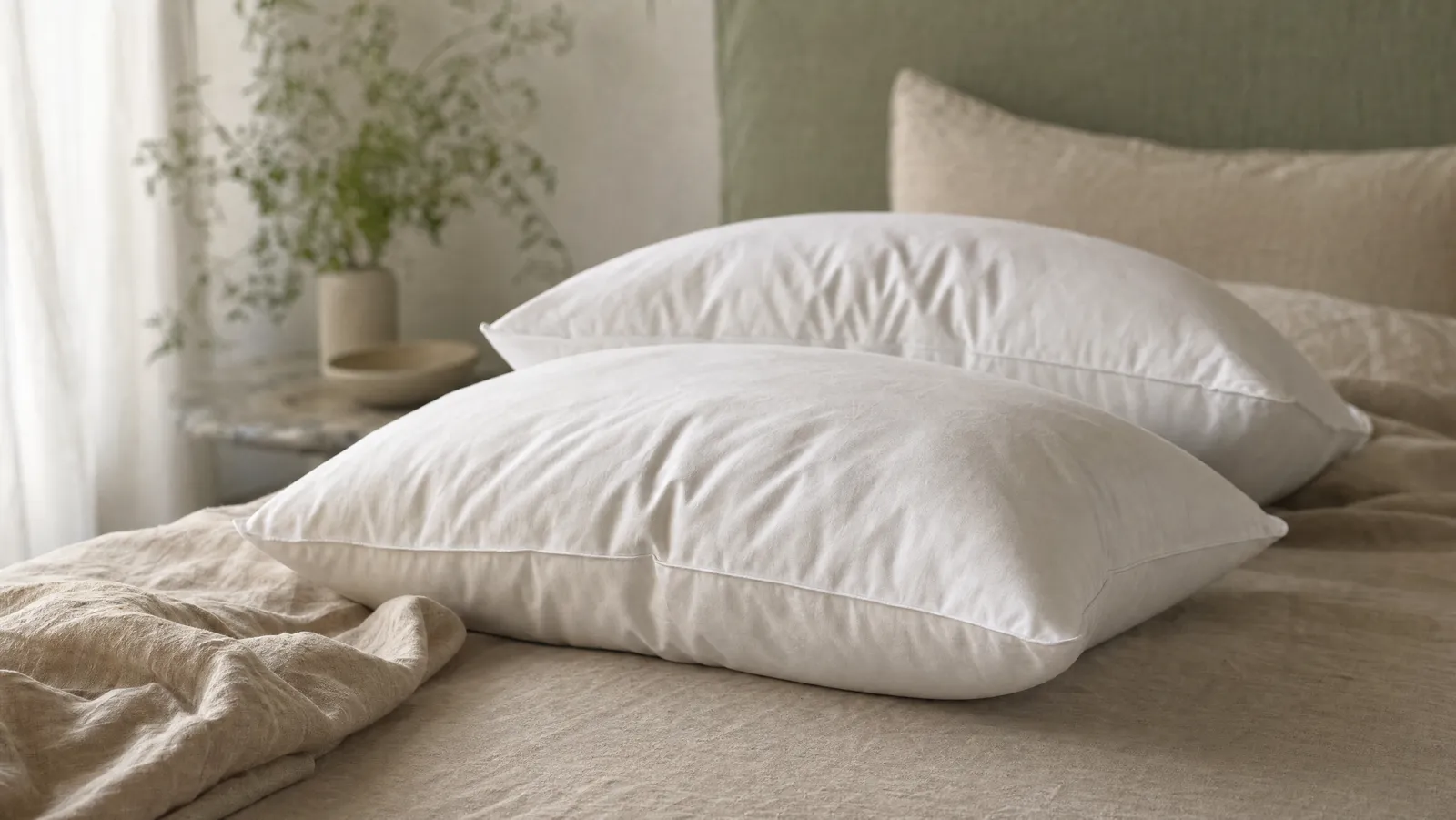
This is the exit from the question entirely: 100% kapok fibre in a 100% cotton shell. Kapok is a seed fibre, and Cheer Collection describes it as lightweight and more breathable than cotton or wool, with a down-like softness from a plant source. There is no polyurethane foam in it, so there is no foam emissions curve to wait out.
One honest qualifier on the pick name: no foam does not mean no smell. Natural fibres arrive with a faint scent of their own and with whatever the packaging contributed, and a day of air suits them too. What changes is that you are not waiting on the chemistry of a fresh polyurethane block. You get two standard pillows, 20 x 28 inches, for $59.99 as of September 2026 against a $79.99 list price.
How to Check a Foam Pillow's Emissions Claim Before You Buy
Emissions certification will not stop a new pillow smelling. What it does is put a tested ceiling on what the foam is allowed to release, which is the one thing about off-gassing you can check before the box arrives. It takes about five minutes.
New Pillow Smell FAQ
How long does a memory foam pillow off gas? Plan on two to three days of noticeable smell with good airflow, and a faint trace that can linger a week or two. The closest measured comparison is a 2022 Chemosphere study of two new memory foam mattresses, in which VOC concentrations peaked on the first day and decayed with short-term emission half-lives of roughly 4 to 12 hours and a long-term half-life of about 24 days. A pillow holds a small fraction of a mattress's foam, so we would expect a shorter, smaller version of that curve — but that is our inference, not a pillow measurement.
Can I sleep on it the first night? Many people do and are fine. If the smell bothers you, the low-cost move is to give it 48 hours in a spare room first. If it gives you a headache or a scratchy throat, stop using it rather than pushing through.
Does washing help? Wash the cover if it is removable — it removes the packaging smell that has soaked into the fabric. Do not wash the foam. Most makers, including QUTOOL, say the cover is machine washable and the foam is not, and a soaked foam core takes days to dry and can be ruined.
Does baking soda work? We have not found evidence that it does anything for foam VOCs. The published work on baking soda and odour is about acidic food waste, not polyurethane emissions.
Should I put it in the sun? We would not. Ultraviolet light degrades polyurethane: the foam industry's own technical guidance describes UV causing yellowing, and research on solar exposure of polyurethane foam reports surface hardening and increasing friability. A shaded spot with a breeze does the same job without the damage.
Is memory foam smell dangerous? The peer-reviewed evidence on the nearest comparable product does not support that framing. The Chemosphere authors concluded that concentrations were well below available health-based benchmarks and that it was unlikely the mattress models they evaluated would pose a health risk to consumers. That is two mattresses, not every foam product, and nobody has published the equivalent 32-day measurement for a pillow.
What if it still smells after a month? Stop using it. Contact the seller about a return, and if you have symptoms you associate with it, talk to a clinician. A persistent strong odour is a reason to return a product, not a reason to keep sleeping on it while you research.
Why you can trust us

Aimee Cannon
Sleep & bedding writer
Aimee Cannon is a sleep and bedding writer who has spent years testing pillows of every kind — memory foam, down, wool, bamboo, buckwheat, and specialty support pillows. She focuses on matching the right pillow to each sleeping position and need, and reports what actually holds up after months of nightly use. When she is not testing pillows, Aimee is usually with her husband and her dog.