Are Polyester Pillows Toxic? What the Evidence Actually Says
Are polyester pillows toxic? On the evidence we can find, no — not in the way the question is usually meant. Polyester fibre is PET, the same polymer family used for drinks bottles, and it is a finished solid rather than a curing foam. The two genuinely open questions are a trace metal residue and shed microfibres, and neither has been measured in a pillow. We may earn a commission from links on this page, at no extra cost to you.
That is a duller answer than most of what is written about polyester, and we think it is the accurate one. And it matters, because this is the fill most people actually own. According to Textile Exchange's Materials Market Report 2025, polyester made up 59% of the 132 million tonnes of global fibre production in 2024 — the report calls it "the most widely produced fiber". If you want the shopping side rather than the chemistry, our guide to the best non-toxic pillows works through materials and certifications in order. What follows is the evidence, and where it runs out.
What polyester pillow fill is actually made of
One polymer, under a lot of names. Biver, Turner and Filella, in a 2021 paper in Regulatory Toxicology and Pharmacology, state that "polyethylene terephthalate (PET) is the most common type of polyester used in textiles". Carneado, López-Sánchez and Sahuquillo, reviewing the beverage side of the same material in Molecules in 2023, write that PET's use in food packaging "is growing faster than that of any other plastic". A drinks bottle and a pillow fill are different forms of the same chemistry.
So when a listing offers you down alternative, pearl fibre, ball fibre, hollow fibre or microfibre, it is almost always describing the shape of the strand and how it is packed, not a different material. Two of the pillows below are sold as down alternative and both are polyester. The fill statement is the claim; the marketing name is not.
Polyester pillow off gassing is a foam question, not a fibre one
Readers conflate polyester with memory foam constantly, and separating them is half the value of this page. Memory foam is polyurethane, a material made by a chemical reaction in the factory, and it has an emissions literature of its own, which we go through in are memory foam pillows toxic. If you own a foam pillow, that is your page, not this one.
For fibre, the measurement does not exist: we could not find a published VOC measurement of polyester pillow fill, or of fibre bedding generally, in the literature we can search — so we will not tell you polyester off-gasses, and we will not tell you it does not. If a new fibre pillow smells to you, the compression packaging and the cover finish are as plausible a source as the fill, and pillow off-gassing covers what is known about new-bedding smell. Not liking a smell in your bedroom is a good enough reason to return something, and it does not have to be evidence of harm.
The antimony residue: the one real chemistry question
This is the part most articles on the subject either miss or exaggerate. Antimony trioxide is used as a catalyst to make PET, and some of it stays in the polymer. Biver and colleagues put it plainly: "antimony is present in 80–85% of all virgin PET because antimony compounds (mainly Sb2O3) are used as catalysts in its production." Carneado and colleagues call antimony trioxide "the most important catalyst used in the process". This is ordinary industrial chemistry, and it is in the fibre. The question is whether any of it gets out.
Biver and colleagues soaked six polyester items chosen because they touch skin in normal use — shirts, swimming trunks, a fleece blanket, a microfibre cloth and a pillowcase — in standard artificial sweat solutions. Total antimony in the fabrics ran from about 125 to 470 micrograms per gram, and of that, under default conditions, "between about 0.05 and 2% of total antimony (or 0.1–1 μg g−1) was mobilized into artificial sweat".
Their own conclusion is neither reassuring nor alarming: the fabrics "release antimony to sweat solutions in non-negligible amounts", and "given the suspected toxicity of antimony, this is a problem that manufacturers and regulatory authorities should be aware of and address". They also note there is no regulatory limit on antimony concentrations in polyester apparel or furnishing textiles at all.
On the hazard side, the classification changed recently and much of the writing on this topic has not caught up. IARC's Working Group, meeting in 2022 for Volume 131 of the Monographs, classified trivalent antimony as probably carcinogenic to humans, Group 2A — an upgrade from the Group 2B ("possibly carcinogenic") classification antimony trioxide had carried since 1989 — on "limited evidence for cancer in humans (for cancer of the lung), sufficient evidence for cancer in experimental animals, and strong mechanistic evidence".
Now the limits, which matter more than the headline:
- IARC classifies hazard, not dose. A 2A classification says nothing about how much of a substance you meet or by what route. The human exposures IARC describes are occupational — mining, copper smelting, antimony production, battery and electronic-waste work, firefighting.
- Nobody has measured a pillow. Biver and colleagues tested finished fabrics, including a pillowcase — not fibre fill sitting inside a shell, a cover and a pillowcase. We could find no antimony measurement of a polyester pillow fill.
- Sweat extraction is not a dose. The study measured what leaves fabric into a solution. It did not measure what crosses skin, estimate absorption, or compare its results to a health-based benchmark.
- Most of the research is about drinking, not sleeping. As Carneado and colleagues' review shows, migration has been studied far more intensively in PET bottles than in PET fabric.
The practical upshot comes from the researchers, not from us: because the bulk of the mobilisable antimony came off in the first extraction, they write that consumers "can significantly minimize their risk of exposure by washing all synthetic textiles before their first use, preferably more than once". They add, honestly, that a 30-year-old shirt in their sample kept releasing small amounts after years of laundering. Every polyester pillow below is machine washable, so that step costs nothing.
Is polyester safe to sleep on when it sheds microfibres?
This is the current concern, and a more honest thing to think about than "toxicity": synthetic textiles shed, and some of what they shed ends up in the air of the room. The closest measurement we can point at is Vianello and colleagues in Scientific Reports in 2019, who used a breathing thermal manikin to sample air in three Danish apartments. They measured 1.7 to 16.2 microplastic particles per cubic metre, averaging 9.3 plus or minus 5.8, and polyester was the dominant synthetic polymer at 81%, ahead of polyethylene at 5% and nylon at 3%. They attribute indoor fibres to clothing and to "the majority of the textiles involved in furniture and carpet production", and estimated that at the highest concentration they measured, a person doing light activity could inhale up to around 272 particles in 24 hours.
Read the authors' own caveats. Their method reached down to 11 micrometres in the major dimension, and they note smaller particles may be present and were simply not detectable; they also observe that most of the particles they found were large enough to be deposited by impaction and likely cleared by the mucociliary escalator rather than reaching deep lung. Three apartments is three apartments, and the study did not trace particles to individual items — nobody has shown what share of the fibres in your bedroom air came off your pillow rather than your carpet or your sofa.
So: a real phenomenon, an active research area, and no established exposure benchmark to judge it against. That is the whole of what we can defend.
Flame retardants and the gap where pillows sit
This comes up in every thread about synthetic bedding. The flat answer: the federal mattress flammability standard at 16 CFR 1632 defines a mattress as "a ticking filled with a resilient material used alone or in combination with other products intended or promoted for sleeping upon", and its exclusions are explicit — pillows, sleeping bags and mattress foundations, among others. No test requirement reaching a bed pillow means no regulatory reason to add a flame retardant.
That is a gap rather than a reassurance, because it also means nobody is checking. The one place the question gets addressed for a pillow is voluntary certification: OEKO-TEX publishes a list of forbidden flame retardant substances in the annex that sets its limit values.
Microfiber pillow safety: what a certification actually buys you
The reason a certification beats a natural-sounding name on a synthetic fill is structural. OEKO-TEX describes STANDARD 100 as "a label for textiles tested for harmful substances", tested against "a list of over 1,000 harmful substances", with testing "based on the intended use of the textiles" and stricter requirements the more intensive the skin contact. It does not care what the material is called. It cares what comes off it.
The standard's own limit-value annex makes that concrete. For product classes I, II and III, extractable antimony is capped at 30.0 milligrams per kilogram. Note the word extractable: antimony appears in the extractable-metals table and not in the separate total-content table, which covers arsenic, cadmium, mercury and lead. The standard limits what an article releases, not what sits inertly in the polymer — which is why one of Biver's samples, an OEKO-TEX certified pillowcase, could hold 452 micrograms per gram of total antimony and release only 0.689 into artificial sweat — far below that cap, though measured by the researchers' protocol rather than the certifier's.
Two more things before you trust a badge:
- The class tells you the tier. OEKO-TEX's four product classes run from Class 1, for babies and children up to three years, which it says "has the strictest requirements and limit values", through direct-skin-contact and non-skin-contact articles to decoration materials. In the annex, Class 1 tightens several limits — formaldehyde must be non-detectable where Class II allows 75 mg/kg, arsenic and lead drop from 1.0 to 0.2 mg/kg — while the antimony cap is the same 30.0 mg/kg across the first three classes.
- A certification is a specification, not a health verdict. It is a checkable fact about a tested article, not a statement that a product is safe for you. And a listing's paraphrase is not the certificate: two of the listings below cite "100-plus harmful substances" where OEKO-TEX's own current description of STANDARD 100 says over 1,000. Look for a certificate number rather than a number in ad copy.
If you want the marks compared properly, we take them apart one at a time in pillow certifications explained.
Are down alternative pillows safe? The real trade-offs are heat and durability
Yes, as far as anyone has shown. The costs of a polyester pillow are real; they are just not the costs people worry about. The first is moisture. Polyester barely absorbs water, which is a defining physical property rather than a defect. Møllebjerg and colleagues, writing in Microbiology Spectrum in 2021, measured this directly: inoculated with artificial sweat and sebum at 37 °C and 30% relative humidity, "cotton retained 2.24% of the textile weight in water while polyester retained 0.23%", consistent with published moisture regain figures of roughly 4% for cotton against practically zero for polyester. Moisture a fibre will not take up has to go somewhere else, which is why a synthetic-shelled pillow can feel clammy under your cheek on a warm night. That is a comfort problem with a comfort solution: a cotton cover.
The second is durability, and here we are giving you our own experience rather than a citation. Fibre fill compresses, soft low-density fill fastest, and no amount of fluffing brings a flattened polyester pillow all the way back. A $30 pair that needs replacing annually is not obviously cheaper than a pillow that holds its shape for years. If that pushes you toward another material, our guides to non-toxic latex pillows and the best organic cotton pillows are the next stops. Bamboo pillows are their own labelling puzzle, which we will handle separately.
Which polyester pillow we would buy
Here is the irony that earns this page. The LOFE Organic Pillow at $39.95 and the downluxe Down Alternative pair at $29.99, both as of September 2026, are both polyester pillows. The difference is not the material. It is that LOFE states its pillow meets OEKO-TEX Standard 100 and CPSC safety requirements, while downluxe's listing names no certification at all — the normal condition of most inexpensive pillows, not an accusation.
That is the buying logic, and why these four picks are illustrations rather than a leaderboard. LOFE is ours because it is the cheapest certified fill here that you can also adjust through a side zip — noting that its organic cotton describes the cover and inner shell, not what is inside them. The Beckham Hotel Collection pair is the plush version of the same idea, with 1,050 grams of hollow fibre and roughly 8 inches of loft by Beckham's account, which is a lot of height for a back or stomach sleeper. And the Sleep On Latex shredded natural latex pillow at $49 as of September 2026 is the exit from synthetic fill entirely, certified to Standard 100 Class 1 by the maker's account and off the table for anyone with a latex allergy.
The bottom line
Are polyester pillows toxic? Not on anything we can find. Polyester is PET, the emissions literature that scares people is about polyurethane foam rather than fibre, and we could not locate a published measurement of a polyester pillow to argue about either way. The one real chemistry question is a catalyst residue: antimony is in most virgin PET, a small fraction of it comes off fabric into artificial sweat, IARC now classifies trivalent antimony as probably carcinogenic to humans on occupational and animal evidence, and nobody has connected those facts to a dose from sleeping.
Buy a pillow that names a standard and a certificate number, because on a synthetic fill a finished-article test is worth more than a natural-sounding name. Wash it before the first night, which is the researchers' own suggestion. Choose a cotton cover if you sleep warm. And spend your worry on loft and durability rather than on a toxicity claim nobody can substantiate. If you would rather leave synthetics behind altogether, that is a legitimate preference and our non-toxic pillow guide lays out the alternatives material by material. And if you are here because you feel unwell and suspect your bedroom, take that to a clinician rather than to a checkout page.
The shortlist
4 pillows compared — firmness, loft, and temperature side by side. The top pick is highlighted.
| Pillow | Firmness | Loft | Sleeps | Best for | Price |
|---|---|---|---|---|---|
Medium | Adjustable | Neutral | Certified polyester fill on a budget | $39.95 Check | |
Best Plush OptionBeckham Hotel Collection Bed Pillows, Standard/Queen, Set of 2 | Medium Firm | High | Neutral | A plush certified polyester pillow | $41.96 Check |
Soft | Medium | Neutral | A guest bed where nothing needs verifying | $29.99 Check | |
Best Non-Polyester AlternativeSleep On Latex Natural Latex Shredded Foam Pillow, Standard | Medium | Adjustable | Cooling | Leaving synthetic fill behind | $49 Check |
LOFE Organic Pillow 20x26 with Cotton Case

Being able to unzip it and pull out a couple of handfuls got the height right in one night, and it is the only pillow I own where I can look up what was tested.
Pearl-fibre polyester still flattens faster than latex or wool, so plan on replacing it sooner, and the organic cotton claim covers the cover and shell rather than what is inside them.
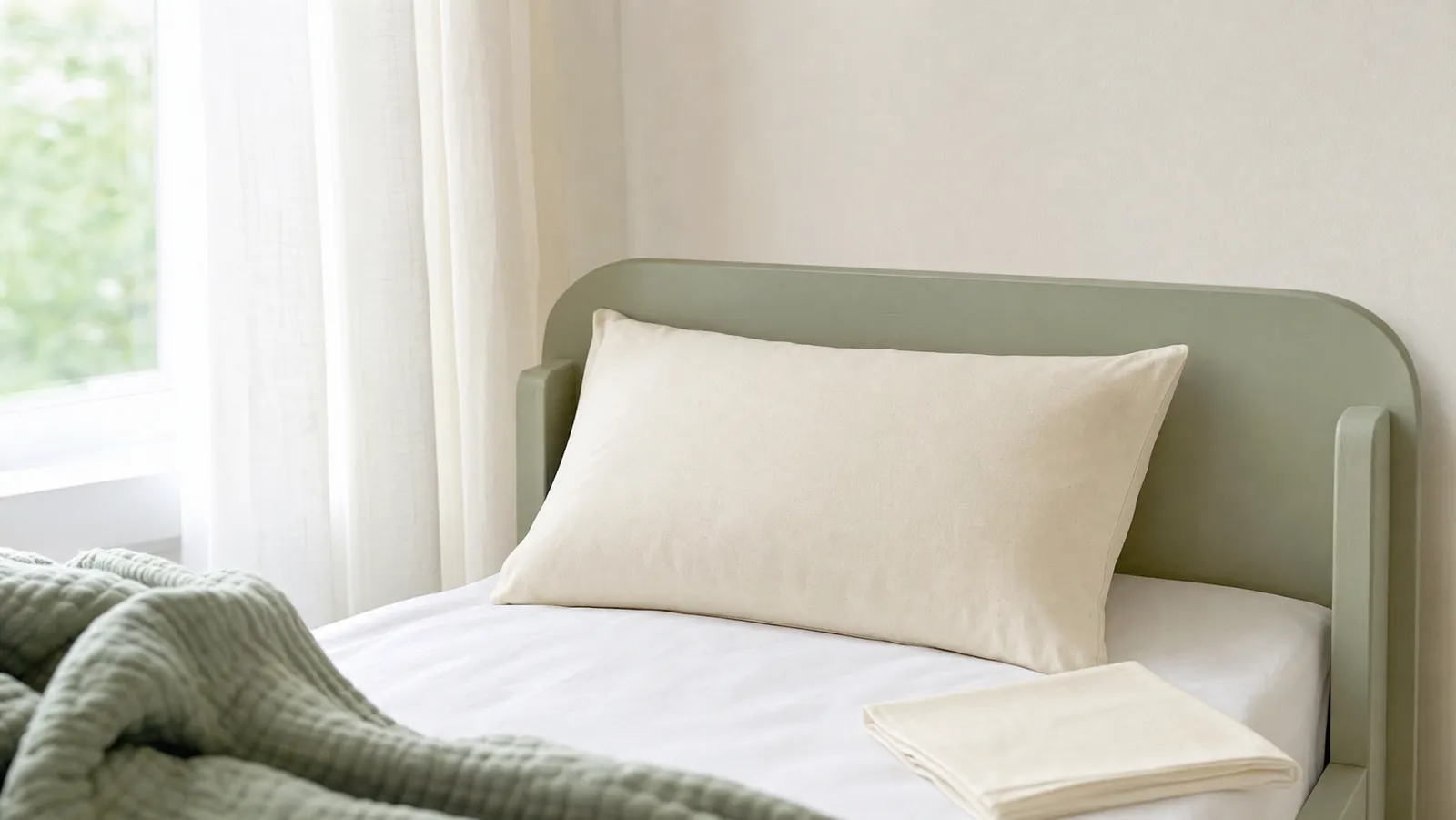
This is the pick that makes the whole argument on this page. It is a polyester pillow — LOFE describes the fill as premium polyester pearl fibre — and it is also the most documented pillow here. LOFE states that the pillow meets OEKO-TEX Standard 100 and CPSC safety requirements, and that it has been tested free from 100-plus harmful substances. "Polyester" and "tested" are not opposites, and this listing is the proof.
Read the materials line precisely: the 100% organic cotton describes the cover and the inner shell, not the fill. That is not a trick, it is how almost every pillow in this category is built, and knowing it is the difference between buying a fabric and buying a fill. The side zipper is a practical bonus rather than the headline — you can take pearl fibre out until the height suits you, which is rare at this money. It is 20 by 26 inches, the whole thing is machine washable, and it is $39.95 as of September 2026.
Beckham Hotel Collection Bed Pillows, Standard/Queen, Set of 2

Two certified pillows for the price of one premium one, and the cotton cover feels cooler against my face than the microfibre pillows it replaced.
Eight inches of loft is a great deal of height — too much for a lot of back and stomach sleepers — and hollow fibre compresses over time, so the loft you unbox is not the loft you keep.
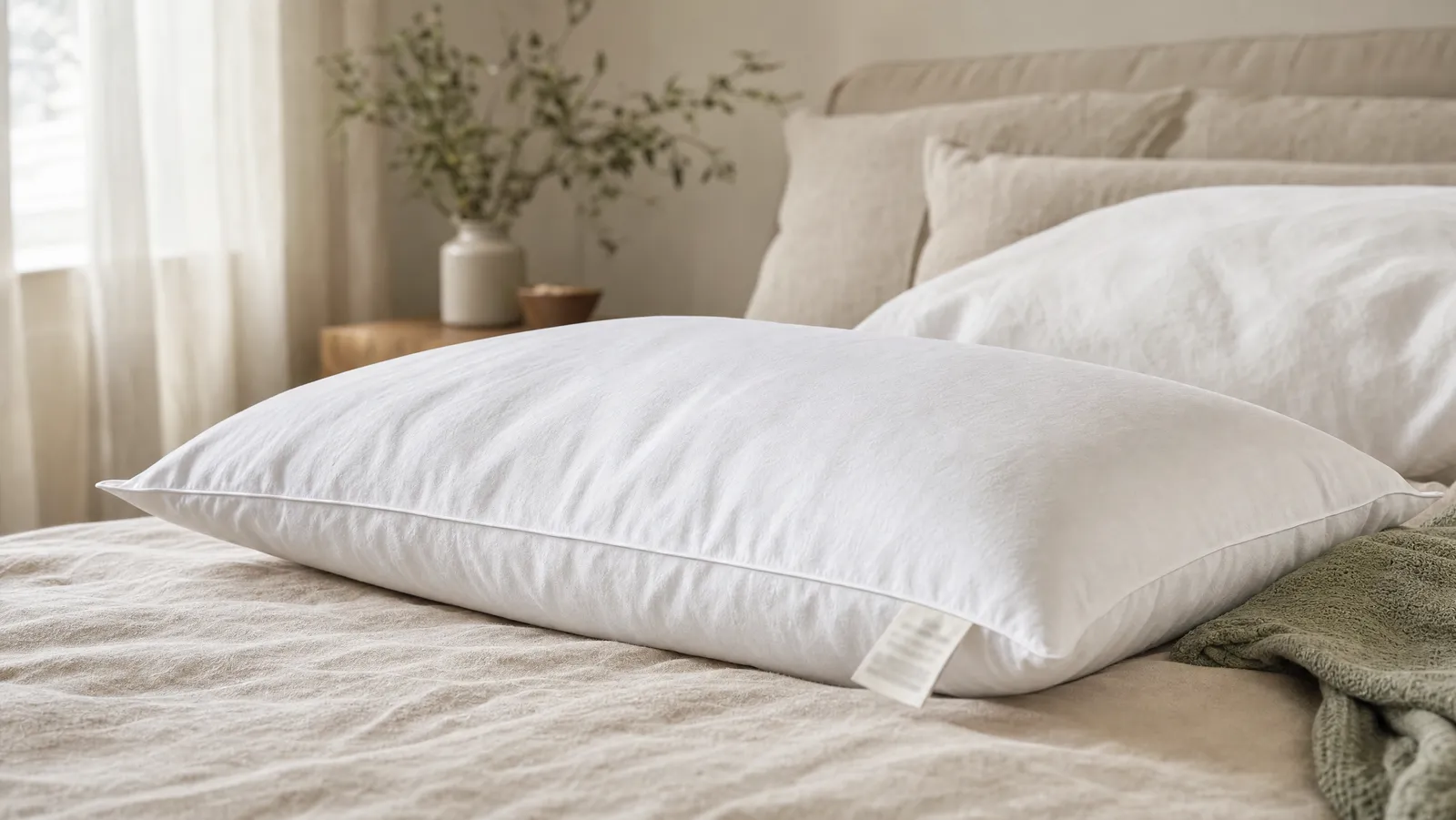
When someone says "a polyester pillow", this is usually the shape of thing they mean: a plush hotel-style down alternative, sold in pairs, stacked high on the bed. It is a fair example of the mass market done properly. Beckham states a 250 thread count 100% cotton cover, an OEKO-TEX certification, and materials tested free from 100-plus harmful substances, which is more than most pillows at this price can point to.
The numbers on the listing are worth taking literally. Beckham states 1,050 grams of hollow-fibre down alternative fill and roughly an 8 inch loft, with a medium-firm bounce-back feel. That is a lot of pillow. A cotton cover also breathes better than a microfibre shell, which matters more for how a fibre pillow feels than any chemistry question does. The set of two is $41.96 as of September 2026, against a $59.99 list price, and it is machine washable and air dry.
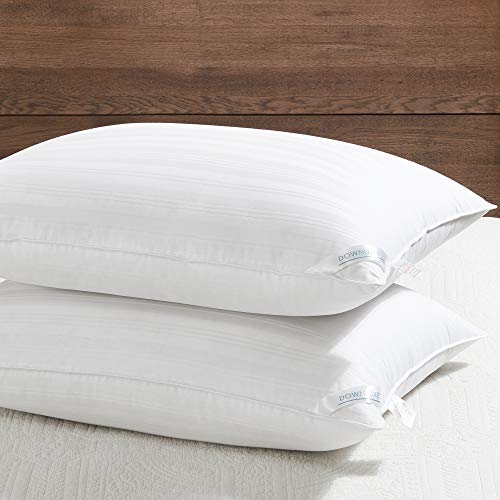
downluxe Down Alternative Pillows, Standard, Set of 2
Cheap, soft, washable, and fine for the spare room — I stopped worrying about which pillow the guests get.
No stated certification means there is nothing to look up, the blend is undefined, and soft low-density fill flattens faster than anything else on this page.
This is the honest contrast case, and the reason this article exists. The listing describes a premium polyester blend fibre and a soft striped cover with a piped edge, and it names no third-party certification at all. We are not accusing it of anything. This is simply the normal state of most inexpensive pillows, and it is exactly the situation where a careful shopper has nothing to check.
Two standard 20 by 26 inch pillows for $29.99 as of September 2026, against a $36.99 list price, is a genuinely low number, and they are machine washable. They arrive roll-packed, and downluxe asks for 24 hours for them to recover their shape. What you give up is not safety, as far as anyone can demonstrate either way — it is verifiability. "Polyester blend" is an undefined phrase, and nobody has published a limit value this pillow had to meet.
Sleep On Latex Natural Latex Shredded Foam Pillow, Standard

It is the first pillow I have owned that held the same height after a year, and the cover comes off and washes like a pillowcase.
It costs more than the fibre pillows, it is noticeably heavier to handle, and natural latex is not an option for anyone with a latex allergy.
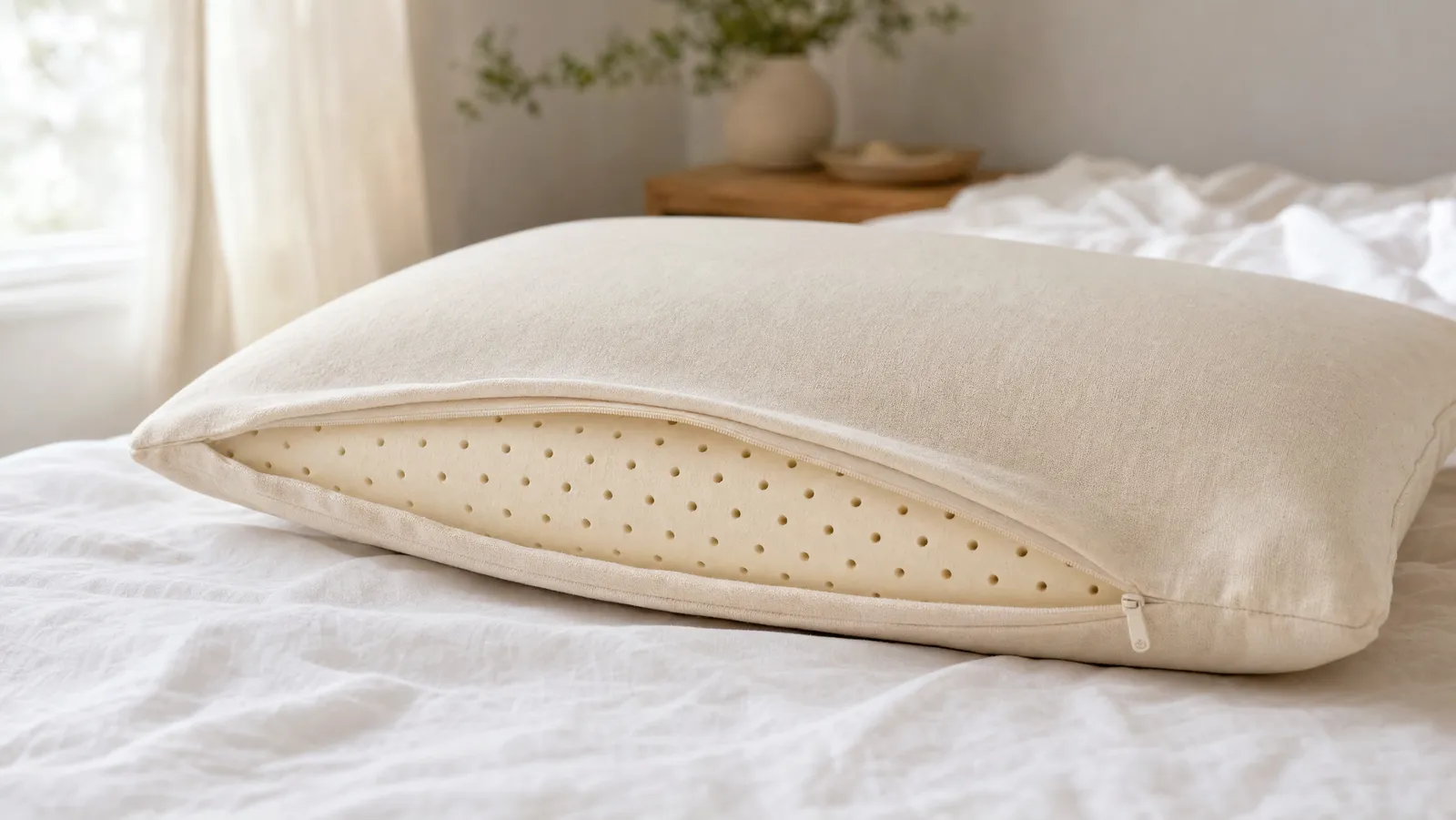
Some readers will finish this article and decide they would simply rather not sleep on a synthetic fill, whatever the evidence says. That is a legitimate preference and it does not need a health claim propping it up. This is the swap we would make. Sleep On Latex states the fill is Fair Trade natural latex foam from Sri Lanka, under a machine-washable organic cotton cover, and that the pillow is certified to OEKO-TEX Standard 100 Class 1 — the tier OEKO-TEX describes as covering articles for babies and children up to three years, with the strictest limit values of the four product classes.
Shredded fill also behaves differently in use: you can take some out to set the height, and in our experience it sleeps cooler than fibre. At $49 as of September 2026 it is the most expensive pillow here and, in our experience, the one you will still be using when the fibre pillows have gone flat. Note that a natural fill is not the same thing as a chemical-free one, and we would not describe it that way.
How to Check a Polyester Pillow in Five Minutes
There is nothing you can test at home. What you can do is find out whether anyone else has tested the pillow you are about to buy, and that takes about five minutes on a listing.
Polyester Pillow FAQ
Are polyester pillows toxic? We have found no evidence for that framing. Polyester fibre is polyethylene terephthalate, and the emissions research on bedding that we can find concerns polyurethane foam rather than fibre. There is no published measurement of a polyester pillow that we could locate, which is the most honest sentence on this page.
What is polyester pillow fill made of? PET. Biver and colleagues state that "polyethylene terephthalate (PET) is the most common type of polyester used in textiles", and Carneado, López-Sánchez and Sahuquillo, writing in Molecules in 2023, describe PET as the fastest-growing plastic in food packaging — the same polymer family, in a different form.
Is there really antimony in polyester? Yes, as a catalyst residue. Biver and colleagues write that "antimony is present in 80–85% of all virgin PET because antimony compounds (mainly Sb2O3) are used as catalysts in its production". In their six polyester fabrics, total antimony ran from about 125 to 470 µg per gram, and between about 0.05 and 2% of it — 0.1 to 1 µg per gram — was mobilised into standard artificial sweat.
Does that mean it is dangerous? The paper does not say so, and neither do we. It measured what came off fabric into a solution, not what crosses skin or enters a body, and it set no health benchmark. The authors called the amounts "non-negligible" and asked regulators to standardise the test method.
What does IARC say about antimony? In Volume 131, evaluated in 2022, the IARC Working Group classified trivalent antimony as probably carcinogenic to humans (Group 2A), on "limited evidence for cancer in humans (for cancer of the lung), sufficient evidence for cancer in experimental animals, and strong mechanistic evidence". IARC classifies hazard, not dose, and the human exposures it describes are occupational — mining, smelting, battery and electronic-waste work, firefighting.
Do polyester pillows off-gas? We could not find a VOC measurement of polyester fibre bedding in the published literature. The bedding emissions studies we can find are about polyurethane foam, which is a different material made a different way.
Do bed pillows contain flame retardants? There is no federal flammability test that reaches one. The mattress standard at 16 CFR 1632 defines a mattress as "a ticking filled with a resilient material used alone or in combination with other products intended or promoted for sleeping upon" and expressly excludes pillows, along with sleeping bags and mattress foundations.
I feel unwell and I think it is my bedding. Stop guessing and talk to a clinician. We can tell you what a pillow is made of and what somebody has tested; we cannot examine you.
Why you can trust us

Aimee Cannon
Sleep & bedding writer
Aimee Cannon is a sleep and bedding writer who has spent years testing pillows of every kind — memory foam, down, wool, bamboo, buckwheat, and specialty support pillows. She focuses on matching the right pillow to each sleeping position and need, and reports what actually holds up after months of nightly use. When she is not testing pillows, Aimee is usually with her husband and her dog.