Flame Retardants in Pillows: What the Law Actually Requires
Do pillows have flame retardants? Nothing in US law requires one to be treated, and most are probably not. But "not required" is not the same as "not present": a published 2016 screening found a flame retardant in 9 of 32 polyurethane foam pillow samples. We may earn a commission from links on this page, at no extra cost to you.
Both halves point at one practical question — what is your pillow filled with? That screening tested polyurethane foam, where memory foam pillows live; latex, wool, down, feather, cotton and polyester fibrefill are different materials it did not sample. The rest of this page is the paperwork: which standards exist, what each covers, what has been measured, and what a "flame retardant free" label is worth. If you want the shopping side rather than the regulations, our non-toxic pillow buying guide works through materials and certifications in order.
The federal mattress standards do not cover pillows
16 CFR 1632 is the older of the two federal rules for sleep surfaces, the Standard for the Flammability of Mattresses and Mattress Pads. The CPSC describes it as a cigarette ignition test: it measures how a mattress or mattress pad resists a smouldering ignition source. 16 CFR 1633 is the open-flame standard, and the CPSC describes its test as limiting the size of the fire generated by a mattress or mattress set during a 30-minute test.
Now the definition. Under 16 CFR 1632.1 a mattress is "a ticking filled with a resilient material used alone or in combination with other products intended or promoted for sleeping upon", and that section's own exclusion list names "sleeping bags, pillows, mattress foundations" and juvenile product pads. The CPSC's guidance on the open-flame standard excludes more, listing "mattress pads, mattress toppers, sleeping bags, pillows" and several further categories as outside the definition. Mattress pads move between the two: 1632 covers them, 1633 leaves them out.
So a bed pillow has no federal flammability performance requirement, and no test its maker must engineer around. And where the standards do apply they are performance tests, not chemistry mandates: barrier fabrics, tight ticking and inherently resistant fibres are all legitimate routes.
Are flame retardants required in bedding? Not by any US rule we can find
The second suspect is California, where most American furniture flammability rules originate. TB117-2013 is the current upholstered furniture standard, and its scope is the point: it sets smoulder resistance test methods for cover fabrics, barrier materials, resilient filling and decking used in upholstered seating furniture. Seating. A sofa cushion is in; a bed pillow is not.
The 2013 revision also changed the test. The older TB117 included an open-flame component, which manufacturers commonly met by adding flame retardant chemicals to foam; TB117-2013 replaced it with a smoulder test, a lit cigarette laid on the fabric with char length measured. That does not ban the chemicals — it removed the test that had driven manufacturers to them. California's own label language, set by Business and Professions Code section 19094, says the state "has updated the flammability standard and determined that the fire safety requirements for this product can be met without adding flame-retardant chemicals."
For bedding, California is blunter. The Bureau of Household Goods and Services, which enforces the state's Home Furnishings and Thermal Insulation Act, publishes a labelling FAQ that requires a law label on every new bedding product with concealed filling — "comforters, bed pillows, decorative pillows, etc." — and then states that those bedding products "are not required to have flammability labels attached."
TB117 and bedding: what the California flame retardant label really means
California did create the label people are looking for. SB 1019, signed in 2014, added a flame retardant statement to the flammability label, not the law label (BHGS allows the two to be combined), with two boxes: "contains added flame retardant chemicals" and "contains NO added flame retardant chemicals." The statute defines added flame retardant chemicals as those above 1,000 parts per million, and BHGS says the requirement took effect on 1 January 2015.
But BHGS says the statement is required "for all covered products, which includes any flexible polyurethane foam, or upholstered or reupholstered furniture sold in California that is required to meet the flammability requirements of Technical Bulletin (TB) 117-2013."
So the label is real, useful, and on your sofa. It is not on your pillow — and its absence there means nothing, because pillows were never covered. Shopping for a pillow, you are hunting a document the category never had.
Why everyone assumes bedding is treated
The belief has honest origins, and there are three. The first is children's sleepwear. Under 16 CFR 1615 and 1616, children's sleepwear in sizes 0 through 14 must be flame resistant and self-extinguishing — and the CPSC defines the category as "any product of wearing apparel (sizes 0 through 14) such as nightgowns, pajamas, robes, or similar or related items, such as loungewear, intended to be worn primarily for sleeping or activities related to sleeping." Wearing apparel. Pyjamas are regulated; the pillow the child sleeps on is not. Furnishing a child's bed on this basis? Our guide to non-toxic pillows for kids is the right page.
The second is polyurethane foam in juvenile products, where the concern was real and well documented. A 2011 study in Environmental Science & Technology by Stapleton and colleagues analysed foam from 101 commonly used baby products — changing pads, nursing pillows, car seats, high chairs and portable crib mattresses among them — and found an identifiable flame retardant additive in 80 of them, most often tris(1,3-dichloroisopropyl) phosphate at 36% of samples, with Firemaster 550 components at 17% and a chlorinated compound sold as V6 at 15%. Berkeley News, reporting the study, attributed those additives to California's old TB117 open-flame standard. The state's own rulemaking record is consistent: the Bureau's 2013 Initial Statement of Reasons records that among baby products only strollers, infant carriers and nursing pillows were then exempt, and proposes exempting seventeen more baby and infant products as "subject to flammability standards unnecessarily." That paper is about juvenile products. The 2016 screening below is the one that sampled bed pillows.
The third is category collapse. Mattress, mattress pad, topper, sofa cushion and pillow feel like the same kind of object. Legally they are five different things: mattresses and mattress pads answer to 16 CFR 1632 and 1633, sofa cushions to 16 CFR 1640 (which made TB117-2013 federal in 2021), and the bed pillow to no flammability test at all.
What testing has actually found in foam pillows
Cooper and colleagues, writing in Environmental Science & Technology in 2016, reported results from a free public screening service at Duke University. Between February 2014 and June 2016 the lab analysed 1,141 polyurethane foam samples that members of the public cut from their own household products and mailed in, across 12 product categories. Overall, 52% contained a flame retardant above 1% by weight, most often tris(1,3-dichloroisopropyl) phosphate.
Pillows were one of those 12 categories. Nine of the 32 pillow samples — about 28% — contained a flame retardant above 1% by weight. The authors single the category out, writing that products "that were not expected to contain flame retardants (e.g., pillows)" may also be sources of exposure, and that "pillows in particular may be a significant source of exposure given the proximity and duration of time that people spend in contact with these products on a daily basis."
That is a real detection, peer-reviewed, in this product category. Two things temper it, and the authors raise both.
- It is 32 samples of polyurethane foam, self-selected. Because the project was a public-service survey, the authors write, "there are likely some biases and limitations," including product information participants may not report accurately. Thirty-two volunteered foam samples is not a market survey, and 28% of them is not a 28% chance that the pillow on your bed is treated.
- Detection is not dose. A flame retardant in foam above 1% by weight is a measurement of the foam, not of what reaches a sleeper. The paper argues pillows deserve study because of contact time; it does not report an exposure figure for pillow users, and we have not found one. A chemical class with documented hazards in occupational, animal or house-dust research is not the same as a pillow delivering a meaningful dose.
Note what was sampled: polyurethane foam — the fill in which these chemicals have actually been found in pillows. Latex, wool, down, feather, cotton and polyester fibrefill are different materials this screening did not sample — a narrower statement than "they are clean," and the only one the evidence supports. It is a different question from whether pillows contain PFAS, where the vector is a stain- or water-repellent finish rather than an additive in foam.
What states have actually restricted, and where
Some states went past labelling to prohibition. These are narrower than the headlines.
- California AB 2998 prohibits selling new juvenile products, mattresses and upholstered furniture containing covered flame retardant chemicals above 1,000 parts per million, effective 1 January 2020. Its "juvenile product" definition names nursing pillows explicitly. Its mattress definition, though, states that mattress "has the same definition as that term is defined in Section 1632.1 of Title 16 of the Code of Federal Regulations" — the definition that excludes pillows.
- New York's Family and Fire Fighter Protection Act (S4630B) prohibits covered flame retardant chemicals — halogenated, organophosphorus, organonitrogen and nanoscale — from being intentionally added to new mattresses and upholstered furniture. The International Sleep Products Association reported the mattress provisions took effect 1 December 2024.
Bed pillows are absent from these bans not because legislators cleared them but because they were never the problem the legislation was written to solve. Put that beside the 2016 screening and the shape is clear: no US rule pushes chemical treatment onto a bed pillow, and flame retardants have nonetheless been measured in some polyurethane foam ones. The lever here is not the statute. It is the fill, and the certificate.
What a "flame retardant free pillow" claim is worth
Very little on its own, and the reason is structural: when no rule required treatment, a maker announcing "no added flame retardants" is making an unverified negative claim about its own product. Nobody audits it.
The phrase "chemical free pillow" is worse. Everything is chemicals, latex and wool included, and no US agency defines the term.
What you can check is a positive claim tested by someone else. OEKO-TEX Standard 100 tests the finished textile article against a restricted substance list, and OEKO-TEX's own FAQ states that most biologically active and flame retardant substances "are forbidden from use in OEKO-TEX certified products," with exceptions only for substances on its Active Chemical Products list. Products are certified in four classes by intensity of skin contact, with Class 1 — articles for babies and toddlers — the strictest.
Be precise about what that buys you: OEKO-TEX certifies that a specific article was tested against a specific list, on a certificate with a number and an expiry. It does not certify a product as free of anything. We unpack the other marks in what pillow certifications actually mean — but between a maker's own sticker and a certificate number you can look up, the certificate does the work.
Wool, and why it keeps coming up
Wool earns its place here on physics rather than marketing. According to the International Wool Textile Organisation, wool's fire resistance comes from its naturally high nitrogen and water content: it is difficult to ignite at 570 to 600 degrees C, against roughly 255 degrees C for cotton and 485 to 560 degrees C for polyester. IWTO adds that wool does not normally support flame or melt, and that its cross-linked cell membranes swell when heated to combustion, forming an insulating layer that slows flame spread.
That is a real material property, achieved with no additive, and wool has the further advantage of not being polyurethane foam. Keep it in proportion: ignition resistance is not a certificate, and nobody has established that wool pillows are free of anything.
Three pillows that show the buying logic
These illustrate the two levers rather than rank anything, and none of the three is filled with polyurethane foam. None is certified flame-retardant free, and we will not describe any of them that way. We have not slept on them; we can only separate the maker's claims from somebody else's.
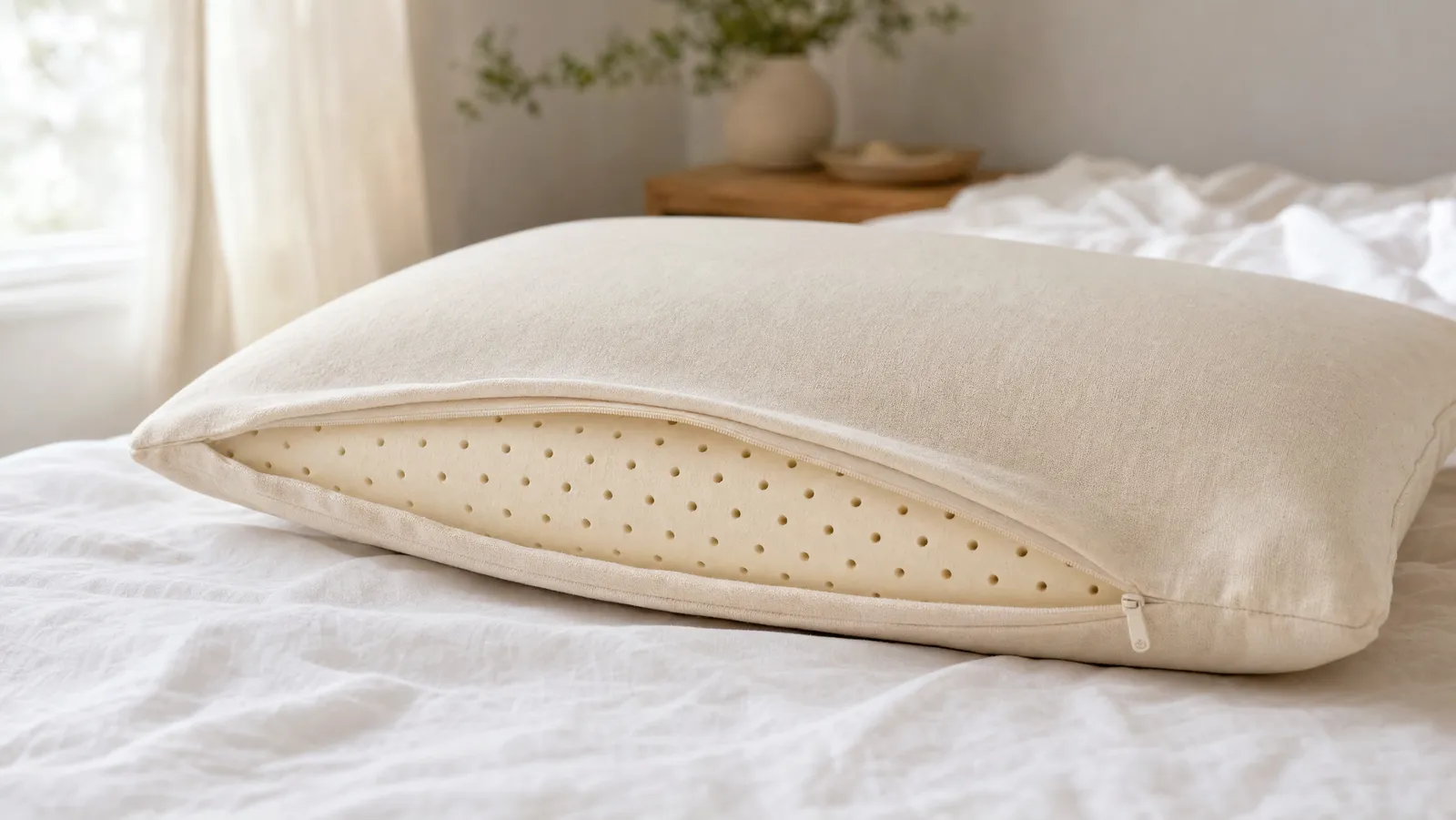
- The Sleep On Latex Shredded Natural Latex Pillow, $49.00 as of September 2026, is the short-materials-list pick: the maker says Fair Trade Sri Lankan natural latex under an organic cotton cover it lists as Oeko-Tex Standard 100 Class 1.
- The YOUR MOON Natural Wool Pillow, $45.99 as of September 2026, carries a caveat: YOUR MOON states the top layer is 100% wool while the bottom layer is 51% Australian wool and 49% microfiber. It is a wool-topped pillow, not a wool pillow.
- The LOFE Organic Pillow, $39.95 as of September 2026, is the cheapest naming a testing programme — LOFE says it meets OEKO-TEX Standard 100 and CPSC requirements — over an adjustable polyester pearl fibre fill in an organic cotton case and shell.
The bottom line
Do pillows have flame retardants? The regulatory answer is that nothing required them to: 16 CFR 1632 excludes pillows from the mattress definition, TB117-2013 governs upholstered seating with a smoulder test that cut the reason to treat foam, California requires a law label on your pillow but explicitly not a flammability label, and the state bans that exist reach mattresses, upholstered furniture and juvenile products such as nursing pillows.
The measured answer is that a published 2016 screening found a flame retardant above 1% by weight in 9 of 32 polyurethane foam pillow samples, and its authors flagged pillows as deserving more attention than they have had. Both answers are true at once, and a page that gives you only the first is not being straight with you.
Which leaves two levers that are yours:
- The fill. Polyurethane foam is the material in which these chemicals have been measured in pillows. Latex, wool, down, feather, cotton and polyester fibrefill are different materials the screening did not sample — a narrower claim than "they are clean," and the honest one.
- The certificate. A finished-article test against a restricted substance list, with a number and an expiry you can look up, is a claim somebody else stands behind.
So read the fill statement on the law label, prefer a certificate number over a slogan, and check whether a pillow is foam before you spend any worry on it — the same filter our non-toxic pillow guide applies across the category. Some people prefer to avoid these chemicals wherever they can, which is a reasonable preference. And if you feel unwell and suspect your bedroom, that is a conversation for a clinician, not a checkout page.
The shortlist
3 pillows compared — firmness, loft, and temperature side by side. The top pick is highlighted.
| Pillow | Firmness | Loft | Sleeps | Best for | Price |
|---|---|---|---|---|---|
Medium Soft | Adjustable | Cooling | A short, checkable materials list at a low price | $49 Check | |
Best Wool OptionYOUR MOON Soft Natural Wool Pillow, Queen, Flat & Thin Low-Loft | Soft | Low | Neutral | Wool's inherent fire resistance in a low-loft pillow | $45.99 Check |
Medium Soft | Adjustable | Neutral | A finished-product certification on a small budget | $39.95 Check |
Sleep On Latex Natural Latex Shredded Foam Pillow (Standard)

It arrived, I pulled out two handfuls, and it has been right ever since — and there was none of the chemical smell I braced for after reading too much about pillows.
Latex has its own faint rubbery smell for the first day or two, and shredded fill clumps if you never fluff it.
This is the pillow we point to when someone wants a materials list short enough to read out loud. Sleep On Latex says the fill is Fair Trade natural latex foam from Sri Lanka, shredded rather than moulded, under a machine washable organic cotton cover the maker lists as Oeko-Tex Standard 100 Class 1 certified — the strictest of OEKO-TEX's four product classes, the one used for articles for babies and toddlers.
Nothing about the construction depends on a finish. It is latex and cotton, and because the fill is shredded you can open it and take some out until the height suits your shoulder. At $49.00 as of September 2026 it is the cheapest route here to a pillow whose ingredients you can name.
YOUR MOON Soft Natural Wool Pillow, Queen, Flat & Thin Low-Loft

It is flat in the way I wanted flat to mean — my head is not shoved forward all night — and the cotton shell has washed twice without going stiff.
Only the top layer is pure wool; the bottom is about half microfiber, and if you like a tall pillow this is not one.
Wool is the reason this conversation keeps circling back to natural fibres: according to the International Wool Textile Organisation, wool resists ignition on its own account, without treatment. So read this pillow's fibre content carefully, because it is a wool pillow in the way most wool pillows are. YOUR MOON states a dual-layer fill — a top layer of 100% premium wool over a bottom layer of wool balls that are 51% Australian wool and 49% microfiber. It is not wool all the way through, and the listing is the source for that, not us.
The outer shell is 100% cotton and quilted, and the maker says all materials are OEKO-TEX certified. It is a queen at 20 x 30 inches but deliberately flat and thin, which YOUR MOON positions for back and stomach sleepers. It ships vacuum-compressed; the maker says to tumble dry on low for 30 to 40 minutes to bring the loft back. $45.99 as of September 2026.
LOFE Organic Pillow 20x26 with Organic Cotton Case, Adjustable

Under forty dollars, it names a certification I could look up, and the zipper meant I set the height myself instead of hoping.
The organic cotton is the case and the shell; the fill is polyester, and the listing does not hide that but the product name almost does.
This is the cheapest pick here that names a testing programme instead of making a promise. LOFE says the pillow meets OEKO-TEX Standard 100 and CPSC safety requirements. That matters on this page because OEKO-TEX's own FAQ says most flame retardant substances are forbidden in certified products, with limited exceptions — a restriction tested on the finished article, which is a different kind of claim from "no flame retardants added."
Read the fibre content before you buy. The pillowcase and inner shell are 100% organic cotton; the fill is polyester pearl fibre, so "organic" describes the fabric, not the stuffing. A side zipper lets you add or remove fill to set the loft, and LOFE says to wash the cover rather than the fill to keep it from clumping. At $39.95 as of September 2026 — and at 20 x 26 inches, a standard rather than a queen — it is the best value of the three.
How to Check What Is Actually in Your Pillow
You cannot test a pillow for flame retardants at home, and you do not need to. What you can do is read the two documents every pillow comes with — the law label and the listing — and find out what it is made of.
Flame Retardants and Pillows FAQ
Do pillows have flame retardants? Some do, though nothing requires them to. The federal mattress flammability standard at 16 CFR 1632 defines a mattress in a way that expressly excludes pillows, so a bed pillow has no federal flammability test to pass, and California does not require a flammability label on bedding products either. But a 2016 screening published in Environmental Science & Technology detected a flame retardant above 1% by weight in 9 of 32 polyurethane foam pillow samples — so "not required" is not the same as "not present."
Are flame retardants required in bedding? No US rule requires that any bedding be chemically treated. 16 CFR 1632 requires mattresses and mattress pads to resist ignition by a lit cigarette, and 16 CFR 1633 limits the size of the fire a mattress set produces in a 30-minute open-flame test. Both are performance tests. Neither names a chemical, and neither covers pillows.
Does TB117 apply to bedding? California's TB117-2013 is an upholstered furniture standard: it sets smoulder resistance methods for cover fabrics, barrier materials, resilient filling and decking used in upholstered seating furniture. Bed pillows are regulated in California as bedding products, which BHGS says do not require flammability labels.
What about my child's pillow or a nursing pillow? Nursing pillows are a different legal category. California's AB 2998 lists nursing pillows among the "juvenile products" in which covered flame retardant chemicals above 1,000 parts per million have been prohibited since 1 January 2020. An ordinary bed pillow for an older child is not in that definition.
Does an OEKO-TEX label mean a pillow is flame-retardant free? Not in those words. OEKO-TEX's own FAQ says most flame retardant substances "are forbidden from use in OEKO-TEX certified products," with narrow exceptions for substances reviewed on its Active Chemical Products list. That is a tested restriction on the finished article, which is more than a maker's promise — but it is not a certificate of absence, and OEKO-TEX classifies products by skin contact rather than certifying a product as free of anything.
Is a "chemical free pillow" a real thing? No. Everything is made of chemicals, and no US agency defines that phrase. "Filled with shredded natural latex under an OEKO-TEX Standard 100 Class 1 cover" is a claim you can check; "chemical free" is not.
Should I throw out an older foam pillow? That is your call, and it is the one question on this page where the answer is not simply "relax." Polyurethane foam is the material in which flame retardants were actually measured, and the 2016 samples were cut from products households already owned. We would not tell anyone to bin a pillow on a 28% detection rate in 32 volunteered samples — but if a foam pillow is also flat and eight years old, you now have two reasons to replace it rather than one. A wool, latex or down pillow is a different material and was not what that study sampled.
I think my bedding is making me ill. What now? Talk to a clinician. Symptoms you associate with your bedroom have many possible causes, and no product page can examine you.
Why you can trust us

Aimee Cannon
Sleep & bedding writer
Aimee Cannon is a sleep and bedding writer who has spent years testing pillows of every kind — memory foam, down, wool, bamboo, buckwheat, and specialty support pillows. She focuses on matching the right pillow to each sleeping position and need, and reports what actually holds up after months of nightly use. When she is not testing pillows, Aimee is usually with her husband and her dog.