How to Position Your Pillow to Ease Neck Pain

If you wake up with a stiff, aching neck, the fix may be free. Slide the pillow you already own a couple of inches up the bed so its bottom edge meets the tops of your shoulders instead of sitting underneath them. That single change fills the hollow under your neck rather than pushing your head forward all night.
We may earn a commission from links on this page, at no extra cost to you. Most people answer morning neck pain by buying another pillow, and sometimes that is the right call. But learning how to position your pillow for neck pain costs nothing and takes one night to test — and the pillow most people already own is closer to correct than the place they put it.
This is not a niche complaint. A 2024 analysis published in The Lancet Rheumatology, drawn from the Global Burden of Disease Study 2021, estimated that roughly 203 million people worldwide were living with neck pain in 2020, and projected that number to reach 269 million by 2050. Bedding is obviously not the cause of all of it. But if your neck is at its worst in the first ten minutes after waking, your sleep setup is a sensible place to start — and if it turns out the pillow itself is the problem, our guide to the best pillow for neck pain is the next stop.
One plain caveat first. If your neck pain is severe, persistent, follows an injury, or arrives with numbness, weakness, or pain radiating down an arm, that is a question for a clinician and not a pillow. The Mayo Clinic advises seeing a doctor for neck pain accompanied by weakness, numbness, or pain that radiates into the arms or legs.
The one rule of pillow position for neck pain
Everything below is a different route to the same destination: your ears, shoulders and hips should form a straight line, and your chin should sit level — neither tipped down toward your chest nor tilted back toward the ceiling.
The Cleveland Clinic puts the second half of that plainly, advising sleepers to avoid tucking in the chin and to "sleep looking forward" in order to maintain the natural curve of the neck. It also recommends choosing a pillow height that keeps your head in a neutral position to reduce strain.
Two checks you can run tonight, in bed, with no equipment:
- The chin check. Lie down in your usual position and, without moving your head, notice where your chin is. Tucked toward your chest means too much pillow. Tilted back means too little.
- The hand check. Slide a hand into the space between your neck and the mattress or pillow. If there is an obvious air gap, nothing is supporting the curve of your neck — the pillow is holding up your skull and leaving the part that actually needs help unsupported.
In our experience, most people who "hate their pillow" fail the second check, not the first.
Where your pillow's bottom edge goes
Here is the error we see most often: the pillow drifts down the bed over the course of a night or a week, and people end up sleeping with the top of their shoulders on it. That lifts the whole shoulder girdle, which pushes the head forward and holds the neck in flexion for seven hours.
The mental model that fixes it is a gap, not a prop. Cleveland Clinic chiropractor Andrew Bang, DC, described the pillow's job on the clinic's own health podcast as filling "this space between your head and the bed." Your upper back does not need the pillow. That is the mattress's job.
So, in order:
- Lie down the way you actually sleep, not the way you think you should.
- Reach down and find the pillow's bottom edge. If any part of your shoulder is on top of it, the pillow is too far down the bed.
- Slide the pillow toward the headboard until its bottom edge is snug against the tops of your shoulders — touching them, resting against them, not underneath them.
- Push that bottom edge gently into the hollow under your neck, so the pillow fills the gap instead of bridging over it.
- Re-check your chin. Level is the target.
That is roughly two inches of movement for most people, and it is free.
Side sleeping: fill the ear-to-shoulder gap
Side sleepers have the biggest gap to fill, because the distance from the mattress to your ear is the width of your shoulder. Harvard Health's guidance is specific here: if you sleep on your side, keep your spine straight by using a pillow that is higher under your neck than under your head.
Two things to aim for:
- Nose in line with your sternum. If your head is tipping down toward the mattress, you need more height. If it is craning up, you need less. The Sleep Foundation makes the same point, advising side sleepers to keep the head and neck aligned with the rest of the body so that excess weight is not placed on the neck.
- Shoulder tucked in front, not squashed underneath. Ease your lower shoulder slightly forward so you are not lying directly on the joint, then let the pillow's bottom edge rest against it.
Broad shoulders need more loft than almost anyone expects, which is why so many side sleepers give up on a pillow that would work perfectly for a back sleeper. If this is you, our guide to choosing a pillow for neck pain if you sleep on your side goes deeper on how to measure that gap before you buy anything.
Back sleeping: much less loft than you think
Back sleepers usually have the opposite problem. The gap between the back of your head and the mattress is small, so a tall pillow shoves your chin into your chest for the whole night.
The Cleveland Clinic notes that sleeping on your back is generally the position that puts the least pressure on the spine — but only if the height is right. Harvard Health suggests back sleepers use a rounded pillow to support the natural curve of the neck with a flatter pillow cushioning the head, and the Sleep Foundation similarly describes a small pillow at the base of the neck keeping the head in a neutral position.
In practice that means supporting under the neck curve, not just under the skull. A flat pillow with a roll along its bottom edge does this well; a single thick pillow almost never does. If you sleep on your back and have been cycling through pillows without luck, our pillow setup for back sleepers with neck pain walks through the specific arrangements worth trying.
Stomach sleeping: the hardest case for your neck
We are not going to tell you to stop. People rarely can, and lying awake trying to retrain yourself has its own costs. But it is worth being straight about the mechanics.
Harvard Health notes that sleeping on your stomach is tough on the spine because the back is arched and the neck is turned to the side, and the Sleep Foundation observes that sleeping face-down with the head rotated may increase weight on the neck and limit recovery from pain.
If it is your position, two adjustments may make it kinder:
- Go very thin, or go without. A thick pillow under a stomach sleeper's head adds extension on top of rotation. Many stomach sleepers do better with a soft, nearly flat pillow.
- Put a pillow under your hips. The Sleep Foundation suggests a pillow under the pelvis for stomach sleepers, saying it lifts the hips and abdomen and reduces pressure on the spine — which may take some of the strain out of everything above it.
The towel trick: a free towel pillow for neck pain
Before you buy a cervical roll, make one. The Sleep Foundation explicitly suggests rolling up a hand towel and inserting it along the long edge of the pillowcase, noting that the shape of a rolled towel can be changed to fit the natural curve of the neck — which is exactly why it makes such a good first experiment. It costs nothing and you can adjust it in ten seconds.
The short version: roll a hand towel along its long edge, slide it inside the pillowcase against the bottom edge, and lie down. Your chin should stay level. If it tips up, unroll a layer. Step-by-step instructions are in the box above.
Two honest caveats. First, towel rolls flatten — you will be re-rolling every few days, and that is the main reason people eventually buy a purpose-made roll. Second, if the towel makes no difference after several nights, adding one is not your answer, and stacking more fixes on top of a wrong one only muddies your test.
The supporting pillows nobody mentions
Your neck sits at the top of a chain. When your pelvis rotates, your ribcage tends to follow, and your neck can end up compensating at the far end of it — which is why the most useful pillow for a sore neck is sometimes nowhere near your head.
- Side sleepers: one between the knees. The Sleep Foundation notes that sleeping with a pillow between your knees can improve spinal alignment and reduce pressure on the hips and knees by stopping the top leg from dragging the pelvis forward.
- Back sleepers: one under the knees. The Cleveland Clinic suggests slipping a small pillow under your knees, saying the lift works with the spine's natural curve and takes pressure off the lower back. The Sleep Foundation adds that placing a pillow beneath the knees or thighs can keep the muscles along the spine flat and relax the muscles in the neck.
To be clear about what this is: it is not treating your neck. It is holding the rest of the line steady so your neck is not the joint doing the compensating.
How to test a change without fooling yourself
This is the part almost everyone gets wrong, and it wastes more money than any bad pillow.
- Change one variable at a time. Move the pillow. Or add a towel roll. Or add a knee pillow. Not all three on the same night — if things improve you will have no idea which one did it, and if they get worse you will have no idea what to undo.
- Give it three to five nights. Foam needs to warm up and take a shape, fiber needs to settle, and your body needs a few nights to stop noticing that anything changed at all.
- Judge it in the morning, not at bedtime. Rate your neck in the first ten minutes after waking, before you have stretched or had coffee. A pillow that feels wonderful at lights-out and leaves you stiff at 6 a.m. is the wrong pillow, no matter how good the first five minutes were.
Keep a note on your phone if you can be bothered. Three words a morning is enough.
Three positioning aids, not replacement pillows
If placement alone has not closed the gap under your neck, a small roll can. Every product below is an add-on you use with the pillow you already own — none of them replaces your main bed pillow, and we would not recommend trying to sleep on any of them by itself.
The buying decision is simpler than it looks, and it comes down to fill. The AllSett Health Firm Cervical Neck Roll and the Cozyhealth 3.1-inch cervical roll are memory foam, which means a fixed shape and a fixed thickness: 4 inches of firm foam for the AllSett, a much gentler 3.1 inches for the Cozyhealth. You choose the one that matches your gap, and you live with that choice.
The Core Products Jackson Roll is the opposite: a fiber bolster whose fill Core Products says can be redistributed by hand, so you can thin it out, shift it toward one end, or fluff it back up as you learn what your neck wants. The trade-off is that fiber packs down and needs re-fluffing, where both foam makers say their cores hold their shape rather than settling. Prices ran from $14.99 to $28.56 as of August 2026, so this is a cheap experiment either way.
Rolls do take some getting used to. Cozyhealth's own listing advises easing in with about five minutes at first and building up before sleeping on it overnight, which strikes us as sensible advice for any of them.
When placement is not the problem
Sometimes the answer really is a new pillow, and it is worth knowing when you have reached that point.
If you have worked through the steps above, changed one thing at a time, and nothing has shifted after two to three weeks, placement is probably not your constraint. The two usual culprits are the pillow's loft — it is simply too tall or too flat for your shoulder width and sleep position, and no amount of sliding it around will fix a number that is wrong — or a mattress that lets your hips or shoulder sink far enough to change the geometry of everything above. Our guide to choosing the right pillow height for neck pain is the place to start on the first of those.
And it bears repeating: pillow position is a comfort and posture question, not a medical one. Persistent, severe, or worsening neck pain, pain after an injury, or any numbness, weakness or arm symptoms deserve a proper assessment.
The short version
Move the pillow before you replace it. Get its bottom edge up against the tops of your shoulders, fill the hollow under your neck rather than propping up your upper back, keep your chin level, and add a rolled hand towel if the gap is still there. Then hold everything steady with a pillow between or under your knees, change one thing at a time, and judge the result by how your neck feels in the first ten minutes after you wake.
Most people who do this find that the pillow they were about to throw out was fine. If yours genuinely is not — if the loft is wrong for your shoulders and no amount of repositioning helps — Home Pillow Review's pillow guide for neck pain covers what to buy instead, and why.
The shortlist
3 pillows compared — firmness, loft, and temperature side by side. The top pick is highlighted.
| Pillow | Firmness | Loft | Sleeps | Best for | Price |
|---|---|---|---|---|---|
Firm | Low | Neutral | Filling the gap under your neck | $17.99 Check | |
Best Low-Profile RollCozyhealth 3.1-Inch Small Cervical Roll Pillow | Medium Soft | Low | Neutral | A shallow neck gap or a first try at a roll | $14.99 Check |
Best All-Purpose PositionerCore Products Jackson Roll Bolster Pillow | Medium | Medium | Neutral | Knees, lower back and neck from one bolster | $28.56 Check |
AllSett Health Firm Cervical Neck Roll Memory Foam Bolster
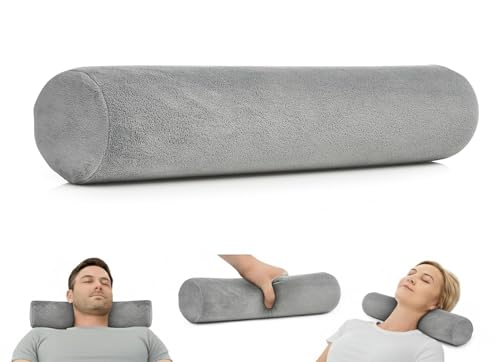
The dull ache at the base of my skull stopped waking me after about a week, and because it hides inside my normal pillowcase nobody can tell it is there.
It is genuinely firm and cannot be reshaped, so a shallow neck gap will feel over-filled for the first few nights, and it needs a day out of the box before it reaches full size.
This is the roll we hand to most people, because it does one job well: filling the curve under your neck without asking you to replace the pillow you already sleep on. It is a firm memory foam bolster, 17 by 4 inches, that slides into a standard pillowcase — the detail that makes it practical: you tuck it along the bottom edge of your own pillow instead of rearranging the bed around it. AllSett describes it as ergonomically designed to encourage a therapeutic sleep posture and to support head, back, neck and shoulder alignment.
The 4-inch thickness is also its honest limit: firm and fixed in shape, it either matches your neck gap or it does not. AllSett says the foam holds its shape rather than settling, and advises allowing up to 24 hours for it to expand fully after unwrapping. If it proves too much under your neck, the maker also suggests using it under the legs, shoulders or back.
Cozyhealth 3.1-Inch Small Cervical Roll Pillow
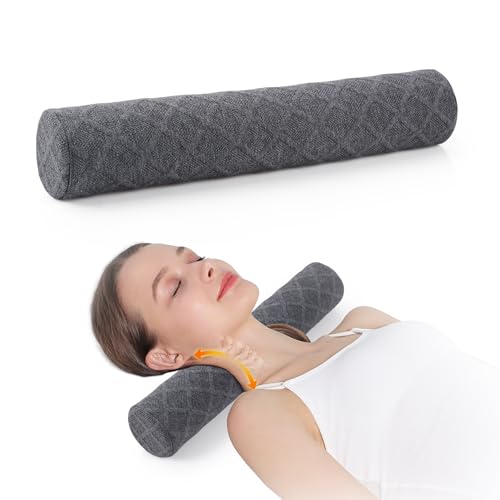
Starting at five minutes and working up was the right call; by the fourth night I slept through with it, which never happened with the taller roll I tried first.
At 3.1 inches it is deliberately low, so broad-shouldered side sleepers with a big ear-to-shoulder gap will probably find it does not fill enough on its own.
If a firm roll under your neck sounds like too much, start here instead. The Cozyhealth is a small cylinder just 3.1 inches high in a medium-soft, slow-rebound memory foam, which makes it the gentlest way to find out whether filling your neck gap changes anything at all. Cozyhealth positions it as a posture aid intended to keep the neck and shoulders aligned and to maintain the spine's natural curve.
We appreciate that the listing is upfront about the adjustment period: Cozyhealth advises easing in with roughly five minutes at first, increasing gradually, then moving to overnight use. That matches our own advice to change one thing at a time and give it several nights. The maker states the memory foam core resists flattening and hardening over long-term use. Like the AllSett, though, it is a fixed shape — a deliberately low one — so it suits a shallow gap and a first experiment far better than a deep one.
Core Products Jackson Roll Bolster Pillow

Being able to squeeze fill out of the middle let me dial in the thickness over a few nights instead of hoping a fixed roll happened to match my neck.
Fiber fill packs down where your head rests, so every couple of weeks you have to work it back into shape by hand — a memory foam roll never asks that of you.
The Jackson Roll is what we reach for when we do not yet know what the problem is. It is a 17 by 7 inch fiber bolster with a cotton/polyester shell, and the fill is the point: Core Products uses a high-resiliency polyester fiber that the company says can be redistributed by hand to change the support you get. That is the real dividing line between this and the two memory foam rolls above — you can squash it thinner, push fill toward one end, or fluff it back up.
That makes it the most forgiving answer here, since the same bolster can sit under your neck one week and between your knees the next. Core Products markets it for the neck, knees, back, arms, legs and ankles, and says it helps reduce joint pressure and relieve neck tension and back soreness. It is latex-free, hand washable, and assembled in the USA of globally sourced materials.
The Towel Roll, Step by Step
Before you spend anything, spend five minutes with a towel. The Sleep Foundation suggests rolling up a hand towel and inserting it along the long edge of the pillowcase, noting that the shape of a rolled towel can be changed to fit the natural curve of the neck. Here is how we do it.
Pillow Positioning FAQ
How far down the bed should my pillow sit? Far enough that its bottom edge meets the tops of your shoulders and no further. If any part of your shoulder is resting on the pillow, it is too low on the bed and your head is being pushed forward. The pillow's job is to fill the space between your head and the mattress, not to prop up your upper back.
Should my shoulder be on the pillow? No. Slide the pillow up until it stops at the shoulder line, then push its bottom edge gently into the hollow under your neck so the gap is filled rather than bridged.
Is a rolled towel really as good as a cervical pillow? It is a legitimate free experiment, and the Sleep Foundation describes the technique on its own neck-pain guidance. What it is not is durable — it flattens and has to be re-rolled. If the towel helps consistently, a fixed roll such as the AllSett Health cervical roll does the same job without the nightly maintenance.
How long before I know whether a change worked? Give any single change three to five nights, and judge it by how your neck feels in the first ten minutes after you wake up rather than how it felt at lights-out. Foam and fiber both need a short break-in, and one bad night proves very little.
Can I just stack two pillows? Stacking usually makes things worse, because two pillows tend to lift the head without supporting the neck curve underneath it, leaving your chin tucked toward your chest. One pillow at the right height, positioned correctly, beats two at the wrong one.
What if none of this helps? After two to three weeks of honest testing, the limiting factor is most likely the pillow's height or your mattress rather than placement. And if the pain is severe, persistent, follows an injury, or comes with numbness, weakness or pain radiating down an arm, that is a conversation for a clinician rather than a shopping problem.
Why you can trust us

Aimee Cannon
Sleep & bedding writer
Aimee Cannon is a sleep and bedding writer who has spent years testing pillows of every kind — memory foam, down, wool, bamboo, buckwheat, and specialty support pillows. She focuses on matching the right pillow to each sleeping position and need, and reports what actually holds up after months of nightly use. When she is not testing pillows, Aimee is usually with her husband and her dog.