The Best Pillow Setup for Back Sleepers With Neck Pain
You sleep on your back and you still wake up with a stiff neck. Usually the culprit is height. On your back, the only real gap to fill is the hollow behind your neck — an inch or two — not the four-to-six-inch shoulder-to-ear gap a side sleeper fills. Most back sleepers own too much pillow.
That extra loft pushes your chin toward your chest and holds it there all night. We may earn a commission from links on this page, at no extra cost to you.
Height is the single variable most worth getting right when you are choosing a pillow for neck pain, and it is the one back sleepers most reliably overshoot — usually because they bought the pillow that felt plush in the store, or inherited a loft that was sized for a side sleeper. Below: the geometry, a two-minute self-test, three pillows that fit, and the rest of the setup that no one mentions.
The gap a back sleeper fills is about an inch
Lie flat on your back with no pillow at all. The back of your head rests almost level with your upper back — the mattress is already doing most of the work. What is left unsupported is the small hollow behind your neck, where the cervical spine curves forward. That hollow is the gap. It is not deep.
Now do the same thing on your side and the picture changes completely: your shoulder holds your torso up and your head hangs several inches below it, so a side sleeper needs a tall pillow to keep the head level. The same pillow that keeps a side sleeper neutral will jack a back sleeper's head forward. That is the entire problem in one sentence.
How much loft, exactly? The honest answer is that nobody has nailed down a universal number. A 2021 review in the journal Healthcare by Lei and colleagues concluded that "there remain no firm conclusions about the optimal pillow height for the supine and lateral positions," and noted that individual studies have variously recommended 10 cm and 7 cm as the best height for lying on your back. That is a range of roughly 2.75 to 4 inches, and it happens to bracket most of the pillows worth buying for this. If you want to go deeper on the numbers, we cover pillow height for neck pain separately.
What is better established is that height changes the mechanics. A 2016 study in PeerJ that measured supine sleepers on a contoured cervical pillow raised from 110 mm to 170 mm found that average cranial pressure at the tallest pillow was roughly 30 percent higher than at the shortest, and concluded that "pillow height elevation significantly increased the average and peak pressures of the cranial and cervical regions, and increased the extension and lordosis of the cervical spine." An inch of pillow is not a rounding error to your neck.
The two-minute check that settles it
Do not try to judge this standing up. Lie down on your back on your own mattress, with your pillow where you normally put it, and let your shoulders go slack for thirty seconds. Then have someone crouch beside the bed at mattress level and look at you from the side — or prop a phone on a chair and take a photo.
You are looking for one thing: your chin should sit level, with your forehead roughly level with your chin. That is a neutral neck. Anything else is information:
- Chin tucked toward the chest — too much loft. The common result.
- Chin pointing at the ceiling, mouth falling open — too little support, and the head has tipped back.
- An open gap you can wiggle fingers into under your neck — the pillow is holding your skull and ignoring your cervical curve.
Take the photo again after two weeks. Foam softens, and you adapt.
Two ways a back sleeper's pillow goes wrong
Too high is by far the more common failure, and the one people misdiagnose. You wake with a tight band across the back of the neck and the tops of the shoulders, because your chin has been parked near your chest for seven hours. The Sleep Foundation notes that a pillow with too much loft can create pressure points in the neck even for back sleepers, and that the goal is a pillow that keeps the head and neck in line with the spine rather than arching the neck upward.
Too flat is less common but real. With nothing under the cervical curve, the head tips backwards, the throat lengthens, and the mouth tends to fall open. Worth one careful note: sleeping on your back is associated with more breathing disturbance than sleeping on your side — a 2014 review by Joosten and colleagues in Sleep Medicine Reviews reported that "more than half of all obstructive sleep apnea (OSA) patients can be classified as supine related OSA" — but snoring has many causes, sleep apnea is a medical diagnosis, and no pillow treats it. If you snore heavily or wake unrefreshed, that is a conversation for a doctor.
Here is the part most guides get wrong: the fix for a too-high pillow is not always "buy thinner." Very often it is thinner under the skull and thicker under the neck — which is exactly the shape a contoured pillow already has.
Why contours suit back sleepers better than most sleepers
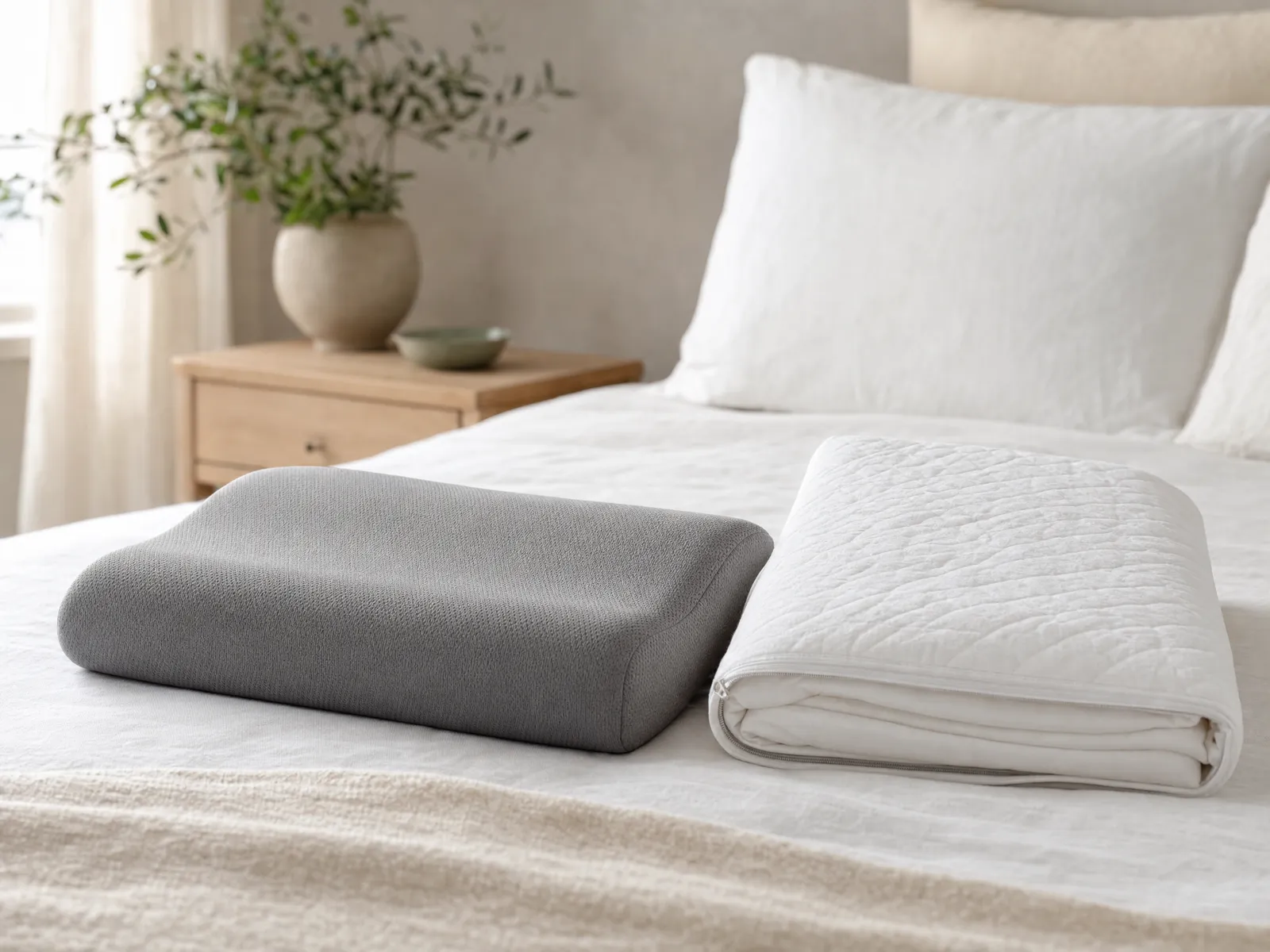
A cervical or contour pillow has a raised ridge at the edge and a shallow dish behind it. For a side sleeper that shape is a compromise. For a back sleeper it is close to a purpose-built fit: the ridge fills the cervical hollow, the dish lets the skull settle lower than the neck, and the head stops being levered forward. This is one of the few cases where the molded shape is genuinely a better match than a flat rectangle, and it is worth saying plainly.
But be honest about the evidence. A 2010 study by Gordon and colleagues in the Journal of Pain Research found that a foam contour pillow "performed no better than the foam regular pillow" for waking cervical symptoms, and a 2019 pilot randomised trial of pillow preferences in people with known cervical spine degeneration found that overall no pillow significantly altered the outcomes measured. Both trials recruited people who slept on their side, so neither tested a contour on the case it suits best — but neither supports the therapeutic language on the box either. Contours make sense for back sleepers on geometry. They are not a clinical intervention, and anyone selling one as a cure is overselling.
The other honest caveat: contours punish movement. If you turn over four times a night, the ridge that was supporting your neck ends up under your ear, and you will fight the pillow.
Fill type, by what it trades away
- Solid memory foam. Holds a contour, which is the whole point for back sleepers, and does not migrate overnight. The trade is heat — foam sleeps warmer, which is why nearly every pillow in this category advertises gel infusions, ventilation channels or cooling covers.
- Shredded or adjustable fill. The safety net. You open a zip and remove fill, or lift out a layer, until the side-view check passes. This is the right buy when you cannot measure, and it is worth noting whether a given design adjusts in both directions or only downward.
- Down and fiber. The classic back-sleeper trap. It feels perfect when you lie down and then compresses to almost nothing under the weight of your skull — so you spend most of the night flatter than you intended, with no support under the curve. Gordon's 2010 study also found that feather pillows "performed least well, producing the highest frequency of waking symptoms." If you wake up flat, this is why.
Our three picks for back sleepers with neck pain
Start with the adjustable if you cannot measure. The zibroges three-layer cervical pillow is our pick because its middle layer lifts out, so you can take height away until your chin sits level. Back sleepers almost always need to go down, and this goes down. It does not go up — that is the limitation to know before you buy.
If your chin visibly tips forward, buy genuinely thin. The Bluewave Bedding Ultra Slim we link is the 2.75-inch version, and the reason we like the line is that Bluewave sells the identical pillow in five lofts — 1.75, 2.25, 2.75, 3.25 and 4 inches. Very few brands let you re-buy the same foam at a different height. If 2.75 lands half an inch off, you are not starting over.
If you want soft on top and firm underneath, pay up. The COLASNEST dual-layer puts a soft top layer over a high-density foam base, with a cervical ridge on one face and a shoulder recess on the other for when you roll. At $59.99 as of August 2026 it costs about half again what the Bluewave does, and at 3.94 inches it is low, not thin — if your check said "too high," this is not the fix.
Most back sleepers are part-time side sleepers
You may fall asleep on your back and wake up there, but very few people hold one position for seven hours. If you spend a meaningful part of the night on your side, a pillow tuned exactly to the supine gap will be too short the moment you roll — the shoulder-to-ear distance a side sleeper has to fill is several times deeper, which is why we treat a pillow for neck pain if you sleep on your side as a different purchase entirely.
Two workable answers. Buy for the position you wake up in, since that is the one you spend the most hours in. Or buy adjustable and set it between the two — slightly taller than the supine test suggests, accepting a little chin tuck on your back in exchange for not collapsing when you turn. A flip-side pillow with a shoulder recess is a third option, though you have to be awake enough to flip it.
The rest of the setup, including the bit everyone skips
A pillow is not a system. Two other things matter, and both are free or nearly so.
Put a pillow under your knees. Mayo Clinic advises that back sleepers place a pillow under the knees, which may help relax the back muscles and maintain the curve of the lower back. Slightly bent knees may reduce the lumbar arch and ease the pelvic tilt that can drag the whole spinal line out of position, and it is the single cheapest change in this guide. Any spare pillow works.
Get the pillow's edge right. The bottom edge should meet the tops of your shoulders, not sit up under your neck with a gap beneath it, and your shoulders should stay on the mattress rather than riding up onto the pillow. We walk through the placement in detail in how to position your pillow for neck pain.
And check the mattress. A sagging mattress drops your hips and changes the geometry of everything above them, so no pillow will fully compensate for a bed that has given out in the middle.
Give it two weeks, and judge the first ten minutes
A lower pillow feels wrong at first. That is not a verdict — it is what unlearning a habit feels like, and it is the reason so many people return a correctly-sized pillow on night three. Give a new pillow about two weeks before deciding.
Then judge it on the right thing: how your neck feels in the first ten minutes after you wake up, before you have moved around and loosened everything off. Not how the pillow feels when you lie down at night. Bedtime comfort is what got you the too-tall pillow in the first place.
When to stop shopping and see a clinician
Pillows are a comfort and positioning tool, not medical care. If your neck pain is severe or persistent, follows an injury or accident, or comes with numbness, tingling, weakness or pain radiating down an arm, see a doctor rather than buying another pillow — Mayo Clinic lists radiating pain, numbness and arm weakness among the reasons to seek medical attention for neck pain.
The bottom line
Back sleepers need less loft than they think and more support than they have — thinner under the skull, thicker under the neck. Do the side-view check tonight, aim for a level chin, and pick the shape that fills the hollow behind your neck rather than the one that feels softest at bedtime. If you are not sure, start with an adjustable and take height away.
Once you have the height sorted, everything else is refinement. For the full picture across every sleeping position and pillow type, start with our guide to the best pillow for neck pain.
The shortlist
3 pillows compared — firmness, loft, and temperature side by side. The top pick is highlighted.
zibroges Adjustable Three-Layer Cervical Pillow (Queen)

Pulling the middle layer out was the whole fix — the pillow went from pushing my chin toward my chest to letting my head sit level, and the cover still feels cool against the back of my neck.
It only adjusts downward, so if you take a layer out and decide you actually wanted more support under the neck, there is nothing to add back.
Start here if you cannot measure your own gap. The zibroges is a three-layer memory foam pillow with a contoured profile, and the middle layer lifts out — so you can lower the height without buying a second pillow. That matters for back sleepers, who almost always need to go down rather than up. Note the direction of travel, though: it only adjusts downward from the height it ships at.
The foam is CertiPUR-US and Oeko-Tex certified, and zibroges says its dynamic memory foam holds its shape rather than flattening. The contour carries raised bumps the maker says align with neck pressure points; treat that as a comfort feature, not a treatment. The removable ice silk cover is machine washable. It is a queen, and the maker markets it to back, side and stomach sleepers. As of August 2026 it lists at $35.14.
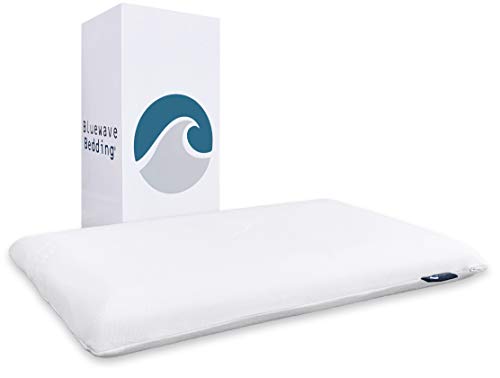
Bluewave Bedding Ultra Slim Gel Memory Foam Pillow (2.75 in, Standard)
After years on a fat pillow, the first week on the 2.75-inch felt like sleeping with no pillow at all — by week three the tight, stiff feeling I used to wake up with in the back of my neck had gone.
There is no way to fine-tune it: if the 2.75-inch loft is not right for you, changing height means buying another pillow rather than adjusting this one.
If your chin visibly tips forward in the two-minute check, you need a pillow that is genuinely thin rather than one merely marketed as low. This one is 2.75 inches, and the useful part is that Bluewave sells the same pillow in five lofts — 1.75, 2.25, 2.75, 3.25 and 4 inches. If 2.75 turns out to be half an inch off in either direction, you can buy the identical foam at the height that fits.
Bluewave positions this loft for stomach and back sleepers and says it is their best-selling and least-returned pillow. The fill is 3.25 lb high-density memory foam, which the maker says holds its shape instead of going flat within months, gel-infused with ventilation channels it says draw warmth away from the head. It is CertiPUR-US certified and the cover is machine washable and dryer safe. As of August 2026 it lists at $39.95.
COLASNEST Dual-Layer Low Profile Cervical Pillow (Standard)

The soft top is the part I did not expect to care about — my head sinks a little, but the base underneath never gives way, and the flip side is genuinely useful on the nights I end up on my shoulder.
It costs around half again what the thin foam pillows cost, and at 3.94 inches it is still too much height for back sleepers who need a truly low profile.
Buy this one if you want a soft surface without losing the base underneath it. The COLASNEST is built in two layers: a soft top the maker calls Mousse Cloud over a high-density memory foam base, so your head meets something yielding while the foam below keeps the height from collapsing. One side has a cervical ridge COLASNEST designed for back sleeping; flip it over and you get a contoured shoulder recess for the nights you end up on your side.
The standard size measures 26.1 by 14.97 by 3.94 inches and weighs 4.37 lbs — low for a two-layer pillow, though not ultra-thin. COLASNEST rates the open-cell structure above 95 percent and pairs it with wave-surface airflow channels and a moisture-wicking cover. It lists CertiPUR-US, OEKO-TEX Standard 100 and EU REACH certification, plus glue-free construction the maker says arrives odorless. As of August 2026 it lists at $59.99.
The Back Sleeper's Two-Minute Loft Check
You cannot judge a pillow from above, standing next to the bed. You have to be lying on it, on the mattress you actually sleep on, and someone has to look at you from the side. Here is the whole test.
If the result is ambiguous, buy adjustable and remove fill or layers until the chin sits level. It is far easier to take height away than to add it.
Back Sleeping and Neck Pain FAQ
How thick should a back sleeper's pillow be? There is no single number, and a 2021 review in Healthcare concluded that firm conclusions about optimal pillow height for the supine position have not yet been established. The individual studies it cites recommended 7 cm and 10 cm — roughly 2.75 to 4 inches — for sleeping on your back. Use that as a starting range, not a prescription, and let the side-view check settle it.
Are contour pillows better for back sleepers? Geometrically they fit a back sleeper well, because they put height under the neck and less under the skull. But the evidence is thinner than the marketing: a 2010 study by Gordon and colleagues in the Journal of Pain Research found a foam contour pillow performed no better than a regular foam pillow for waking symptoms in the side sleepers it followed. Try one because the shape matches your gap, not because it is sold as therapeutic.
Can a pillow be too thin? Yes. A pillow flat enough to let your head tip backwards leaves the curve of your neck unsupported, and many people find they wake with the front of the neck feeling stretched. The usual fix for back sleepers is not simply thinner — it is thinner under the skull and thicker under the neck.
Does a pillow under my knees really matter? Mayo Clinic suggests that back sleepers place a pillow under the knees, which may help relax the back muscles and maintain the natural curve of the lower back. It is the cheapest change in this whole guide and the one most pillow guides leave out.
Will a lower pillow stop my snoring? Pillow height can affect how open the airway sits, and research has long linked sleeping on your back with more breathing disturbance than sleeping on your side. But snoring has many causes and sleep apnea is a medical diagnosis — a pillow is not a treatment for it. If you snore heavily, stop breathing in your sleep, or wake unrefreshed, talk to a doctor.
How long should I give a new pillow? About two weeks. A lower pillow feels wrong for the first several nights almost regardless of whether it is right, because you are unlearning a habit your neck has held for years. Judge it on how your neck feels in the first ten minutes after you wake, not on how the pillow feels at bedtime.
Why you can trust us

Aimee Cannon
Sleep & bedding writer
Aimee Cannon is a sleep and bedding writer who has spent years testing pillows of every kind — memory foam, down, wool, bamboo, buckwheat, and specialty support pillows. She focuses on matching the right pillow to each sleeping position and need, and reports what actually holds up after months of nightly use. When she is not testing pillows, Aimee is usually with her husband and her dog.