Pillows for Neck and Shoulder Pain: What Actually Helps
If you wake with a burning ache under one shoulder and a neck too stiff to check your blind spot, start with the pillow under your head. A pillow for neck and shoulder pain has two mechanical jobs: fill the gap between your ear and the mattress so your neck stays level with your spine, and give the bottom shoulder somewhere to go instead of carrying your body weight. Get those right and morning stiffness often eases. We may earn a commission from links on this page, at no extra cost to you.
Now the honest part, and we would rather say it in the second paragraph than bury it near the bottom. A pillow cannot treat a rotator cuff tear, a frozen shoulder, arthritis, or a pinched nerve. It changes the load on those tissues for the third of your life you spend lying down. That is worth doing. It is not treatment, and any pillow sold as treatment is overselling itself. If you want the wider view before you shop, start with our guide to the best pillow for neck pain — this piece narrows in on the shoulder half of the problem.
The scale of the problem is not small. A Global Burden of Disease analysis published in The Lancet Rheumatology in 2024 estimated that about 203 million people worldwide were living with neck pain in 2020, and projected that number to rise roughly 32.5% to 269 million by 2050. Most of those people have not injured anything. They are simply loaded — by desks, by phones, and by eight hours a night in a position nothing is supporting.
What a Pillow for Neck and Shoulder Pain Can Actually Change
A pillow changes three things and nothing else. Everything printed on the box reduces to one of them:
- Loft — how high your head sits relative to your shoulder. Too low and your head drops toward the mattress, bending your neck sideways for hours. Too high and it cranks the other way.
- Contour — the shape your neck rests in. A flat slab supports the back of your skull and leaves the curve of your neck unsupported in mid-air.
- Shoulder pressure relief — how much of your body weight the bottom shoulder has to carry, and whether your arm has anywhere to go.
That third variable is the one most guides skip, and it is the one that matters most when your pain is in the shoulder rather than the neck.
There is reasonable evidence that pillow design is not just a comfort preference. A 2021 systematic review and meta-analysis in Clinical Biomechanics by Chun-Yiu and colleagues pooled 35 studies and concluded that spring and rubber (latex) pillows were effective at reducing neck pain, waking symptoms and disability in people with chronic neck pain. The useful takeaway for a shopper is not "buy latex" — it is that the shape and material under your head measurably change how you feel in the morning.
Why the Bottom Shoulder Takes the Beating
Side sleeping is less a preference than a default. A 2017 study in Nature and Science of Sleep that tracked 664 adults with body-worn accelerometers on the thigh, upper arm and upper back found they spent 54.1% of their time in bed on their side, 37.5% on their back, and just 7.3% on their front.
That matters because on your side, the shoulder is the widest part of you. Three things happen at once:
- The gap gets big. The distance from your ear to the mattress is now roughly the width of your shoulder. A pillow that was fine on your back leaves your head hanging sideways for hours.
- The shoulder becomes a load-bearing point. Your torso presses down through a joint that was never designed to be a foundation.
- The arm has nowhere to go. Most people either trap it under the pillow, fold it under their ribs, or throw it across the bed — and a compressed arm is a common reason people report waking with a dead, tingling arm.
A taller pillow fixes the first problem and does nothing for the second and third. That is the gap the arm-channel design tries to close, and it is why side sleepers need their own approach — covered in more depth in our guide to the right pillow for side sleepers with neck pain.
Loft: The One Measurement Worth Taking
Here is the only fitting test that matters, and it takes thirty seconds. Lie on your side in your normal sleeping position and have someone look at you from behind. Your ear should sit roughly over your shoulder and your nose should point straight ahead, in line with the center of your chest. If your head is tilted down toward the mattress, you need more loft. If it is craned up toward the ceiling, you need less.
Two things people get wrong here:
- Shoulder width sets your loft, not your height. Broad-shouldered sleepers need noticeably more loft on their side than narrow-shouldered ones, at the same body height.
- Your mattress is part of the equation. A soft mattress lets your shoulder sink in, closing the gap, so you need a lower pillow than the same person on a firm mattress.
Research gives a rough starting range. A 2021 systematic review by Radwan and colleagues in the European Journal of Integrative Medicine reported moderate evidence that a latex material, a contoured design, a pillow height of about 7 to 11 cm (2.75 to 4.3 inches) at the unloaded center, and a cooling surface were associated with better sleep comfort and quality and better spinal alignment. Treat that as a starting point to test against your own shoulder, not a prescription.
How We Chose
We prioritised the three variables above and ignored everything else. Specifically: loft options (does the pillow let you match your shoulder width, or does it assume a body?), shape (does it do anything for the shoulder, or only the head?), temperature (memory foam holds position well and traps heat, so the cover matters), and washability, because a pillow that gets nightly face and skin contact needs to go in a machine. We favoured pillows with published dimensions over pillows with adjectives, and we treated every manufacturer performance claim as a claim, not a fact. Prices are the current Amazon listings as of July 2026.
Four Shapes for Four Different Problems
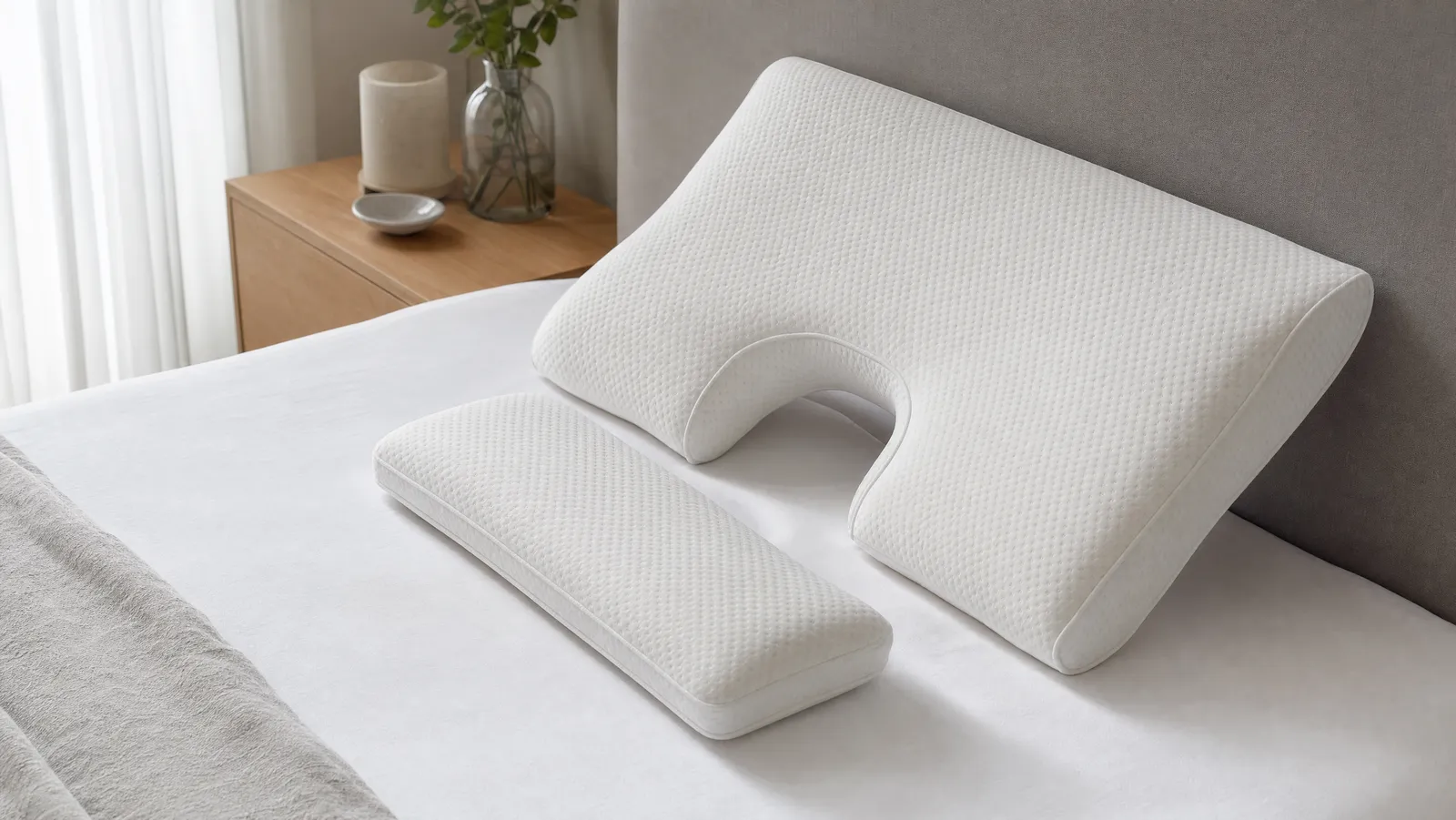
If your arm is the problem, buy the arm channel. Our pick, the Wattne Side Sleeper Pillow with Arm Hole, has an enlarged arm channel and a widened sleep opening, which gives the bottom shoulder and arm a place to sit rather than being pinned under your torso. The maker positions it for neck, shoulder and rotator cuff pressure relief; we would describe it more modestly as offloading the shoulder you lie on. The fill is CertiPUR-US certified 70D slow-rebound memory foam and it comes with two machine-washable covers, one all-season and one cooling. It is $59.99 as of July 2026.
If your head keeps drifting out of line, buy the contour. The Besyodo Ergonomic Cervical Neck Pillow uses a hollow center to cradle the head with raised contoured edges to support the neck's curve, and adds extended armrest cut-outs for side sleepers. Its two curve heights, 5.3 inches and 3.7 inches, let you flip the pillow to match your shoulder instead of buying twice, and it is $39.99 as of July 2026, down from a $49.99 list.
If foam cooks you, buy the gel version. The SOFTGAS Cooling Gel Cervical Neck Pillow pairs CertiPUR-US memory foam with a cooling gel layer and a silk satin cover, in an S-curve profile with a 4.22-inch low side and a 5.43-inch high side. SOFTGAS states the gel lowers skin temperature by up to 5 degrees Celsius — that is the maker's number, not one we can verify. It is $79.99 as of July 2026.
If you have no idea what loft you need, buy the adjustable one. The TWK Original Adjustable Bed Pillow ships with a spare bag of foam filler so you add or remove material until your head sits level. At $39.99 as of July 2026, it is cheaper than guessing wrong twice.
When the Problem Is the Shoulder, Not the Pillow
Some shoulder pain is structural, and no amount of foam addresses it. Two patterns are worth recognising so you know when to stop shopping and start making an appointment.
Rotator cuff pain classically gets worse at night. The Cleveland Clinic notes that the reason is not fully understood — physical therapist Kelly Kinsey puts it as "your body is quieter at night, so you're more likely to hear the thing in your body screaming the loudest" — but their positioning advice is concrete and costs nothing to try. For back sleepers, they suggest a pillow or folded blanket under the arm so the elbow does not drop below the body, supporting the arm up toward the midline. For side sleepers, they suggest lying with the sore shoulder up and building a "pillow wall" in front of you to rest that arm on. They advise avoiding stomach sleeping, which tends to put the arm and shoulder in an awkward position.
Frozen shoulder is a slow, self-limiting condition, not a positioning problem. According to the American Academy of Orthopaedic Surgeons, the "freezing" stage typically lasts 6 weeks to 9 months, the "frozen" stage another 4 to 6 months, and a complete return to normal or near-normal motion generally takes 6 months to 2 years. AAOS lists physical therapy focused on shoulder flexibility as the primary treatment. A pillow may make those months more bearable. It does not shorten them.
Some people with shoulder or neck pain find they simply cannot tolerate lying flat and sleep better propped semi-reclined. If that describes you, wedge pillows do that job properly, and are a better answer than stacking three flat pillows that collapse by 2am.
Please see a clinician if your pain is severe, has not settled after a couple of weeks, followed a fall or injury, wakes you repeatedly, or comes with numbness, weakness, or pain radiating down your arm. The American Academy of Orthopaedic Surgeons advises seeking immediate medical attention when an injury causes neck pain that radiates down the arms or legs, and consulting a professional when neck pain is severe, or continuous and persistent, or accompanied by headaches, numbness or weakness.
How to Test a New Pillow Without Fooling Yourself
Pillow shopping is unusually prone to self-deception, because you are judging the thing while half asleep and you badly want the money to have been well spent. A few rules help.
- Give it two weeks. Contoured foam feels wrong for the first three or four nights while your neck adapts. Judging it on night one tells you about novelty, not fit.
- Change one thing at a time. New pillow and new mattress topper in the same week means you learn nothing from either.
- Judge it in the first ten minutes after waking. That is when mechanical, position-related stiffness is loudest. How you feel at 4pm is mostly about your desk.
- Keep the old pillow for a fortnight. If the new one is worse, you want a control to go back to.
- Watch for the arm. A numb or tingling arm on waking may simply mean the arm was compressed under you rather than that the loft was wrong. Numbness, tingling or weakness that persists once you are up and moving is one of the symptoms AAOS says to take to a clinician, not to another pillow.
The Honest Downsides
No pillow in this category is a clean win, and the failure modes are predictable:
- Contoured foam is bossy. A moulded shape decides where your head goes. If you like folding, bunching, or burrowing into a pillow, you will resent it.
- Arm-channel pillows assume commitment. They work beautifully for a dedicated side sleeper and get in the way of everyone else. Combination sleepers should skip the shape and buy adjustable.
- Cooling is a surface effect. Gel layers and satin covers help most when you first lie down. Under a duvet, several hours in, the difference narrows — and maker-quoted temperature figures are measured in conditions that are not your bed.
- Adjustable means fiddly. Removing fill is messy, takes several nights of iteration, and the spare bag ends up lost in a closet.
- One pillow rarely fits two positions. The loft that keeps your neck level on your side is too tall for your back. Flippable dual-height designs are the practical compromise.
- None of this touches daytime load. If you spend nine hours a day with your head forward over a screen, the pillow is fighting the other fifteen.
What We Would Buy
If your pain is centred in the shoulder you lie on, or you keep waking with a dead arm, buy the Wattne and give the arm channel two weeks. If it is more of a neck problem and the shoulder just aches along with it, the Besyodo contour is the cheaper, more conventional starting point, and its two curve heights cover most shoulder widths. Hot sleepers who need memory foam anyway should look at the SOFTGAS. And if you genuinely do not know what loft you need — which is most people who have already bought and returned a pillow — start with the adjustable TWK and work backwards from your own shoulder.
Whichever you pick, hold on to the line we drew at the top: you are buying a change in mechanics, not a cure. Track how your neck feels in the first ten minutes after waking, give it a fortnight, and take persistent, severe, or radiating pain to a clinician rather than to another checkout page. For the full picture on loft, fill and shape across every sleeping position, see our full neck pain pillow roundup.
Here are our picks.
The shortlist
4 pillows compared — firmness, loft, and temperature side by side. The top pick is highlighted.
| Pillow | Firmness | Loft | Sleeps | Best for | Price |
|---|---|---|---|---|---|
Medium | High | Cooling | Shoulder and arm pressure | $59.99 Check | |
Best Contoured SupportBesyodo Ergonomic Cervical Neck Pillow | Medium Firm | Adjustable | Cooling | Contoured neck support | $39.99 Check |
Best CoolingSOFTGAS Cooling Gel Cervical Neck Pillow | Medium | Adjustable | Cooling | Hot sleepers with neck pain | $79.99 Check |
Best AdjustableTWK Original Adjustable Bed Pillow (Queen) | Medium | Adjustable | Neutral | Dialing in your own loft | $39.99 Check |
Wattne Side Sleeper Pillow with Arm Hole

Being able to thread my arm through the channel instead of shoving it under the pillow was the first thing that stopped me waking up with a dead, tingling arm.
The arm channel only works if you commit to one side-sleeping posture — if you flip between your side, back and stomach all night, you will fight it.
Most pillows treat the shoulder as an afterthought. The Wattne is built around it: an enlarged arm channel and a widened sleep opening give the bottom shoulder and arm a place to go instead of being pinned under your torso all night. That is a mechanical change, not a medical one, and it is why this is our pick. The maker positions it for neck, shoulder and rotator cuff pressure relief; we would say simply that it offloads the shoulder you lie on.
The fill is CertiPUR-US certified 70D slow-rebound memory foam, so it holds its shape rather than flattening under a heavy head. It ships with two machine-washable pillowcases, an all-season cover and a cooling cover, which covers both warm and cool nights. It also doubles as a leg, lap or sofa cushion, and has a rear pocket for an aromatherapy sachet. At $59.99 as of July 2026, it is not the cheapest pick here and still the one we would buy.
Besyodo Ergonomic Cervical Neck Pillow
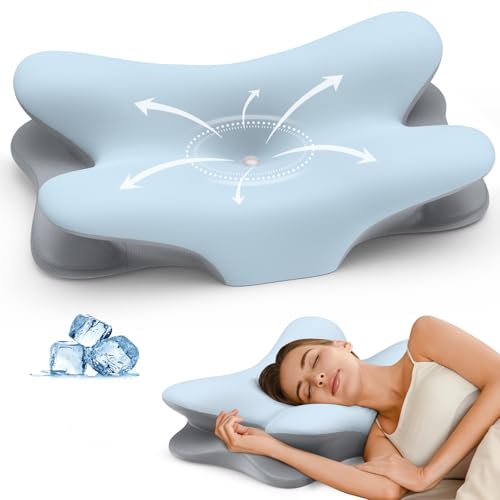
Flipping it to the 3.7-inch side was the fix — the taller curve was too much for me on my back, and switching sides took about three nights to feel normal.
A moulded contour dictates where your head goes, so if you like burrowing or folding a pillow under your cheek, this will feel restrictive.
This is the classic cervical contour done carefully. A hollow center cradles the head while the contoured edges support the neck's natural curve, so your head stops floating forward on a flat slab of foam. What sets it apart from the generic contour pillow is the extended armrest cut-outs, which give side sleepers somewhere to put an arm without it going numb underneath them.
The two curve heights — 5.3 inches and 3.7 inches — mean you can flip the pillow to match your shoulder width rather than buying a second one, and the overall footprint is 25.6 by 15.7 inches (manufacturer's manual measurement, plus or minus 0.5 inch). The fill is high-density slow-rebound memory foam, CertiPUR-US and Oeko-Tex certified, under a removable, zippered, machine-washable ice silk pillowcase. At $39.99 as of July 2026, down from a $49.99 list price, it is the cheapest way to test whether a contour shape suits you.
SOFTGAS Cooling Gel Cervical Neck Pillow

I run hot and usually flip a pillow four times a night; the satin cover plus the gel side meant I stopped hunting for a cold spot.
It needed the full airing-out period the maker recommends before it stopped smelling of new foam, and it is the priciest pillow here.
Memory foam is the material most likely to hold your neck in position and the material most likely to make you hot. The SOFTGAS answers that trade-off with CertiPUR-US certified memory foam plus a cooling gel layer, under a removable, machine-washable silk satin pillowcase. SOFTGAS states the gel lowers skin temperature by up to 5 degrees Celsius, to around 25 degrees — that is the maker's figure, not a result we can verify.
The structure is the more interesting part. It uses an ergonomic S-curve with what the maker calls a six-zone support system, and it comes in dual heights: a 4.22-inch low side and a 5.43-inch high side, so back sleepers and broader side sleepers can use the same pillow. SOFTGAS advises airing it out for 24 to 48 hours before the first night and describes the foam as non-toxic and odorless. It is $79.99 as of July 2026, reduced from an $89.99 list price.
TWK Original Adjustable Bed Pillow (Queen)

I pulled out about two handfuls of fill over the first week and finally stopped waking with my head tipped up toward the ceiling.
Adjusting it is messy and takes a few nights of trial and error, and the spare bag of filler is easy to lose once you have stashed it in a closet.
Nobody can tell you your correct loft from a product page, because it depends on how wide your shoulders are and how far your mattress lets them sink. The TWK sidesteps the guesswork entirely: it has an adjustable fill structure and ships with an extra bag of foam filler, so you add or remove material until your head sits level with your spine instead of hoping the box was right.
The maker describes the memory foam interior as breathable and pressure-reducing, and the fill structure is intended to work for side, back and stomach sleepers — which in practice means combination sleepers can set it somewhere in between. The detachable cover is machine-washable and quick-drying. It is a queen-size single pack at $39.99 as of July 2026. If you have already bought two pillows that were the wrong height, buy this one instead of guessing a third time.
What a Pillow Can and Cannot Fix
It is worth being precise about the line here, because a lot of pillow marketing is not.
A pillow changes mechanics. It sets the height of your head relative to your shoulder, the shape your neck rests in, and how much body weight lands on the shoulder you are lying on. Those are real, measurable variables, and they are the ones you can buy your way into.
Where the difference shows up. Mechanical, pillow-related stiffness tends to be worst on waking and often eases as you get up and move around. Pain that wakes you repeatedly, is severe, followed an injury, or comes with numbness, weakness or pain radiating down the arm is a reason to see a clinician — not a reason to buy a fourth pillow.
Neck and Shoulder Pillow FAQ
What pillow height should I use for neck and shoulder pain? Enough to fill the gap between your ear and the mattress so your head stays level with your spine — broad shoulders need more, narrow shoulders and soft mattresses need less. A 2021 systematic review by Radwan and colleagues in the European Journal of Integrative Medicine reported moderate evidence for a pillow height of roughly 7 to 11 cm (about 2.75 to 4.3 inches) measured at the unloaded center of the pillow, along with a contoured shape, latex material and a cooling surface.
Should I sleep on the painful shoulder or the other one? Most people naturally avoid the sore side, and there is no need to force it. For rotator cuff pain, the Cleveland Clinic suggests sleeping with the sore shoulder up and building a "pillow wall" in front of you to rest that arm on, so it is not left hanging across your body.
Do arm-hole pillows actually work? Mechanically, yes: an arm channel gives your bottom arm and shoulder somewhere to go instead of being compressed under your torso, which many side sleepers report as the reason they wake with a numb arm. They only suit committed side sleepers, though — if you rotate between positions all night, an adjustable pillow is a better bet.
Is memory foam or latex better for neck pain? A 2021 systematic review and meta-analysis in Clinical Biomechanics concluded that spring and rubber (latex) pillows were effective at reducing neck pain, waking symptoms and disability in people with chronic neck pain. Memory foam remains popular because it holds a contour well, but latex is the material that keeps showing up in the review evidence.
How long before I know if a new pillow is helping? Give it two weeks. Contoured foam in particular feels strange for the first three or four nights while you adapt, and one bad night proves nothing either way. Change one variable at a time and keep notes on how your neck feels in the first ten minutes after waking.
Can a pillow help if I have already been diagnosed with a shoulder problem? It may make lying down more comfortable, which matters, because sleep itself is part of how people cope with pain. It is not a substitute for the treatment your clinician has recommended, and you should ask them before changing how you position a recovering or post-surgical shoulder.
Why you can trust us

Aimee Cannon
Sleep & bedding writer
Aimee Cannon is a sleep and bedding writer who has spent years testing pillows of every kind — memory foam, down, wool, bamboo, buckwheat, and specialty support pillows. She focuses on matching the right pillow to each sleeping position and need, and reports what actually holds up after months of nightly use. When she is not testing pillows, Aimee is usually with her husband and her dog.